Skip to Content
Streetsblog Massachusetts home
Log In
Equity

WRTA Board Votes to Extend Worcester’s Zero-Fare Buses ‘Til 2022

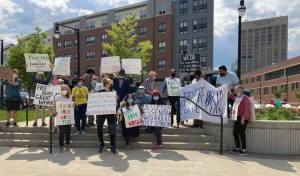
Rider advocates rallied in downtown Worcester on May 17 to preserve the transit agency’s fare-free policies. On May 20, the WRTA Advisory Board voted to extend fare-free buses until 2022. Courtesy of the Zero Fare WRTA Coalition.

The Advisory Board of the Worcester Regional Transit Authority voted Thursday morning to use federal pandemic relief funds to run fare-free buses until January 1, 2022.

The vote overrides an April 29 budget vote that assumed that WRTA buses would start collecting fare revenue again on July 1 of this year.

Thursday's WRTA board meeting included a discussion on how the agency would spend approximately $43 million in federal pandemic relief funds.

WRTA administrator Dennis Lipka, a skeptic of the WRTA's zero-fare policies, has advocated using fare revenue and federal relief funds for increased bus service.

But fare-free advocates observe that the agency’s relief funding is enough to fund improved bus service in addition to keeping fare-free policies going for several years. Before the pandemic, the WRTA received about $3 million a year in fare revenue – which doesn’t count the increased operational costs the agency incurs from fare collection.

"If we suspend fares, it's just not true that we couldn't expand service," Etel Haxhiaj, Zero-Fare Coalition member and Worcester city council candidate, told StreetsblogMASS in a Zoom call Thursday morning. "They don't need to be mutually exclusive."

At Thursday's meeting, WRTA advisory board member Doug Belanger of Leicester introduced a motion to extend the fare-free policy until January 1, 2022.

Other board members then exploited a feature of the advisory board's bylaws to give votes from fare-free supporting board members extra weight.

"Every vote that's cast is supposed to be weighted in terms of population," explained Adam Thielker, Zero-Fare Coalition member and chair of the city's Riders Action Council. "Right away there was a call to make sure that any votes that were taken would be weighted votes. And that's where Worcester City Councilor Gary Rosen comes in – his vote as a representative of Worcester is very heavy."

Rosen, along with the rest of the Worcester City Council, has been a prominent advocate of zero-fare policies.

"Had we raised the fares on July 1, the ridership would go down," Rosen explained to StreetsblogMASS in a phone conversation after the meeting on Thursday. "We want to get people on the bus. I want to see people in the seats. Collecting fares and then running empty buses doesn’t make any sense."

Ultimately, the weighed votes didn't make a difference: the motion passed unanimously, with one abstention.

"Councilor Rosen really turned the tide," says Haxhiaj. "He told everyone that even if the board votes no (on extending the zero-fare policy), he'd be back with this. But this success is a really a credit to the Zero-Fare coalition we've built and its relentless advocacy."

Stay in touch

Sign up for our free newsletter

More from Streetsblog Massachusetts

Boston City Council Seeks Oversight of Mayor’s Transportation Agenda

A hearing order from City Council President Liz Breadon warns that "continued delays to the advancement of these transportation projects could jeopardize an estimated $200 million in public investment."

March 16, 2026

Globe Report Implicates Mayor Michelle Wu In Street Safety, Transit Project Cancellations

The mayor's about-face on street safety initiatives has already cost the City of Boston millions of dollars in lost federal funding.

March 16, 2026

Trump’s Oil Crisis Is Already Costing Massachusetts Drivers Over $2.4 Million A Day In Higher Gas Prices

Massachusetts drivers are now cumulatively spending $20.9 million a day at the pump – more than twice the daily cost of operating the entire MBTA system.

March 13, 2026

Guest Column: South Station Is Not An Adequate Emergency Shelter

There are numerous other public buildings nearby that offer better adaptability, dignity, and safety for unhoused residents.

March 11, 2026
See all posts