MBTA Tells Riders to Expect Faster Speeds on Subways and Buses
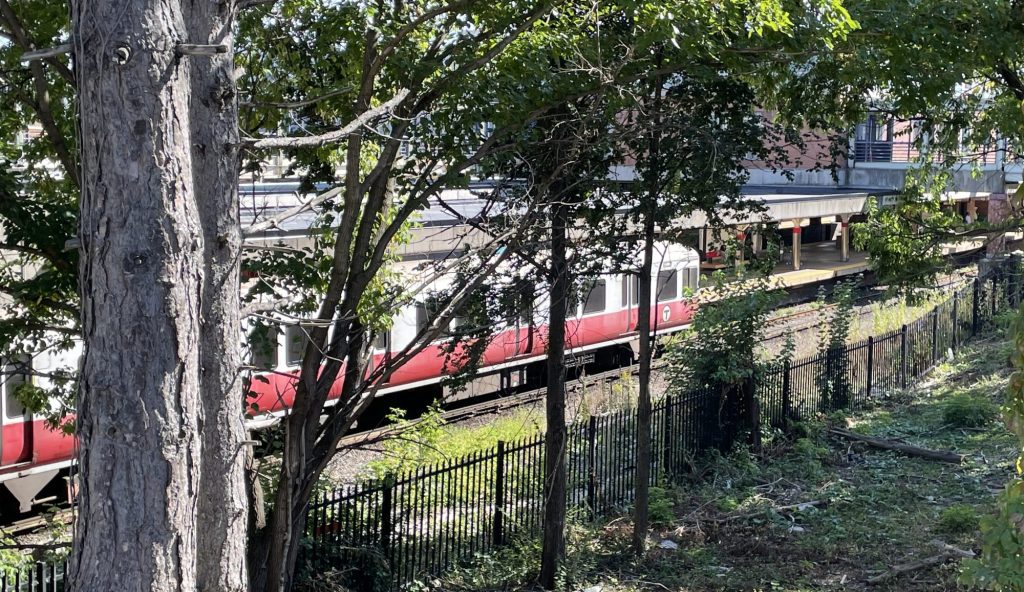
On Monday, the MBTA announced a pair of initiatives to increase speeds on the subway system and reduce the amount of time that buses wait at traffic lights.
The T expects to be raising maximum speeds on the Braintree branch of the Red Line from 40 mph to 50 mph “within days,” according to a press release the agency issued on Monday.
The agency laid the groundwork for the increased speeds during last fall’s 24-day closure of the Braintree branch, which replaced over 13 miles’ worth of rail and eliminated 37 slow zones.
Those repairs reduced round-trip travel times on the Braintree branch by 24 minutes. The higher 50 mph operating speed could shave another 1-2 minutes from the 9-mile trip between Braintree and the JFK/UMass station.
55 mph to Malden
The T is also investigating the possibility of running even faster trains on the northern part of the Orange Line between Oak Grove and Assembly, where trains could potentially run at 55 mph (up from 40 mph today).
“We’re trying to do the same thing on the Orange Line, between Oak Grove and Assembly Square, (and) get the track speed back up to what it was originally designed for when it was built,” said Jody Ray, Senior Director of the MBTA’s Maintenance of Way, at last week’s board meeting.
Ray later explained that although subways on the Red and Orange lines used to travel at these higher speeds regularly, “at some point in the history, I’m going to say it was about 20 years ago, there was a conscious decision that just said the system speed across the entire network was going to be 40. So the 50 went down to 40 (on the Braintree branch) and on the Orange Line, it went from 55 down to 40.”
More green lights for buses
In a separate Monday press release, the MBTA announced that after a successful test-run in Allston, the City of Boston would expand the use of new “transit signal priority” software for traffic lights citywide.
Last July, the Boston Transportation Department began testing new transit signal priority (TSP) systems along the Brighton Avenue bus lanes in Allston, at the intersections of Allston Street, Harvard Avenue, and Linden Street.
Those three signals affect two high-ridership, frequent-service bus routes: the 57, which runs between Kenmore and Watertown, and the 66, which runs between Nubian and Harvard Squares (see map below).
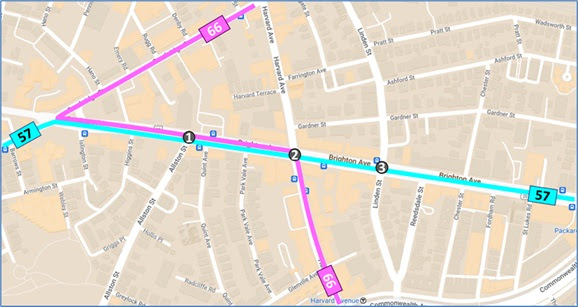
According to the MBTA, the new traffic light software has reduced the time buses waited at these signals by an average of 21 percent, and resulted in faster bus travel times, with the average bus saving 16 seconds on this segment.
Travel time savings were reportedly even greater during rush hours.
“We continue to improve the reliability of public transportation options across the city,” said City of Boston Mayor Michelle Wu in a press statement. “Traditionally, traffic signals have been timed without prioritizing the flow of bus routes. This is another step to retime signals to keep traffic moving for all road users in our city.”
The MBTA estimates that up to 50 percent of its transit delays can be credited to waiting at red lights at signalized intersections.
Streetsblog has migrated to a new comment system. New commenters can register directly in the comments section of any article. Returning commenters: your previous comments and display name have been preserved, but you'll need to reclaim your account by clicking "Forgot your password?" on the sign-in form, entering your email, and following the verification link to set a new password — this is required because passwords could not be carried over during the migration. For questions, contact tips@streetsblog.org.