Traffic Analysis Shows Newton Bikeway Project Reduced Car Traffic, Speeding, and Crashes
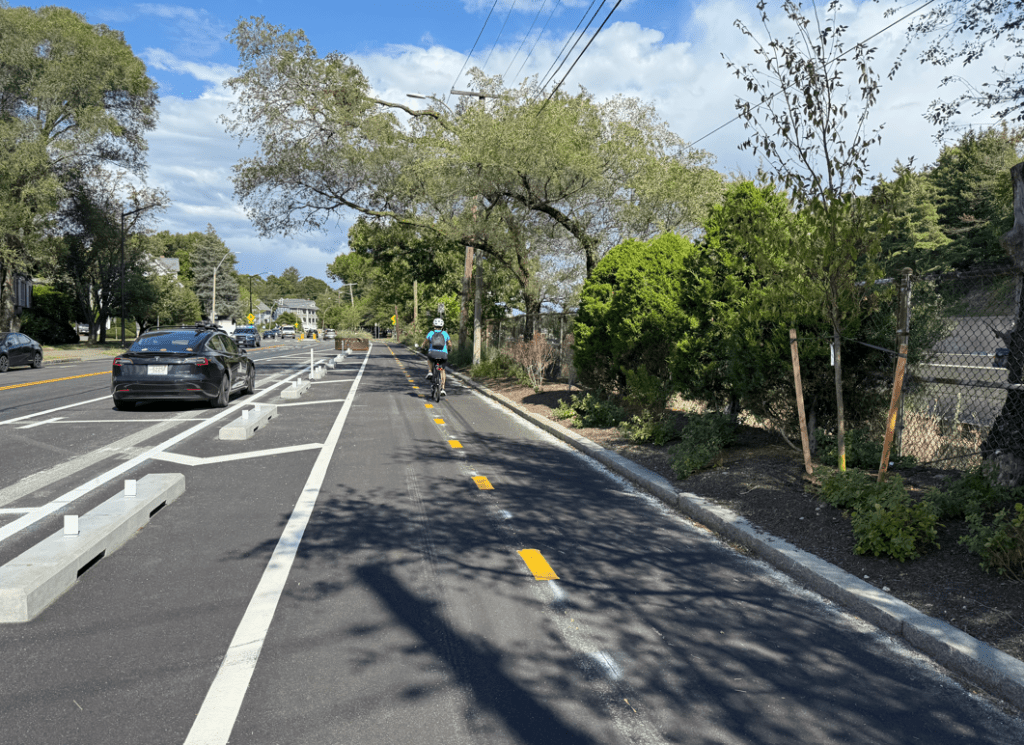
A detailed new traffic analysis of Washington Street in Newton concludes that a new roadway configuration, which sacrificed a motor vehicle lane to create a protected two-way shared-use path on one side of the street, successfully reduced car traffic, slashed the number of speed limit violations, and increased bike traffic between West Newton and Newtonville.
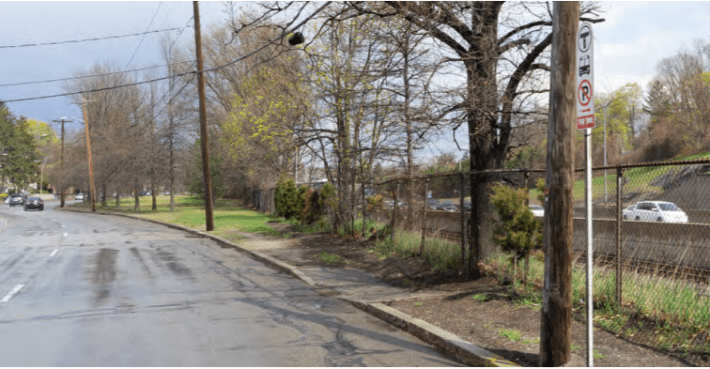
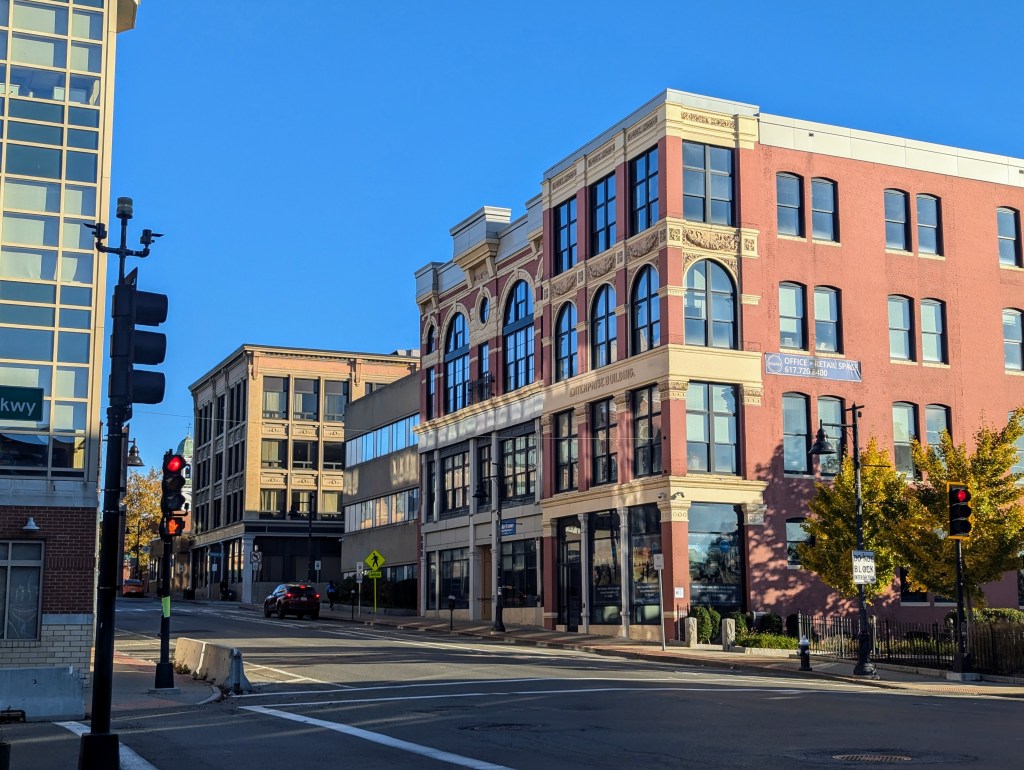
Last summer, Newton repaved Washington Street, which runs alongside the Worcester Line tracks and the Massachusetts Turnpike, and re-striped the street with a new lane configuration. The former street layout featured four lanes for motor vehicles, with a well-worn dirt track on the southern side of the street in lieu of a sidewalk (see photo at right).
Now, the street features just one lane in each direction, with a center turn lane and a new physically-separated bike and pedestrian path along the southern curb.
The project was billed as a “pilot” project and used inexpensive, removable materials, including paint, modular concrete curbs, and planters.
Fewer cars, more bikes
In conjunction with the project, the City commissioned two traffic studies of the area, one in fall 2024 and another in fall 2025, in order to compare traffic and safety data before and after implementation.
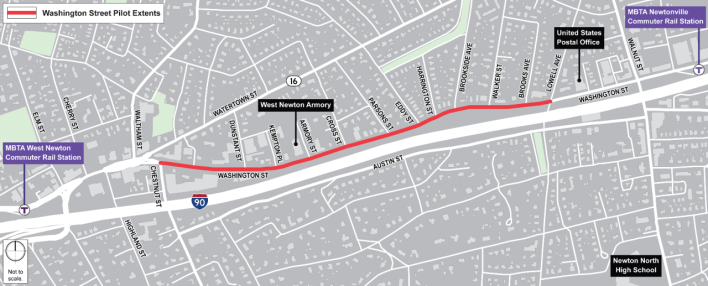
During those periods, consultants from Howard Stein Hudson used automatic traffic counters to survey speed data and volumes at dozens of locations on Washington Street and on connecting side streets.
The City of Newton published the results of that analysis in January, in a technical memorandum from Howard Stein Hudson engineers Emma Enteado and Valerie Chia.
“The Washington Street pilot is on track to meet its objectives for safety and multimodal use,” write Enteado and Chia. “Vehicle volumes on the corridor have decreased without evidence of cut throughs on local roads, speeds within the pilot area have reduced, and bicycle activity has increased.”
Near Chestnut Street in West Newton, for instance, traffic counts found that “the Washington Street corridor carried 2,835 fewer vehicles per day during Fall 2025 when compared to Fall 2024.”
Counts on side streets also found evidence that the project was also reducing traffic throughout the neighborhood, not just on Washington Street.
“Watertown Street (Route 16), which is one of the primary east-west routes where diversion would be expected, did not show any increase in traffic,” according to Howard Stein Hudson’s analysis.
Traffic counts also recorded a decrease of 92 vehicles per day on Eddy Street, one of the north-south streets that connects Washington and Watertown Avenue near the center of the project area.
The reduced traffic volumes on “may suggest that regional drivers who previously used Washington Street as a cut-through to access the Massachusetts Turnpike are now remaining on the Turnpike,” write Enteado and Chia.
Meanwhile, some of the neighborhood’s local trips may have shifted from motorized vehicles to bikes. The traffic counts recorded an average 27 percent increase in bike volumes across the entire project area.
Lower speeds and fewer crashes
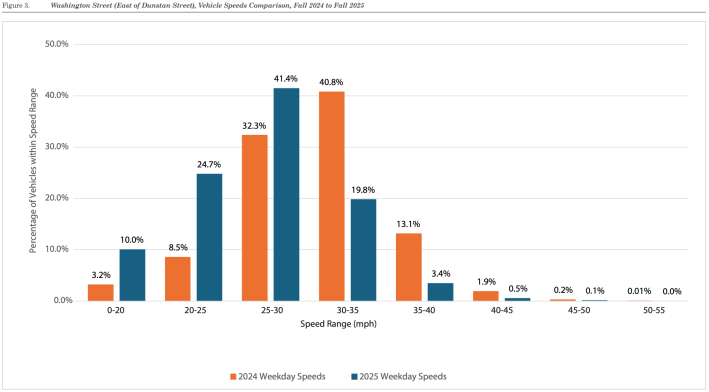
The analysis also found that drivers were more likely to comply with the legal speed limit in fall 2025, with the new street configuration, although a large majority of the street’s drivers are still breaking the citywide 25 mph speed limit:
The state’s crash database also shows a reduction in crashes involving motor vehicles between fall 2024 and fall 2025, although the overall number of crashes was small in both periods, so the decline may have just been a statistical fluke.
In September and October of 2024, MassDOT’s IMPACT crash database records 6 crashes along this segment of Washington Street, all of which were angle or sideswipe crashes involving turning vehicles.
In the same two months of 2025, there were just three crashes, two of which involved only a single motor vehicle hitting stationary objects on the roadside.
“Under the (new) pilot cross-section, vehicles turning onto Washington Street encounter only a single opposing travel lane, decreasing the opportunity for conflicts that typically contribute to angle collisions,” observe Enteado and Chia.
The Newtonville Area Council, a neighborhood organization, is currently surveying residents and area employees for additional feedback on the pilot project. If you live or work in the neighborhood, you can find the survey here.
This story was corrected at 8:25 p.m. on Tuesday, Feb. 10 to correct the cited source of the survey in the last paragraph. A previous version incorrectly stated that the survey was being conducted for the City Council; in fact, it is being conducted by the Newtonville Area Council, a neighborhood organization.

Read More:
Streetsblog has migrated to a new comment system. New commenters can register directly in the comments section of any article. Returning commenters: your previous comments and display name have been preserved, but you'll need to reclaim your account by clicking "Forgot your password?" on the sign-in form, entering your email, and following the verification link to set a new password — this is required because passwords could not be carried over during the migration. For questions, contact tips@streetsblog.org.