New ‘Fair Share’ Funding Gives A Down Payment For MBTA’s Regional Rail Vision
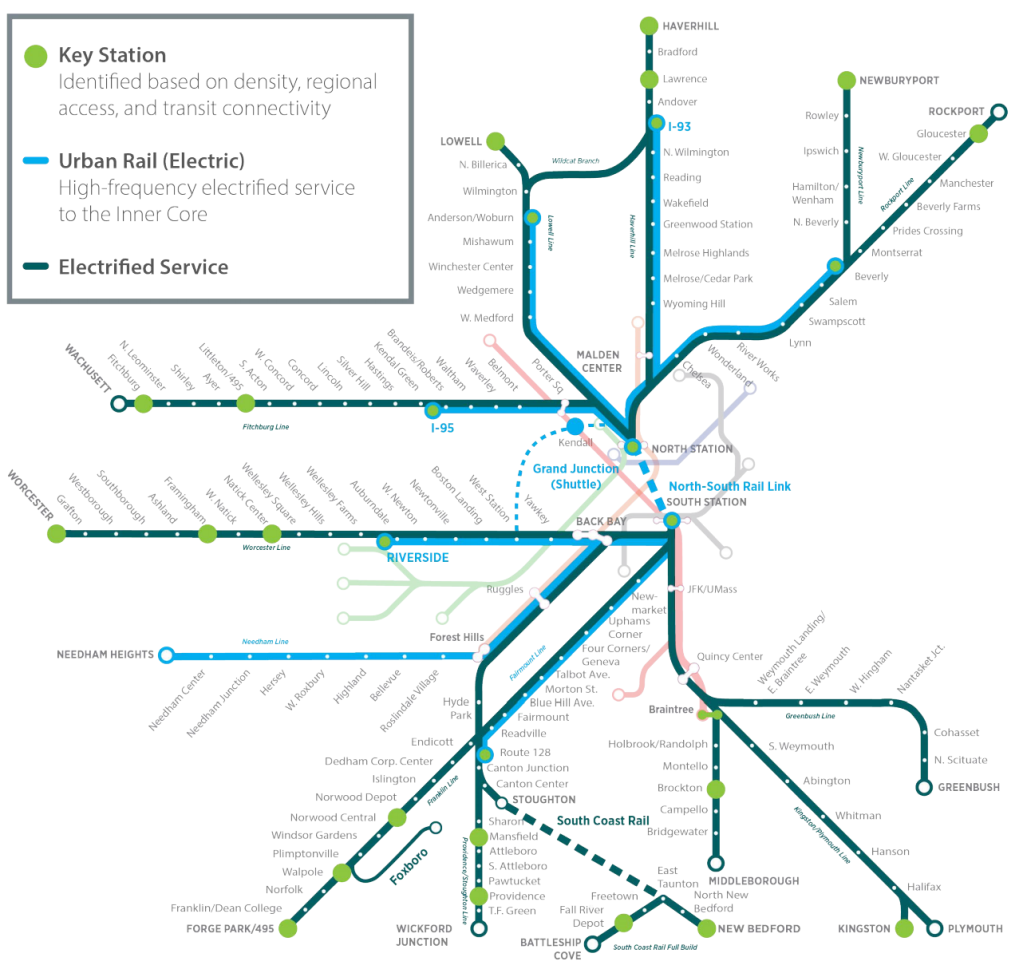
A new supplemental budget law will give the MBTA an extra $60 million to pay for previously-unfunded capital projects, with a $1 million earmark for the agency to prepare a detailed implementation plan for its “regional rail” initiative.
The money will come from the Commonwealth’s “Fair Share” tax on high-income households. Since it took effect at the beginning of 2023, actual tax collections under the Fair Share amendment have regularly exceeded budget writers’ forecasts, prompting lawmakers to pass “supplemental” budget laws to appropriate the extra revenue.
In June, lawmakers passed this year’s Fair Share supplemental budget, which makes a plan for $1.35 billion in unexpected revenue collected during previous fiscal years.
Adam Zeller, a Senior Director of the T’s Capital Finance office, delivered a brief presentation on the additional funding at Thursday’s meeting of the MBTA Finance and Audit board subcommittee.
The final law includes $450 million to top up the MBTA’s deficiency fund, which the agency has been relying on to fill in its structural deficits since the Covid-19 pandemic, plus $20 million in funding to sustain the MBTA’s low-income fare program, which currently has nearly 45,000 participants.
But in addition to those line-items, which will help balance the MBTA’s day-to-day operating budget, the new supplemental budget also includes $60 million for the T’s capital budget, which finances major construction projects and new transit vehicles.
In the context of the agency’s $24.5 billion capital needs shortfall, it’s a drop in the bucket. But it’s enough to finance several projects that weren’t otherwise going to happen under the agency’s current capital investment plan.
Lawmakers also put some interesting conditions on the additional funding.
The law requires the T to “conduct a study on strategies to increase ridership on the commuter rail including, but not limited to, reduced fare or parking pilot programs” – a potential opportunity for the T to reform its outdated, zone-based fare structure on the commuter rail system.
Lawmakers also specified that $1 million of the additional capital funding would be set aside “to prepare, in consultation with the Massachusetts Department of Transportation, a regional rail vision and implementation report” that will be due by July 1, 2028.
The law specifies that this report will include:
- “a proposal for the end-state of the regional rail system, including an idealized operating plan defining optimal service frequencies across all lines”
- “a comprehensive ridership and revenue study evaluating fluctuations in travel patterns against various fare scenarios”
- “an operating pro forma detailing total system costs and projected revenue improvements resulting from increased ridership”
- “a comprehensive strategy for federal funding sources, including an assessment of a reasonable long-term federal cost-share”
- “a comprehensive assessment of the impacts on existing power grids resulting from the electrification and expanded service of the regional rail system”
- “a quantified measure of direct and indirect emissions reductions, including reductions achieved through the transition of rolling stock and equipment and reductions achieved via mode-switch from private vehicles to the rail system”
- “an explicit sequencing plan that establishes a clear timeline for infrastructure and service delivery, detailing which regions and corridors will receive specific improvements and the corresponding dates of implementation, assuming a 2030 start date and a financially constrained scenario”
In a statement, Caitlin Allen-Connelly, executive director of TransitMatters, said that the law’s $1 million earmark for a detailed regional rail implementation plan “ensures we aren’t just getting another vague study.”
The funding and its requirements are “laying the groundwork for a modern, electrified network that is an absolute necessity for our environment and our economy,” Allen-Connelly said. “This allocation pairs immediate project capital with a rigorous, actionable
planning requirement.”
Streetsblog has migrated to a new comment system. New commenters can register directly in the comments section of any article. Returning commenters: your previous comments and display name have been preserved, but you'll need to reclaim your account by clicking "Forgot your password?" on the sign-in form, entering your email, and following the verification link to set a new password — this is required because passwords could not be carried over during the migration. For questions, contact tips@streetsblog.org.