Logan Airport Invites Travelers to Honor Earth Day By Incinerating Gasoline
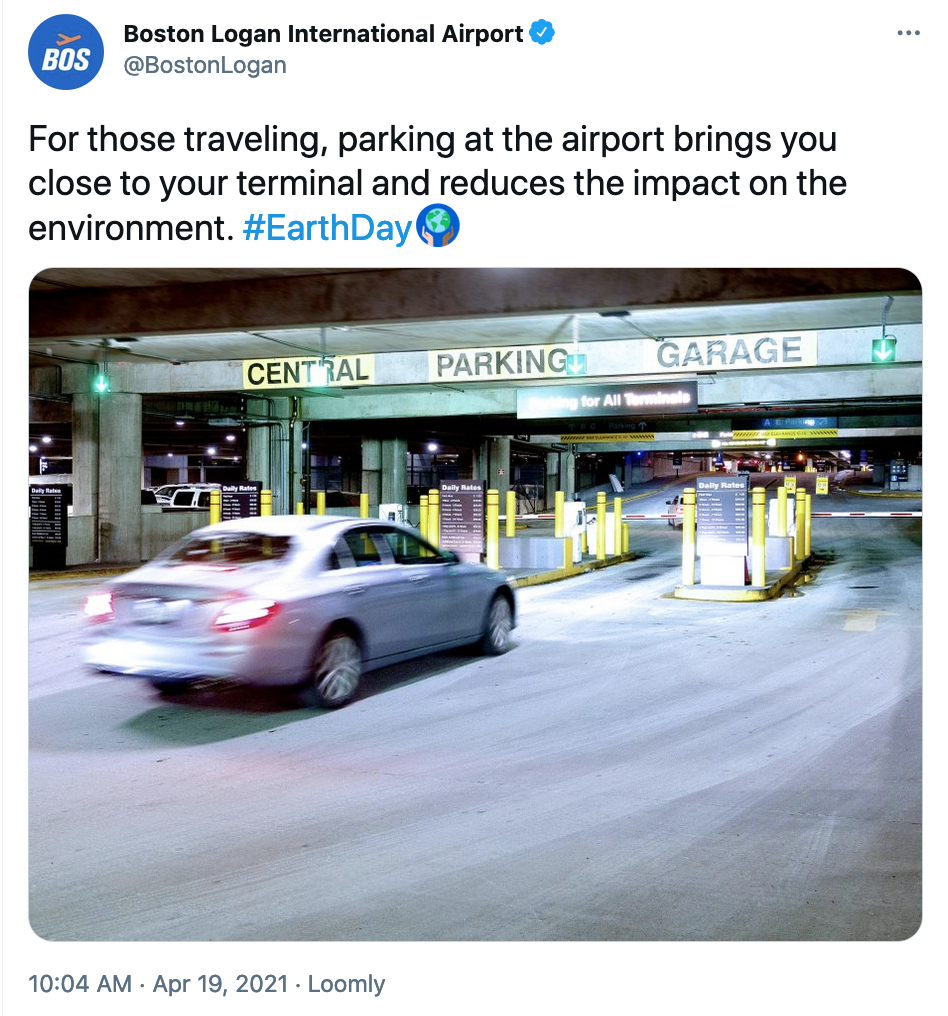
On Monday, a Boston Logan International Airport social media staffer, possibly impaired from the permanent haze of toxic, partially-combusted hydrocarbons that hangs over their workplace, invited travelers to celebrate Earth Day by driving to the airport.
“For those traveling, parking at the airport brings you close to your terminal and reduces the impact on the environment. #EarthDay,” tweeted the Boston Logan International Airport shortly after 10 a.m. on Patriots’ Day.
The tweet, which neglected to mention any of the airport’s abundant public transportation options, was quickly ratioed with a flood of incredulous reactions from all over the world.
“Did a parking garage write this?” asked one user from North Carolina.
The Massachusetts Sierra Club called it “ridiculous greenwashing.”
“Bad buzz pour l’aéroport @BostonLogan,” wrote a Francophone journalist.
Airport staff deleted the tweet Monday afternoon after it had racked up several hundred reactions – most of which were extremely scornful.
Streetsblog reached out to Massport, the state agency in charge of the airport, to offer them a chance to explain the tweet’s reasoning.
Jennifer Mehigan, Massport’s Director of Media Relations, didn’t seem to understand what the big deal was.
“Are you serious that this is generating a lot of attention?” responded Mehigan in an email message on Monday afternoon. “We have had similar messaging for years.”
“Passengers that park at Logan generate two car trips – they drive there, then home – while being dropped off and later picked up by a loved one generates four car trips,” Mehigan explained. “Logan Express and other HOV modes are better for the environment, though parking is better than ‘pick up/drop off’ and often better than taxis and TNCs (e.g., Uber or Lyft) if those cars come to or leave Logan empty.”
In essence: driving to the airport is “good” for the environment because it’s only half as bad as driving there twice – kind of like, if I were to kill just one panda bear, that would be good for the planet because I showed restraint and didn’t kill two of them.
The kicker: because it was built on landfill over former marshlands and open waters of Boston Harbor, Logan Airport is especially vulnerable to rising sea levels and the increasingly severe storm surges associated with a warming climate, and the airport is already spending millions of dollars on “resiliency” projects to protect its infrastructure from flooding.

Read More:
Streetsblog has migrated to a new comment system. New commenters can register directly in the comments section of any article. Returning commenters: your previous comments and display name have been preserved, but you'll need to reclaim your account by clicking "Forgot your password?" on the sign-in form, entering your email, and following the verification link to set a new password — this is required because passwords could not be carried over during the migration. For questions, contact tips@streetsblog.org.