How Transportation Issues Could Shape the Race to Replace Gov. Charlie Baker
The next governor of Massachusetts will enter office with another looming budget crunch at the MBTA, a historic amount of federal infrastructure money in play, mounting pressure to meet the state’s climate goals, and momentum for changing the way we pay for transit.
So far, these issues haven’t taken a prevailing role in the race to replace retiring Republican Governor Charlie Baker. But differences in the candidates’ stances could factor in as the race develops.
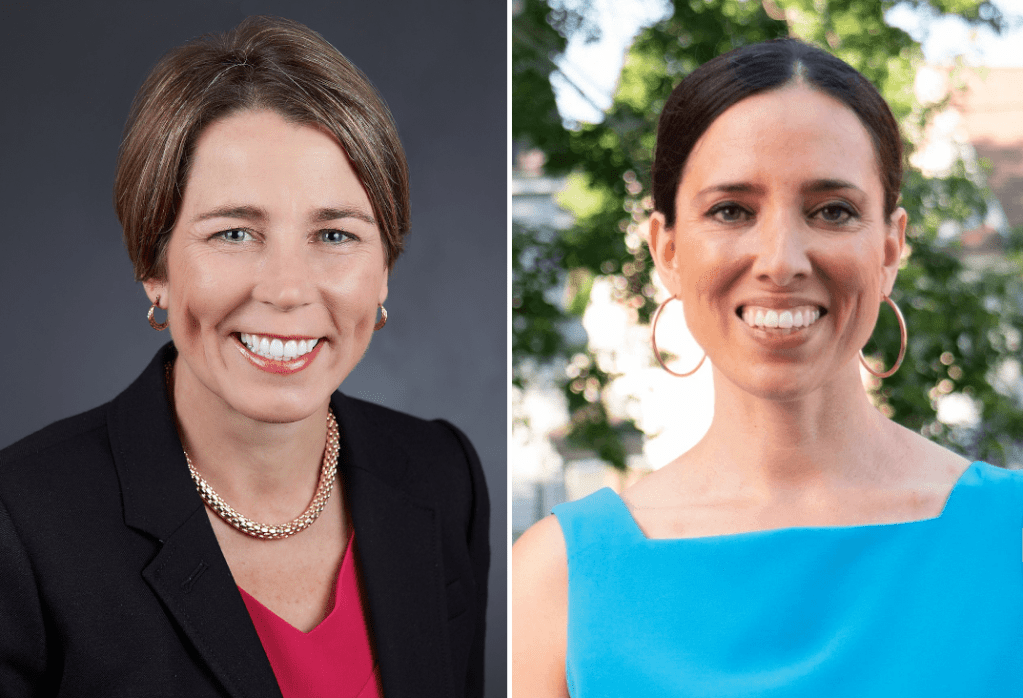
In the race for the Democratic nomination, frontrunner Attorney General Maura Healey has been criticized for being “short on specifics” (highlighted by a cheeky domain name purchase that’s been tracking whether her website has put up an issues page), but her campaign provided StreetsblogMASS with a first glimpse at the AG’s transportation priorities.
“If we are going to create jobs in every region of our state, reduce costs that are hurting families, and make a meaningful impact on the climate crisis, then we have to invest in our transportation system,” Healey wrote in a statement. “That starts with fixing our crumbling bridges and roads, and it also requires dramatically investing in public transit.”
Healey, who launched her campaign at the Maverick Blue Line station in East Boston, called for increasing funding for regional transit authorities and working to expand rail across the state.
“As we transition to a clean energy economy, having an electrified public transit system that is a viable alternative for commuters who would otherwise drive is going to be essential,” she said.
Broadly, those priorities line up with those of primary challenger state Senator Sonia Chang-Diaz, but there’s one area where a distinction is developing: fare-free transit.
“We’re going to be taking a look at all of the ideas on the table, including fare-free transit, with community leaders and experts,” Healey said in her statement.
Contrasting Healey’s careful approach, Chang-Diaz, seen as the further to the left of two generally progressive candidates, is already all-in on taking out fareboxes.
She plans to “incentivize use of public transit by moving to a fare-free system,” her website says. “Sonia’s first budget proposal as Governor will include funding to remove fares from MBTA and RTA buses immediately, and she will lead the charge to identify additional sources of funding — such as repealing tax breaks for corporations that shift their income to off-shore accounts — to transition to a completely fare-free MBTA.”
The issue has the potential to be a differentiator in a race that might otherwise be characterized by similar positions.
“Free the T” stood out in Boston’s mayoral race, where Michelle Wu made a proposal to remove fares on bus lines a centerpiece of her winning campaign. And the debate over fares remains salient as Wu rolls out her implementation of the two-year fare free pilot on the 23, 28 and 29 buses.
“The idea of free fares used to seem like some utopian wilderness, and it’s now a mainstream idea with multiple exemplars,” said Phineas Baxandall, senior analyst and advocacy director at the Massachusetts Budget and Policy Center. “I think policymakers can capitalize on that momentum, but whether they will really remains to be seen.”
Chang-Diaz’s campaign did not respond to a request for comment, but her website’s sturdy “Issues” section lays out the senator’s plans broadly: expand public transit, develop an East-West rail system, support new incentives and rebates for electric vehicles, and invest in shared streets programs to boost bike and pedestrian and infrastructure.
In her State House tenure as well, Chang-Diaz has amassed a record on transportation issues, like leading an effort to cap MBTA fare increases.
While her career as AG has given her fewer opportunities to weigh in on transportation policy, Healey has held a progressive line, denouncing fare hikes at the T and doing battle with Uber and Lyft and freight railroad companies over their labor practices.
Jim Aloisi, former Massachusetts Secretary of Transportation during the Patrick administration, said it’s too early to tell how much daylight there is between the candidates.
But he said that he expects eventually, transportation issues will come to the fore, in one way or another.
“Whether it’s the issue of rising gas prices or traffic congestion, or the free bus experiments happening in Boston, or the desire to connect the state more closely through rail, there are a lot of issues that are percolating,” he said.
The winner of the September Democratic primary will go on to face Geoff Diehl, a Trump-endorsed former Republican state representative, or Wrentham businessman Chris Doughty, both of whom have made a campaign issue out of the state gas tax in recent weeks.
Doughty, a more moderate but lower profile candidate, recently told Commonwealth Magazine that he’s opposed to expanding transit and to reducing or removing fares.
Each party will pick their candidates for Governor in a primary election on September 6. The general election will follow on November 8.
Sam Mintz is a Boston-based journalist covering transportation and energy policy. Before moving back to his hometown in 2021, Sam spent five years in D.C. covering Congress and federal agencies for Politico and E&E News. He lives in Brighton, equidistant to stops on the B,C, and D branches of the Green Line.

Read More:
Streetsblog has migrated to a new comment system. New commenters can register directly in the comments section of any article. Returning commenters: your previous comments and display name have been preserved, but you'll need to reclaim your account by clicking "Forgot your password?" on the sign-in form, entering your email, and following the verification link to set a new password — this is required because passwords could not be carried over during the migration. For questions, contact tips@streetsblog.org.