Our First Look At the T’s Proposed New Bus Network
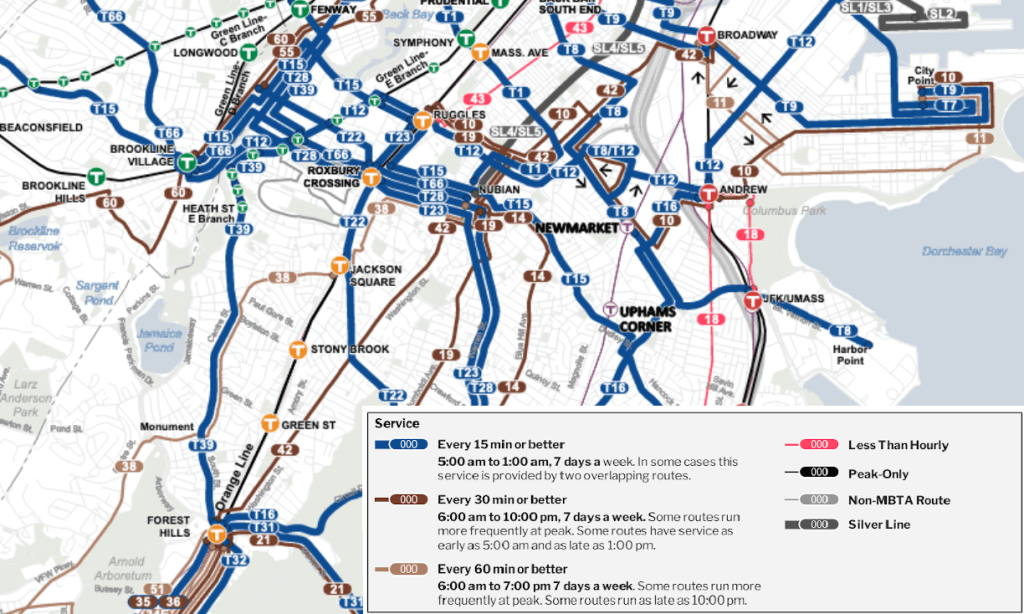
The MBTA has published a draft map of its proposed new bus network – a major milestone in the agency’s efforts to reinvigorate and expand its bus services.
For the past year, the T’s planners have been working on a blank-slate redesign of its bus routes to adapt to the region’s changing travel patterns, better serve fast-growing neighborhoods, and reduce inequities that force Black riders to lose more time stuck in traffic relative to their white counterparts.
The draft map illustrates the T’s overall strategy to provide simpler, more frequent bus service for transit-dependent neighborhoods like Dorchester, Lynn, Chelsea, and Mattapan, and better service to growing neighborhoods like the Seaport and the Longwood Medical Area.
The centerpiece of the new proposal is a network of 30 “high-frequency” bus routes, which promise a bus arriving every 15 minutes or better between from 5 a.m. until 1 a.m., 7 days a week. Collectively, 50 percent of the MBTA’s buses and drivers will operate on these routes when they are fully implemented:

The T’s current bus network features only 15 bus routes that meet the “high-frequency” standard of service, and they don’t reach transit-dependent neighborhoods like Everett and Lynn.
By reaching more communities, the T estimates that this new network would give 225,000 more of the region’s residents access to a high-frequency route.
The map is still being refined, and is subject to revisions in response to feedback from riders and other stakeholders. The T has planned dozens of public outreach events over the next two months to collect input, and the new routes will be implemented in phases over the course of 5 years.
On Monday morning, Kat Benesh, the T’s Chief of Operations Strategy, Policy & Oversight, said that the first route changes from the proposed new bus network would be implemented “no sooner than spring or summer 2023.”
New bus-priority infrastructure on municipally-owned streets is expected to be critical to the success of the proposal, which features numerous routes that converge in dense, congested neighborhoods like Nubian Square, downtown Chelsea, and the Longwood Medical Area.
The increase in bus service will also be contingent on a number of other MBTA initiatives, including addressing its shortage of bus drivers, building new garages that can store more buses, and redesigning streets to create space for more dedicated bus lanes.
“We’re not only doing bus network redesign, but also a number of other things with our bus service. That includes an effort to update our facilities and update our fleet with a goal of electrification of the entire network, and also adding bus priority infrastructure across the system,” said MBTA General Manager Steve Poftak in a press briefing on Monday morning. “All three of these are integrated together.”
Learn more:

Streetsblog has migrated to a new comment system. New commenters can register directly in the comments section of any article. Returning commenters: your previous comments and display name have been preserved, but you'll need to reclaim your account by clicking "Forgot your password?" on the sign-in form, entering your email, and following the verification link to set a new password — this is required because passwords could not be carried over during the migration. For questions, contact tips@streetsblog.org.