Guest Column: South Station Is Not An Adequate Emergency Shelter
The death of Carvell Curry, an unhoused man who froze to death outside South Station in December 2025, is a tragedy. It reflects serious shortcomings in Boston’s approach to homelessness—and, more broadly, in how cities across the United States respond to extreme weather and vulnerable residents. No human being should die in the cold in Boston in 2026.
But returning to the old “gentlemen’s agreement” of allowing unhoused individuals to sleep overnight in New England’s busiest train station is not the right solution.
South Station is neither designed nor equipped to function as an emergency shelter. There are better nearby alternatives that offer greater adaptability, dignity, and safety for both unhoused residents and the general public.
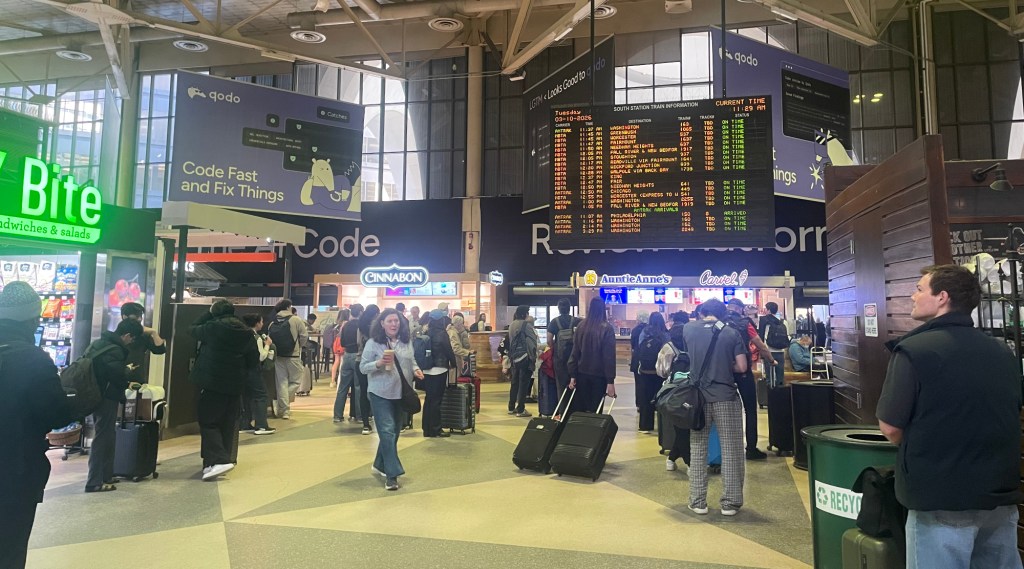
South Station’s rail waiting area encompasses roughly 15,000 square feet in a single large, open room punctuated by alcoves and vendor kiosks—about 20 in total. The space remains in active public use approximately 21 hours per weekday. The first train departs at 4:20 a.m. (Providence Line Train 803 to Wickford Junction), and the last scheduled arrival is at 12:43 a.m. (Providence Line Train 892 from Providence), with Amtrak Acela 2174 arriving at 1:09 a.m. on Fridays. Constant arrivals and departures bring heavy foot traffic, loudspeaker announcements, and doors opening to frigid air—conditions fundamentally incompatible with rest or stability.
The station also has limited restroom facilities and no capacity to create separated, specialized areas for families, children, individuals with acute mental health needs, or other vulnerable populations. Operating the space as a shelter requires MBTA Transit Police staffing—often on overtime—further straining public resources. In short, South Station’s physical layout and primary mission make it an ill-suited emergency housing solution.
There are, however, nearby public facilities that are far better equipped to serve as temporary shelters during severe weather.
The most obvious candidate is the Menino Convention and Exhibition Center (MCEC), located just 0.7 miles away on the same street as South Station. With approximately 2.1 million square feet of heated indoor space—including 516,000 square feet of exhibit space, a 40,000-square-foot ballroom, and more than 80 meeting rooms—the BCEC offers scale, flexibility, and infrastructure. Its numerous restrooms can be designated for specific populations. Its modular spaces allow for safe separation by family status, sex, or medical and mental health needs. It even has massive kitchens that may be pressed into service. Even when hosting conventions, the building’s size makes segregation feasible in ways impossible at South Station. Importantly, it is not subject to 21 hours of daily train activity.
The MCEC has already demonstrated its emergency utility: in 2020, it was converted into Massachusetts’ first temporary COVID-19 field hospital. It is difficult to imagine South Station’s waiting room serving such a function.
Another strong candidate is the MBTA’s Emergency Training Center on Foundry Street in South Boston, adjacent to Broadway Station on the Red Line—just one stop from South Station. This facility has previously offered emergency shelter to MBTA employees during major snowstorms and already contains temporary cots and infrastructure suitable for emergency use.
Other proximate public buildings meriting consideration, that offer superior shelter compared to the South Station lobby include:
- The Federal Reserve Bank of Boston lobby
- The Moakley Federal Courthouse
- MassDOT District 6 Headquarters
- The 10 Park Plaza Transportation Building, which in 2023 housed dozens of unhoused migrant families
Mr. Curry’s death demands change. But meaningful change requires more than reverting to informal, improvised arrangements. It calls for thoughtful planning, interagency coordination, and the use of facilities designed—or at least adaptable—for humanitarian response.
South Station is a transportation hub, not a shelter. Boston can and must do better by identifying and preparing more appropriate emergency spaces that provide safety, dignity, and flexibility for those in crisis. Policymakers should seize this moment not to return to the past, but to build a better system for the future.
Brian Kane is Executive Director of the MBTA Advisory Board, a quasi-state body providing budget oversight of the Massachusetts Bay Transportation Authority on behalf of 178 cities and towns in the Commonwealth. He is also the volunteer Chair of the Brookline Transportation Board.

Streetsblog has migrated to a new comment system. New commenters can register directly in the comments section of any article. Returning commenters: your previous comments and display name have been preserved, but you'll need to reclaim your account by clicking "Forgot your password?" on the sign-in form, entering your email, and following the verification link to set a new password — this is required because passwords could not be carried over during the migration. For questions, contact tips@streetsblog.org.