Congress Allocates $80 Million to Build Blue Hill Ave. Busway
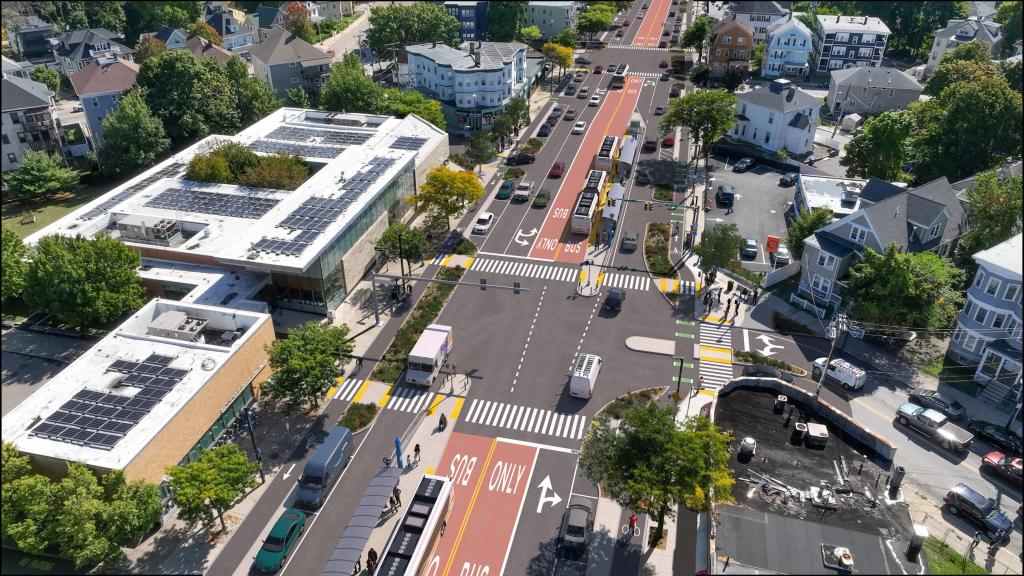
The congressional spending bill that ended the federal government shutdown last month included an $80.3 million earmark to let the MBTA begin construction on the long-planned reconstruction of Blue Hill Ave. with center-running bus lanes.
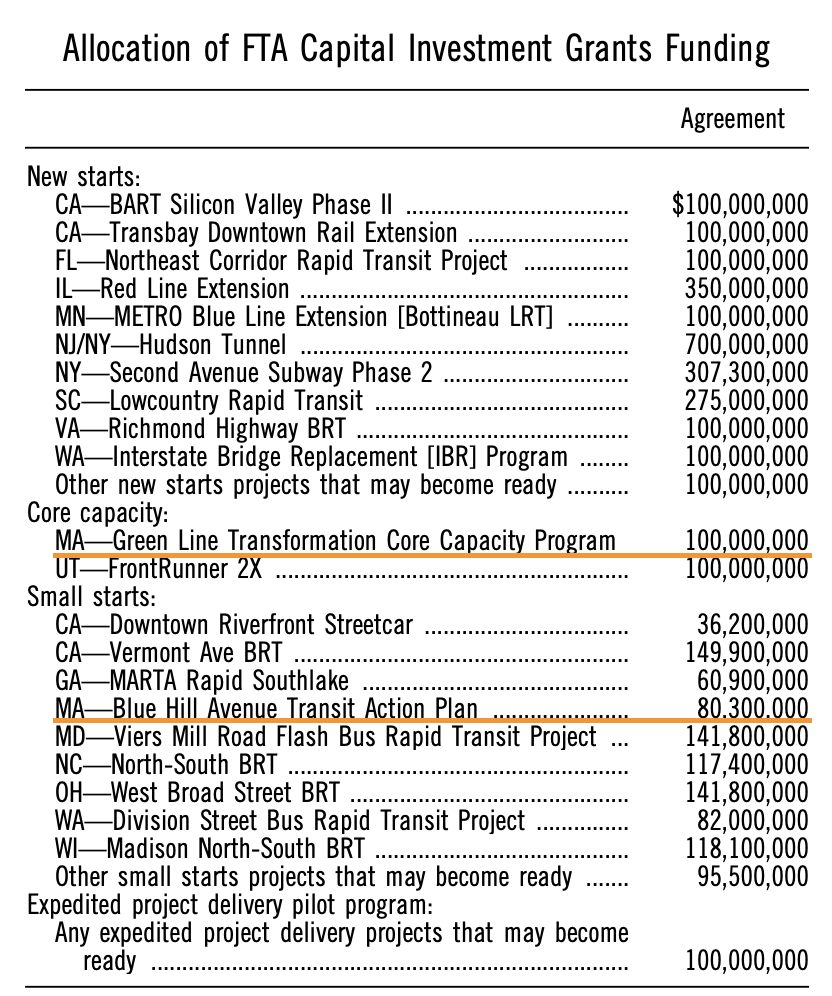
According to a table published in the Congressional Record of Jan. 22, 2026 (shown at left) the Federal Transit Administration will provide $80.3 million for the MBTA to begin construction on the project.
The Consolidated Appropriations Act of 2026 (HR 7148), which President Trump signed into law on Feb. 3rd, says that “the amounts made available under this heading in this or any prior appropriations Act shall be available for the purposes, and in amounts, specified” in this list.
The law also earmarked $100 million for the MBTA’s Green Line Core Capacity project, a suite of major construction projects that will be necessary for the T to introduce its new “Type 10” light rail vehicles.
The FTA’s capital investment grants program provides federal construction funding for new transit projects across the nation.
The Blue Hill Avenue transit project entered the FTA’s “small starts” project development pipeline in March 2025, after Mayor Wu and MBTA General Manager Phil Eng signed a joint memorandum of understanding to endorse the project.
The $80.3 million earmarked in the February appropriations bill fulfills the MBTA’s entire request for funding from the FTA.
Because the funding is now enshrined in law, it is also considerably less at risk of “rescission” from the Trump administration.
Combined with existing pledges of funding from other federal, state, and local sources, the Blue Hill Avenue project is now fully funded for construction.
Faster bus trips for 37,000 people
The total cost of the Blue Hill Avenue project is expected to be about $160 million, the vast majority of which would come from state and federal funds.
Much of that funding would pay for new streetscape and public realm improvements along a roadway whose cracked sidewalks, lack of trees, and packed buses are a damning illustration of how the city has historically neglected predominantly Black neighborhoods like Roxbury and Mattapan.
Blue Hill Avenue is one of the busiest bus routes in New England, with an estimated 37,000 riders who board or disembark an MBTA bus during a typical weekday.
But Blue Hill Avenue’s busiest bus routes, the 23 and 28, rank among the region’s slowest buses, with average speeds of 6.6 and 6.7 mph, respectively.
The T estimates that the new dedicated busway on Blue Hill Avenue will collectively save bus riders over 3,000 hours every day, and enable the agency to add even more bus service to the corridor.
In addition to the center-running bus lanes and stations, the project’s plans also call for a complete reconstruction of the roadway and its sidewalks with comprehensive accessibility upgrades, new crosswalks, new tree plantings, and other public realm improvements.
$15 million of the project’s remaining costs would come from a discretionary grant that the Biden administration pledged in 2021. Governor Healey’s administration has pledged an additional $40 million in state funding, the MBTA would contribute another $11 million from its budget, and the City of Boston will provide the remaining $18 million.
Good news that’s curiously hard to find
Typically, when the MBTA wins a large federal grant, elected officials and the agency’s press office issue a barrage of congratulatory press releases to brag about it.
That hasn’t been the case with the Blue Hill Avenue earmark.
No members of the Massachusetts congressional delegation have come forward to claim credit for the project’s inclusion in the February spending bill.
Congresswoman Ayanna Pressley, whose district encompasses Blue Hill Avenue, actually voted against the bill in a roll call vote in the House on Feb. 3, in protest over violence and civil rights violations by Immigration and Customs Enforcement agents.
Pressley did not respond to our inquiries on Thursday. A spokesperson for Senator Elizabeth Warren confirmed that “Congress secured these funds,” but did not provide any additional details.
Mayor Wu’s press office also did not respond to inquiries about the project and the new Congressional funding (we’ll update this story if we hear back from them).
This story had initially been published Thursday afternoon, and early on Friday morning, the MBTA offered a statement.
“With this new major funding source now secured, the MBTA is pleased to share we will be planning new outreach in the spring to continue the long and robust conversation with the community as we move to finalize the project design and advance towards construction,” a T spokesperson wrote in an e-mail to StreetsblogMASS.
According to the T, construction will begin in late 2027 or early 2028.
The T’s press office also emphasized that the T and City of Boston have collaborated on extensive public outreach during the project’s development over the past 6 years.
“To date, the project team reached out to 24,000 households and held or attended 19 outreach events where they interacted with over 3,200 people to collect feedback on everything from potential bus stop locations to crosswalks to trees and parking,” the MBTA’s spokesperson wrote.

Read More:
Streetsblog has migrated to a new comment system. New commenters can register directly in the comments section of any article. Returning commenters: your previous comments and display name have been preserved, but you'll need to reclaim your account by clicking "Forgot your password?" on the sign-in form, entering your email, and following the verification link to set a new password — this is required because passwords could not be carried over during the migration. For questions, contact tips@streetsblog.org.