Accessibility Advocates Press Boston City Council for Better Snow Removal
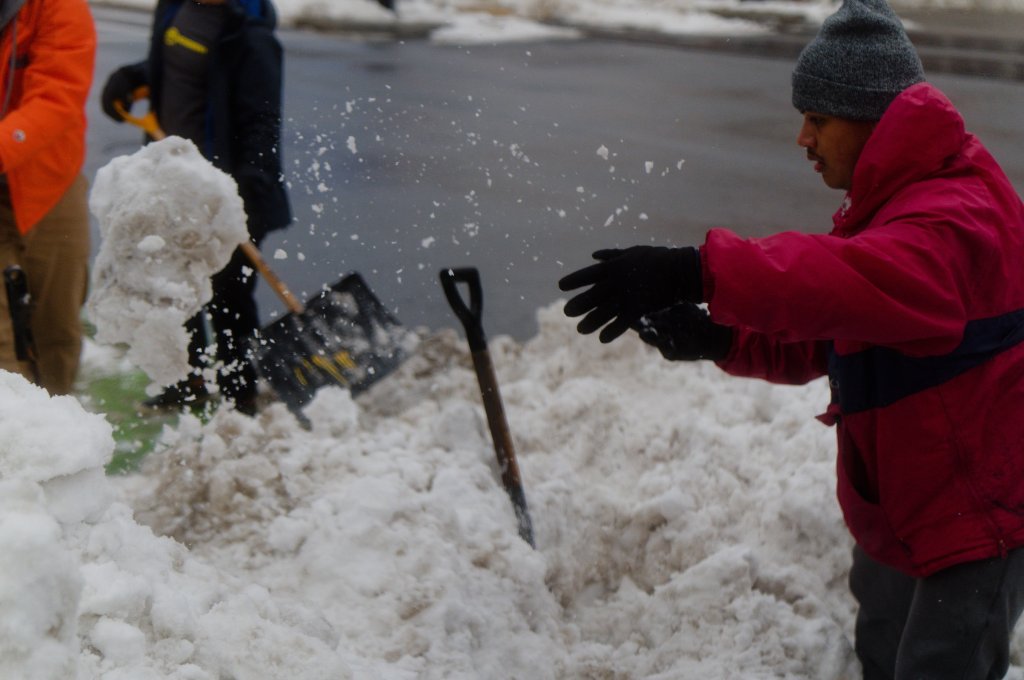
As even more snow began falling outside, dozens of safety advocates from a coalition of pedestrian, bike, transit, and disability rights groups came to Boston City Hall Tuesday afternoon to ask the City of Boston to put a greater focus on pedestrian safety and accessibility after snowstorms.
The City Council’s City Services Committee hosted a public hearing Tuesday afternoon in response to several Councilors’ requests to review the city’s snow removal policies in the wake of this winter’s large snowstorms.
“The City of Boston made some visible efforts this last storm to improve snow response,” said Brendan Kearney, executive director of WalkMassachusetts, at a brief press conference held outside City Hall before the hearing. “But we’re going to call for continued progress in future storms, including clear and enforceable standards for maintenance of sidewalks, transit stops, and bike lanes.”
Kearney spoke alongside other members of the Shared Spaces Coalition, which includes the Boston Center for Independent Living, WalkMassachusetts, MassBike, Boston Cyclists Union, and Transportation for Massachusetts.
“We must work together so that in every storm going forward, sidewalks, curb cuts, bus stops and bike lanes are treated with urgency,” said Kat Torres Radisic, community organizer at the Boston Center for Independent Living.
As the hearing got underway inside City Hall, City Councilors gave the city’s public works department credit for a perceived improvement in snow removal after the most recent storm.
But there was also broad agreement that the city needs to do better.
“Snow isn’t just an inconvenience. It becomes a barrier to safety and mobility in daily life,” observed Councilor Enrique Pepen.
“I’ve seen both the progress and the gaps in our snow response this winter,” said Councilor Julia Mejia. “Main roads are often cleared quickly, but crosswalks, curb ramps, bus stops, and side streets can remain difficult and sometimes dangerous for days.”
The hearing included testimony from Cassandra Xavier, a disabilities rights advocate who has dual sensory loss and relies on a cane to navigate the city’s sidewalks.
Xavier told the Council that she’s frequently had to walk next to cars on busy streets because the city’s sidewalks have been so inaccessible after this winter’s snowstorms.
“This is a very important matter for everyone, with our without a disability,” said Xavier. “The lack of having things shoveled, and the sidewalk access being completely absent, it just made me feel like my disabilities were not ever going to be seen as important, or worth anything. Which is why we’re here today, to make sure everyone has freedom to mobility.”
Xavier also invited the Mayor and the Governor to join her in seeing what it’s like to navigate the city’s sidewalks with impaired vision.
“When we advocate for these things, we’re not complaining, we’re asking for our basic right to be respected,” Xavier said.
What to do about it
Maha Aslam of the LivableStreets Alliance urged Councilors to learn from other snowy cities, like Montreal and Minneapolis.
“One thing that I think was lacking was that Boston does not have a system of prioritization when it comes to what streets, what sidewalks, what bus stops we’re prioritizing, and why,” said Aslam. “This should be a public-facing thing, because we need a very data-driven approach to this… We need to understand, where does it make sense for us to use our resources more effectively?”
Others spoke about the confusion caused by overlapping political jurisdictions. Sidewalks and curb ramps are generally the responsibility of the adjacent property owner, but when the property owner is a state agency like MassDOT or the MBTA, or the City of Boston itself, 311 complaints will often go nowhere.
Jill Suarez, a mobility instructor at the Carroll Center for the Blind, urged the city to focus more on its median strips in the middle of its streets, and to also publish a clear, easy-to-understand map of who’s responsible for which sidewalks and crosswalks.
“As a regular citizen, I don’t know who has jurisdiction over what intersection… So I would love if there would be a link on the website to redirect me to know who to complain to,” suggested Suarez.
Councilor Pepen asked city staff if they had considered the creation of an emergency shoveling corps that could supplement the city’s existing workforce, similar to what New York City did in the most recent blizzard.
“We have implemented those kinds of programs (in the past),” answered Chief of Streets Nick Gove. “I don’t think we’re prepared to really discuss anything today. We just haven’t had time to look into what a new version of that would look like.”

Read More:
Streetsblog has migrated to a new comment system. New commenters can register directly in the comments section of any article. Returning commenters: your previous comments and display name have been preserved, but you'll need to reclaim your account by clicking "Forgot your password?" on the sign-in form, entering your email, and following the verification link to set a new password — this is required because passwords could not be carried over during the migration. For questions, contact tips@streetsblog.org.