‘Micromobility’ Commission Recommends Improved Classification, Regulation of Motorbikes and Scooters
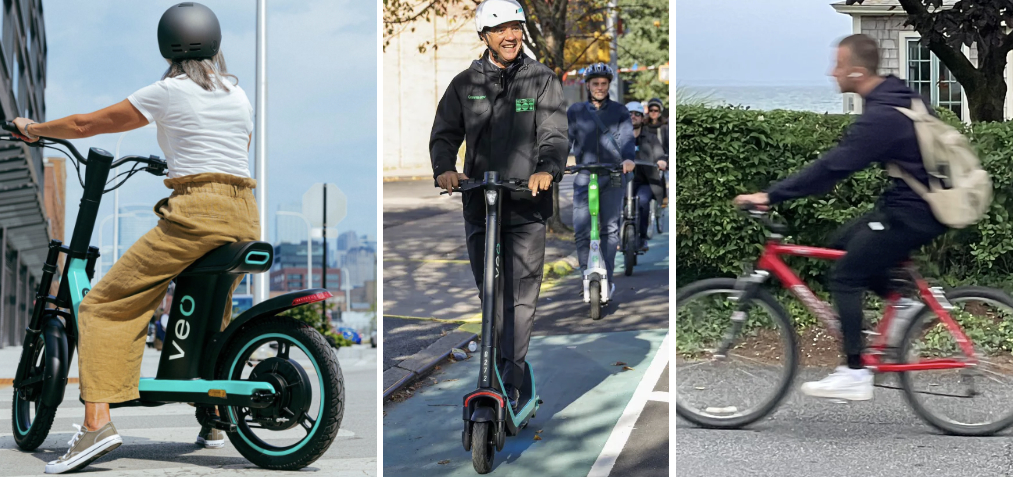
A formal state commission is recommending that Massachusetts lawmakers take steps to more formally regulate small electric vehicles that have been raising safety concerns as they proliferate across the Commonwealth’s roadways as a low-cost, efficient transportation option.
The Massachusetts Special Commission on Micromobility, created by an act of the legislature in late 2024, issued its final report last month after a year’s worth of work.
The group issued 16 public policy recommendations for lawmakers to consider, including several that would more precisely define and regulate different kinds of small electric vehicles based on their maximum speeds and engine power.
Other recommendations include setting a 20 mph speed limit on shared-use paths, improving crash reporting and police training, and increasing the state’s investments in safer infrastructure.
In the law creating the commission, the legislature called for “a review of current state and local laws and regulations for micro-mobility vehicles; (ii) recommendations to regulate micro mobility vehicles, including on bike paths, sidewalks and shared use paths; and (iii) recommendations to support the expansion of micro-mobility vehicle use and innovation.”
The commission, which included members from state transportation agencies, the legislature’s Transportation Committee, safety advocates from WalkMassachusetts and MassBike, and industry representatives, among others, held five formal meetings over the course of 2025.
What even is an ‘e-bike’?
Kris Carter, MassDOT’s Chief Innovation Officer, presented the commission’s findings to the MassDOT Board of Directors at the end of its monthly meeting on Wednesday.
He said that one of the first things the commission struggled with was coming to a common agreement about the kinds of vehicles they were talking about.
“The words that people use to talk about these devices – we’re talking about things in this commission that are mostly smaller than a golf cart – (are) confusing. The terms that the public uses are different from what’s in Massachusetts general law or regulation,” Carter said.
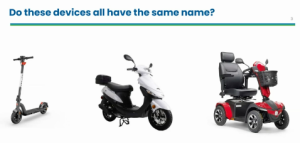
To illustrate the point, Carter showed a slide with three different kinds of “scooter” (left).
“Some people might refer to each of these as a scooter. Some people might say moped, scooter, assisted device, wheelchair. So there’s confusion over what these things are, and that leads to confusion about where they can operate and the rules around them,” Carter said.
That confusion extends to police and media reports about crashes that involve high-powered electric motorcycles and dirt bikes – machines that have little in common with the public’s traditional idea of what a “bicycle” is.
Low-speed e-bikes are already regulated in Massachusetts, and they’re legally defined as bicycles with pedals and an electric motor that ceases to provide assistance at speeds over 20 mph.
Last summer, news outlets produced dozens of headlines and evening news segments about violent “electric bike” crashes – including one in Plymouth, and another crash in Stoneham that killed a 13-year-old rider.
After the Stoneham crash, House Speaker Ron Mariano told NBC10 Boston that “we have begun to look at making sure that the rules that are in place are enforced, and if they have to be expanded or training has to be insisted upon, then we begin to do that — to license these folks that ride these bicycles.”
But the victim in that crash wasn’t riding a bicycle. They were riding a high-powered electric dirt bike, a machine that’s already illegal for on-street use under current law.
“In these crashes that involved young people in the Commonwealth in the past year, some of them fatal, they’re being reported on as being e-bikes, when in fact, none of them were actually e-bikes. They were all things that were out-of-class, not meeting that definition,” Carter said (we should note that some reporters and agencies – including the Middlesex County District Attorney’s Office, WCVB5, and WBZ, more accurately reported on the vehicle involved in the Stoneham crash as an “electric dirt bike”).
Higher speeds, more regulation
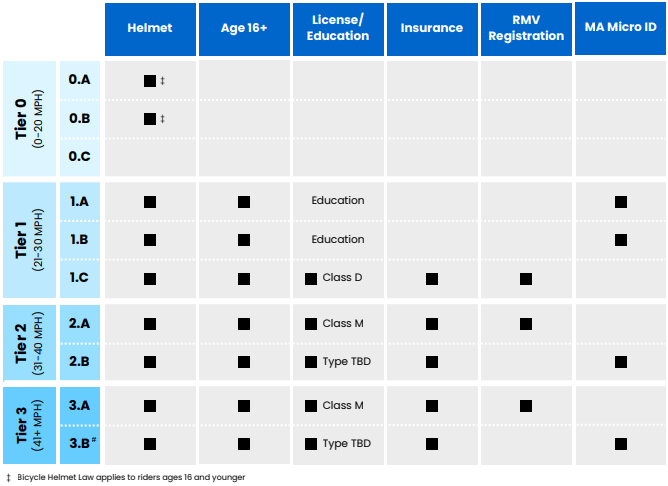
In an attempt to clear up some of the confusion, several of the commission’s recommendations rely on a proposed new classification system for small vehicles.
Under this framework, there would be four tiers based on the vehicle speeds, with increasing safety requirements for faster, more powerful vehicles.
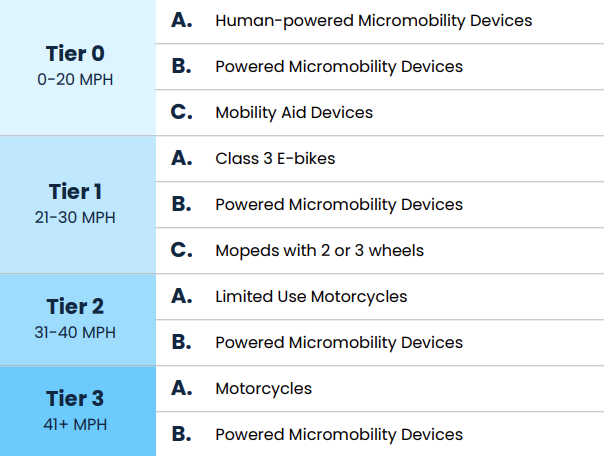
To support this framework, the commission also recommended a new “micro ID” registration sticker to help police and consumers identify higher-speed e-bikes and scooters.
That sticker would complement existing vehicle registration requirements for similarly-powered mopeds and motorcycles:
Other recommendations from the commission’s report include:
- Improving police training and public education on the state’s laws and regulations;
- Adding crashes involving these vehicles in the state’s official crash database (which currently only records crashes that involve traditional cars, trucks, and motorcycles);
- Setting a statewide 20 mph speed limit on shared-use paths;
- Endorsing the legislatures proposed automated enforcement legislation;
- A “model regulation” to help municipal governments regulate illegal parking in bike lanes and bike paths;
- Design guidance and expanded funding for micromobility infrastructure, such as protected bike lanes;
- Supporting “tier 0” micromobility options as a safer, more efficient alternative to driving through expanded bikeshare systems and e-bike subsidies;
- Additional study of the use of scooters and e-bikes in the delivery industry, to evaluate whether that sector merits any additional regulation.

Read More:
Streetsblog has migrated to a new comment system. New commenters can register directly in the comments section of any article. Returning commenters: your previous comments and display name have been preserved, but you'll need to reclaim your account by clicking "Forgot your password?" on the sign-in form, entering your email, and following the verification link to set a new password — this is required because passwords could not be carried over during the migration. For questions, contact tips@streetsblog.org.