Globe/Suffolk Poll Confirms That Fewer Drivers Would Clog City’s Roadways If Boston Had Congestion Pricing
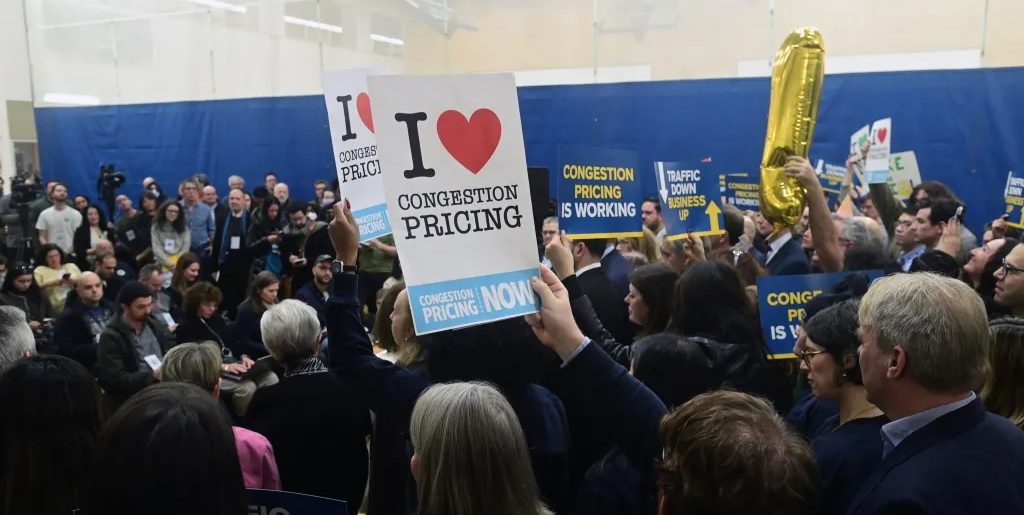
A new Boston Globe/Suffolk University poll released yesterday finds that many respondents would avoid driving into downtown Boston if a congestion charge were in effect – thus confirming the efficacy of the policy.
Pollsters asked 500 Massachusetts registered voters “would you be willing to pay to drive downtown if there was less traffic – yes or no?”
69 percent of respondents answered “no,” and only 26 percent answered “yes.”
According to the poll’s cross-tabulations, responses were relatively consistent across age groups and regions, but registered Democrats were significantly more likely to say “yes” to driving into the city and paying a congestion toll than Republicans (41 percent vs. 11 percent).
The polling results confirm one of the central principles of economics: that by putting a price on roadways that people currently use for free, fewer people will drive, and traffic will decrease.
The Boston Globe’s political reporter, Chris Van Buskirk, jumped to the conclusion that these polling results are “a blow to the idea of introducing congestion pricing in New England’s largest city.”
However, the pollsters explicitly did not ask voters whether they would support congestion pricing as a policy; they asked whether they, as individuals, would be willing to pay a toll to drive a car into the region’s most congested streets.
The assumption that these results indicate opposition for congestion pricing as a policy fails to consider the fact that many Massachusetts voters (including hundreds of thousands of daily MBTA riders) will answer “no” to this question because they already avoid driving into downtown Boston, with or without a toll in place.
NY voters also didn’t like congestion pricing, until they experienced benefits of congestion pricing
The Globe/Suffolk poll results are similar to results from New York, where Governor Hochul approved a $9 toll for drivers entering lower Manhattan starting on January 5, 2025.
A Siena College poll in December 2024 found that only 29 percent of statewide voters supported congestion pricing in New York City, and 51 percent opposed it.
By March 10, after the toll had been in effect for three months, the same pollsters found that statewide voters remained skeptical (33 percent supporting, 40 percent opposing), but that New York City voters – the people who were experiencing the policy’s benefits firsthand – supported keeping the toll by a 42 percent to 35 percent margin.
As the toll approached its one-year anniversary, at the end of 2025, it had become an unvarnished political success story for New York Gov. Kathy Hochul.
Abundant data indicated that the new policy had increased economic activity, reduced traffic crashes, reduced air pollution, and led to a 69 percent decrease in 311 noise complaints about honking cars, among other successes.
“Broadway had their best year in memory,” Hochul bragged to NY1 in an end-of-year interview. “Retail sales didn’t go down. They went up $900 million. And the foot traffic is there.”

Read More:
Streetsblog has migrated to a new comment system. New commenters can register directly in the comments section of any article. Returning commenters: your previous comments and display name have been preserved, but you'll need to reclaim your account by clicking "Forgot your password?" on the sign-in form, entering your email, and following the verification link to set a new password — this is required because passwords could not be carried over during the migration. For questions, contact tips@streetsblog.org.