MBTA’s $2.4 Million Fare Enforcement Team Issued 117 Warnings, Zero Fines During Its First 11 Months
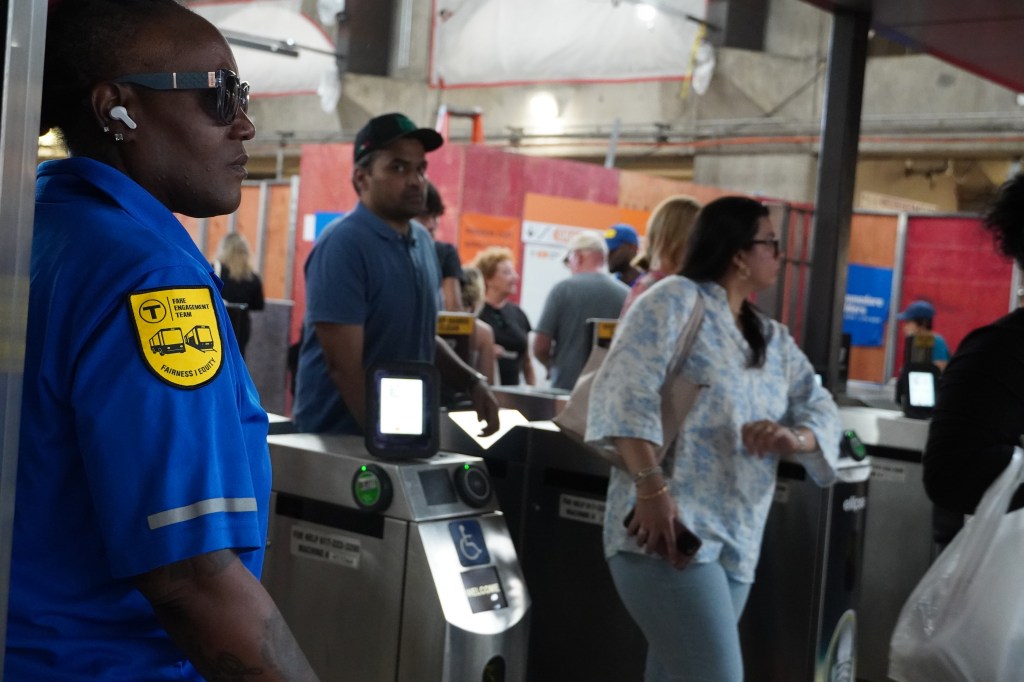
In late Aug. 2025, the T announced that a small platoon of blue-clad fare checkers would, in a few weeks time, begin issuing warnings and citations to rule-breakers trying to board subway trains without paying.
Fare revenue “helps fund the very improvements our riders count on and need for a stronger, a safer, and more equitable system,” Eng said in a promotional video. “When people don’t pay their fares, it impacts all of us. It slows down the progress we’ve worked so hard to achieve.”
On Sept. 8, the day “fare engagement representatives” began their fare policing, the T hosted a press conference in the glass-paneled entrance of Government Center station. T employees extolled the program’s virtues before TV cameras, and T cheerleader Pari Kim graced attendees with a fare-themed song.
Plenty greeted the program with skepticism.
Advocates have long bristled at crackdowns on fare evasion, worrying they unfairly victimize transit’s poorest users.
“Nobody should be discriminated against because they can’t pay $2 or $3. Transit is essential as any other thing like healthcare,” LivableStreets’ Maha Aslam told The Scope, a digital news outlet, last fall. “There has to be a shift in how we see transit, not as something that is just good to have but as a need in today’s day and age.”
As the program approaches its anniversary, enforcement data reveal that there hasn’t been much of a crackdown at all – but they also raise doubts about the program’s value.
Fare checkers have issued only 117 warnings since the program’s launch, according to data provided by the T on Aug. 12.
According to reporting from MassLive last fall, 85 of those warnings happened during the first six weeks of the program. Over the past year, the team has issued zero fines.
The T’s 16 fare checkers face the daunting task of policing a system that’s open around 20 hours a day, with scores of stations and an average weekday ridership topping half a million.
Could it be that the presence of fare checkers at stations has spooked would-be fare skippers into paying?
The T thinks so, though the agency admits that “quantifying fare evasion is highly complex, and quantifying the effect of fare engagement personnel on fare evasion is even more so.”
A T report published in July found that the presence of fare checkers on Green Line cars seemed to improve rates of contactless payment at street level stops, long the sites of frequent and flagrant freeriding (the T didn’t offer details about where fare checkers issued their 117 warnings).
Brian Kane, a Green Line regular who happens to head the T’s public oversight body, couldn’t recall seeing fare checkers on his commutes.
The Green Line, which originated as a streetcar system, “was always designed to have a conductor collecting fares and someone driving the vehicle,” Kane said.
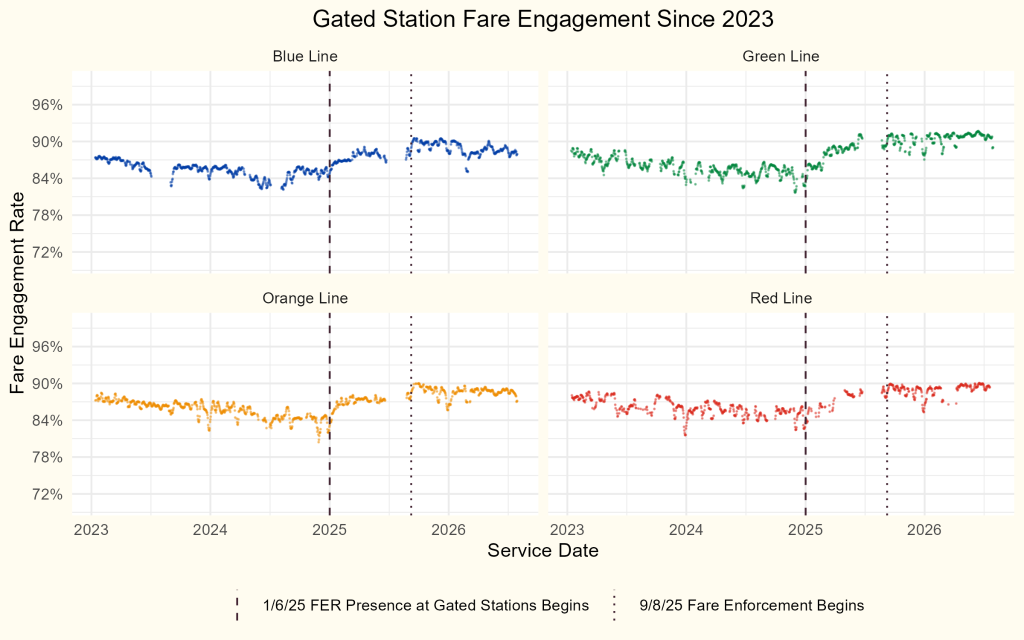
The T also notes that “fare engagement” rates — the ratio of payment “taps” to detected boardings and fare gate entries — appeared to tick up across all four lines after fare checkers began appearing at gated stations (for rider “education”).
But the changes are small, and causal effects are difficult to pinpoint.
Nonetheless, the $2.39 million program’s “long-term future” is “still being evaluated,” an agency spokesperson told StreetsblogMASS.
Kane reckons the T drew up the fare check program to confront an “optics” problem: to counter claims from critics that the perpetually underfunded agency doesn’t do enough to collect loose change from nonpaying riders.
Should fare checkers continue to prowl the system, however, Kane believes they’d benefit from “more targeted” deployment, especially along the Green Line.
The T’s fare check program isn’t the only effort of its kind to record less-than-convincing results.
A May 2025 report published by a criminal justice research group noted that fines from fare evasion citations on the BART network in California covered only a fraction of the expenses incurred by its fare checking program, which involves “fare inspection officers” plus sworn transit police. Many citations simply went unpaid.

Read More:
Streetsblog has migrated to a new comment system. New commenters can register directly in the comments section of any article. Returning commenters: your previous comments and display name have been preserved, but you'll need to reclaim your account by clicking "Forgot your password?" on the sign-in form, entering your email, and following the verification link to set a new password — this is required because passwords could not be carried over during the migration. For questions, contact tips@streetsblog.org.