Boston Officials Pitch New Bus-Priority Corridor Between North Station and Seaport
Monday’s marathon meeting of the MBTA’s Fiscal and Control Management Board (FMCB) was full of discouraging news for transit advocates: it started with a review of a withering safety audit followed by news of additional delays and a ballooning budget for the agency’s beleaguered new fare system.
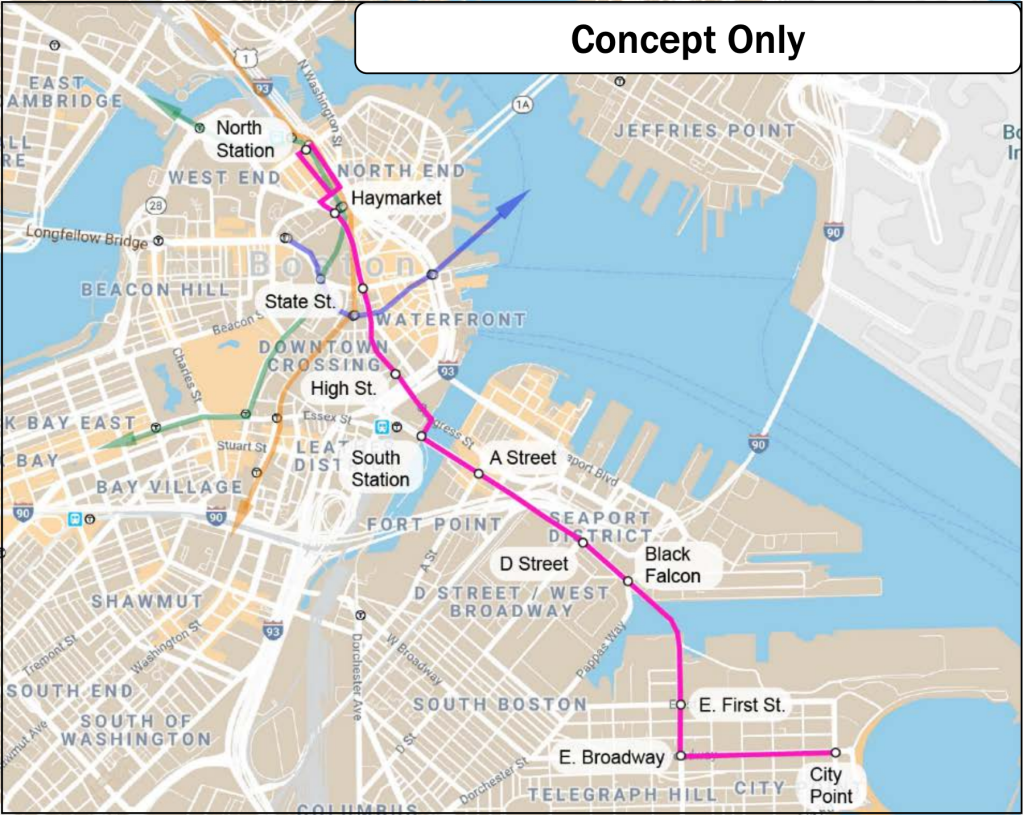
But near the end of the five-hour meeting, MBTA staff had some very good news for bus riders: the City of Boston is considering plans for a new “Center City Link” bus priority corridor (pictured above) that would connect North and South Stations to the Seaport District and facilitate increased MBTA bus service across downtown Boston.
Presenting the concept, MassDOT transit planner Caroline Vanasse said that “we’ve been partnering with the city to get something into design, and to understand what type of bus lane infrastructure, with BRT-like qualities, you could implement to create this central spine… We’re really excited about this.”
Vanasse said that, in addition to serving a new independent cross-town bus route, the proposed bus-priority infrastructure could also benefit and extend existing routes to give more riders a one-seat ride to more destinations.
For instance, the 111 bus from Chelsea, which currently terminates at Haymarket, could instead continue on to South Station, or the Silver Line 4 and 5 buses from Roxbury could run all the way to North Station.
The proposal is one of four potential “demonstration projects” that the MBTA is considering as part of its ongoing “Better Bus Project” planning effort.
Other projects under consideration include a proposal to increase and improve bus services on the Broadway bus lanes in Somerville and Everett, and another City of Boston proposal (illustrated at left) to extend the 29 bus route into the Longwood area.
FMCB board members made clear that bus-priority infrastructure should be an expectation for any service expansions through congested areas like Longwood and downtown Boston, to maximize the effectiveness of the MBTA’s investments.
In the discussion of Boston’s “Center City Link” proposal, MassDOT Secretary and FMCB board member Stephanie Pollack twice asked Vanasse to confirm that the city would be willing to set aside dedicated bus lanes to help buses avoid the congestion of downtown Boston’s streets.
Vanasse answered that the city hadn’t yet committed to a specific design, but intimated that dedicated bus lanes would be necessary.
“You would have to have bus lanes for this to work,” answered Vanasse, noting that current bus routes through downtown are regularly stuck in traffic with poor on-time performance. “Bus lanes would be absolutely crucial.”
Responding to a follow-up inquiry from StreetsblogMASS, Boston Transportation Department (BTD) spokesperson Tracey Ganiatsos wrote in an email Thursday morning that a range of bus-prioritization measures are being considered for the route.
“We have a toolkit of potential improvements for bus corridors including bus stop locations and amenities, bus lanes and queue jumps, and transit signal priority,” wrote Ganiatsos. “Through a process with the downtown community, we will also be investigating bus enhancements and other multimodal enhancements, including improvements to bike and pedestrian infrastructure.”
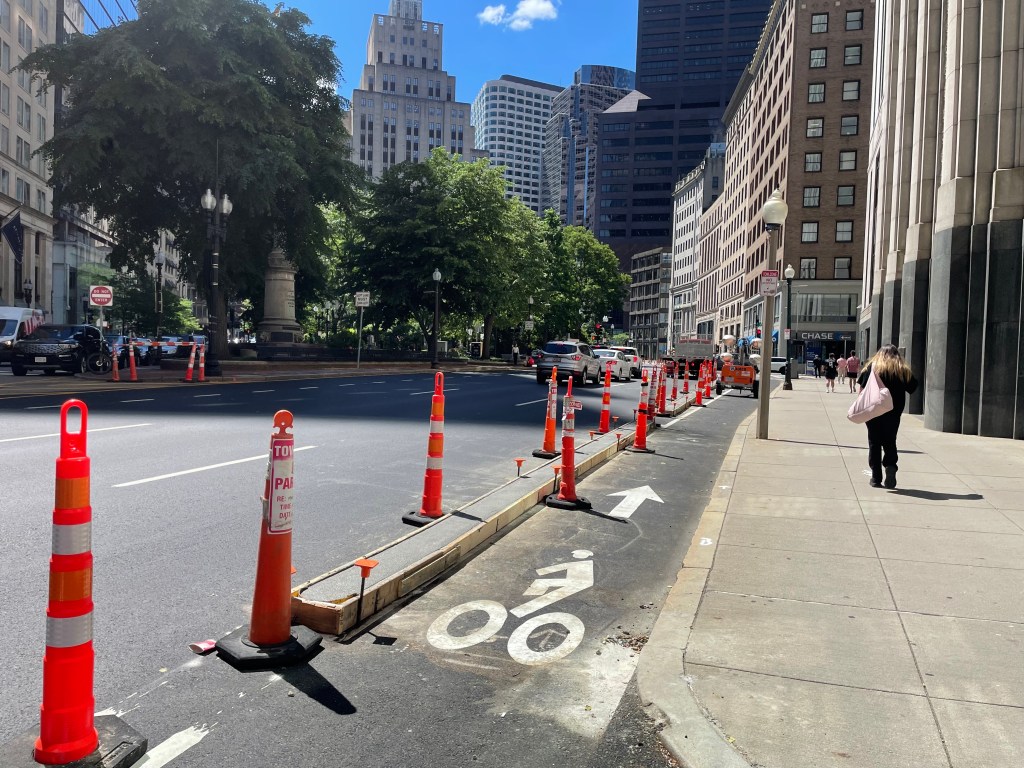
The conceptual “Center City Link” route dovetails with the city’s new Summer Street protected bike lanes, and bus-prioritization work on the rest of Summer Street could also advance the city’s plans to extend those protected lanes southward, past the Boston Convention and Exhibition Center and into South Boston.
Later on Monday’s FMCB meeting, board members also voted to procure 60 new buses to expand the T’s over-extended bus fleet.
Those new buses will be crucial for the agency to be able to add any peak-hour service for these demonstration projects. Earlier this year, a report from the LivableStreets Alliance estimated that the agency needs 67 additional buses just to meet current service commitments on existing routes.
Our reporting relies on support from readers like you. Click here to donate to StreetsblogMASS.

Read More:
Streetsblog has migrated to a new comment system. New commenters can register directly in the comments section of any article. Returning commenters: your previous comments and display name have been preserved, but you'll need to reclaim your account by clicking "Forgot your password?" on the sign-in form, entering your email, and following the verification link to set a new password — this is required because passwords could not be carried over during the migration. For questions, contact tips@streetsblog.org.