

Suburbs Face Their First Deadline for New Transit-Oriented Zoning Law
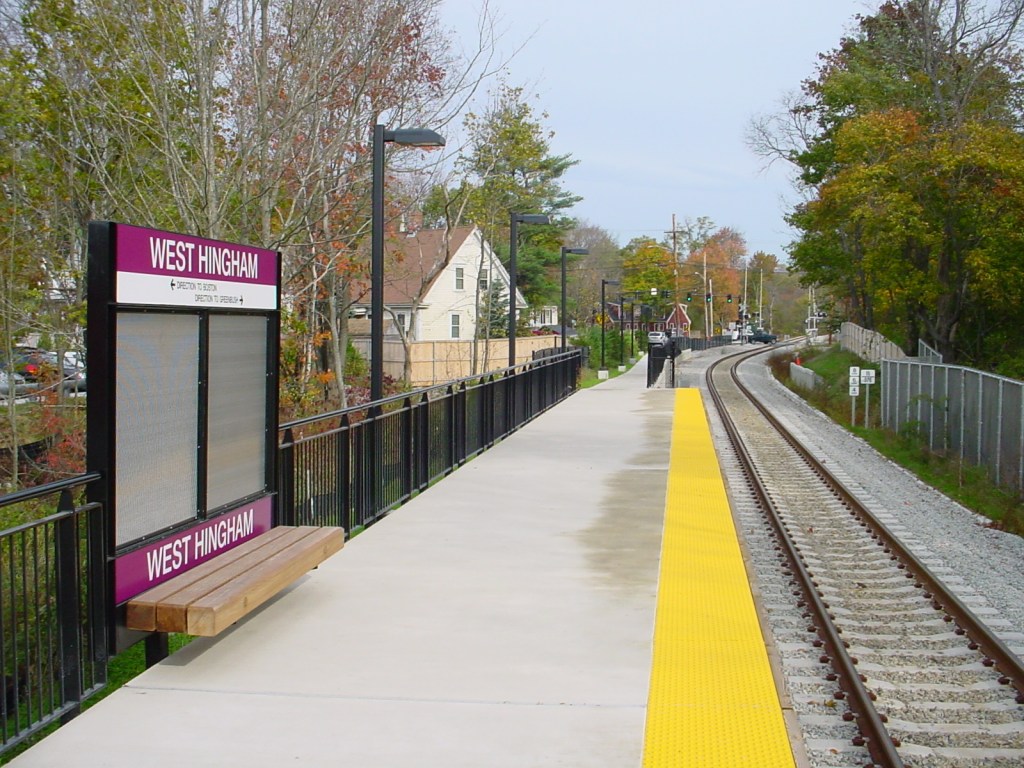
This Tuesday is the deadline for 175 municipalities across eastern Massachusetts to submit an “action plan” to comply with the state’s new multi-family zoning requirement for areas near an MBTA rail station or bus route.
Under the terms of a 2021 economic development law, municipalities in the MBTA service area will need to legalize zoning for multifamily development near transit routes.
Where many suburbs currently only allow single-family homes with large lawns, the new rules will require new zoning districts “of reasonable size,” and generally within a half-mile of transit stops, where builders would be allowed to construct at least 15 homes per acre.
On Monday morning, one of those exclusionary suburbs – the Town of Weston, which is has three commuter rail stations within its boundaries and where the median home price is currently over $2.5 million – convened its Housing Production Plan Implementation Committee on Zoom to discuss the town’s action plan submission before Tuesday’s deadline.
“We would have to produce a by-right zone, the majority of which would have to be within a half mile of one of our three commuter rail stations, and the gross density of that zone would have to be 750 units,” explained Imaikalani Aiu, Weston’s town planner.
Aiu also explained that the towns that do not comply would no longer be eligible for certain state funding programs, like MassWorks infrastructure grants.
Harvey Boshart, a Weston Select Board member whose term expires this year, asked Aiu how much funding the Town of Weston had historically received from those programs.
“I believe it’s been zero,” answered Aiu.
Boshart argued that “as it currently stands, we’re not giving up anything” if the town chose not to comply.
But committee member Sarah Rhatigan noted that even if those penalties might not affect Weston, the town could still be in violation of the state law, and housing advocacy groups might be able to sue the town for compliance anyhow.
“The penalties are probably funds that Weston doesn’t use… (but) there is some concern that if we really didn’t take any action we could be exposing ourselves up to some kind of liability,” said Rhatigan.
“Or at least, minimally, embarrassment,” said another unidentified committee member.
Over the next hour, the committee discussed details about their “action plan” submission to the state’s Department of Housing and Community Development (DHCD), the agency in charge of implementing the new MBTA zoning requirements.
Aiu, the town’s planner, outlined a potential multifamily zoning district along the town’s North Avenue, which runs alongside the Fitchburg Line and includes much of the land within a half-mile of the town’s three rail stations.
But the discussion hinted at some of the political challenges to come for communities like Weston, where zoning has historically been used as a tool to exclude certain classes of people.
The action plans due on Tuesday are not binding, and local Select Boards and Town Meeting members will still need to vote in favor of new zoning proposals.
Committee member Alicia Primer complained about “the absolute slapping I received at the Select Board when I tried to propose some sort of (multifamily zoning) district at Kendal Green at the meeting on January 10th.”
“I don’t remember that, being part of that conversation,” responded Select Board member Harvey Boshart.
“Harvey, it was a discussion of how we could move forward; I wanted to request CPA (Community Preservation Act) funding for a preliminary study of the area to help bring the town into compliance with this issue, but I don’t know if I was even able to get there before I was slapped,” answered Primer.
Committee members also raised the point that simply creating a new zoning law to comply with the new state rules need not necessarily lead to more housing on the ground.
“We don’t need the landowner to be happy, or acquiesce to actually building housing,” said Rhatigan. “We just need to create the district.”
Under the DHCD’s rules, cities and towns that submit action plans by Tuesday will remain compliant under the new state law for the current year. Inner-core cities and towns on the rapid transit network – places like Newton, Cambridge, Brookline, Everett, and Braintree – will then have until the end of 2023 to confirm that they have actually implemented compliant zoning laws.
Other municipalities on the commuter rail network, including Weston, will have until the end of 2024.





Comments Are Temporarily Disabled
Streetsblog is in the process of migrating our commenting system. During this transition, commenting is temporarily unavailable.
Once the migration is complete, you will be able to log back in and will have full access to your comment history. We appreciate your patience and look forward to having you back in the conversation soon.