MBTA Announces Minor Bus Route Changes Coming In April
The MBTA is making minor changes to several of its bus routes this April, but the changes avoid the more sweeping service improvements envisioned by its “bus network redesign” project while the agency copes with an uncertain budget outlook, limited garage capacity, increasing traffic congestion, and the elimination of bus lanes under Mayor Wu’s administration.
Starting Sunday, April 5, the T will make the following changes affecting its CT2, 40, 50, 85, 87, and 350 bus routes:
The CT2 becomes a new 85
The most substantive change the T is planning this spring will consolidate its CT2 route, one of two remaining “crosstown” bus routes recommended from the T’s 2001 “urban ring” study, with the 85, which runs a short route between Spring Hill and Kendall Square.
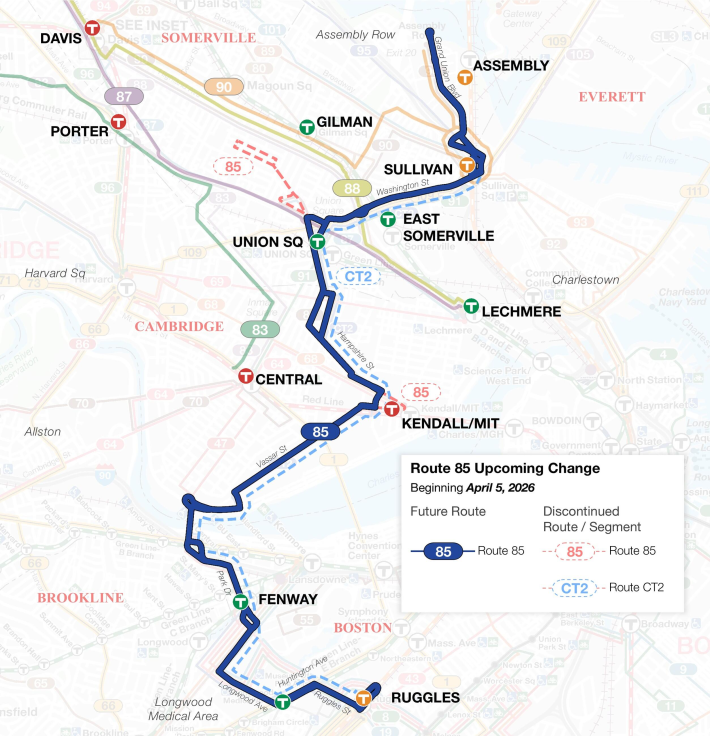
This consolidation was one of the recommendations of the T’s bus network redesign.
The new 85 bus route will follow the same route as the existing CT2, but will extend the route slightly along Somerville’s Grand Union Boulevard to add additional stops between Sullivan and Assembly (see map at left).
It will remain a weekday-only service, running from 5:30 a.m. to 8:30 p.m., every 15 to 25 minutes during peak commuting hours and every 30 to 45 minutes at other times.
Eliminated 40/50
In Hyde Park and Roslindale, the T will eliminate the combined Route 40/50 service, which runs on weekday and Saturday evenings plus during the day on Sundays.
In its place, the T says that it will extend service hours, including new Sunday service, on both Route 40 and Route 50.
Under the T’s bus network redesign plan, both the 40 and 50 were expected to add Sunday service, and their routes were to have been extended south to connect to the Readville regional rail station.
Route 87: More evening and Sunday service to Arlington Center
On the 87, which connects Arlington Center to Lechmere station via Davis Square and Union Square in Somerville, the T will extend all of the route’s trips to travel the full route, and end its practice of turning around some trips at Clarendon Hill near the Arlington-Somerville city line.
The current 87 ends its route at Clarendon Hill for trips before 6 a.m. and after 8 p.m. 6 days a week, plus all day on Sunday, so this change will add more evening, weekend, and late-night bus service to Arlington Center.
Route 350: More service to Burlington Mall Rd.
Similarly, the T will implement a simplified service pattern on the 350, which skips a route diversion to Burlington Mall Road for some trips. Starting in April, all 350 buses will serve the Burlington Mall loop, adding more service to that district.
The 350 runs every 30 minutes during peak hours and every hour at other times, from 6 a.m. to 11 p.m. Under the bus network redesign plan, the 350 is planned to be consolidated with the 80 bus route to create a one-seat bus ride from Burlington to Lechmere.
Bigger network changes will wait
Under the T’s original “bus network redesign” plans, the new bus network was going to be implemented in phases over the course of five years. Phase one introduced several new frequent-service bus routes to Everett, Chelsea, Malden, Revere, and East Boston at the end of 2024; phase two was expected to implement redesigned routes in the City of Boston in 2025.
The T did upgrade six of Boston’s busiest bus routes to the new “frequent-service” service standard last summer, while also adding later-night service on 13 bus routes, for a 3.4 percent increase in overall bus service.
Around the same time, the T began to signal that the timeline for implementing the new bus network would get longer, with smaller route changes happening on a quarterly basis.
The T is facing numerous headwinds in its efforts to increase bus service for the region. New bus garage projects, which are necessary to store and maintain a larger fleet of buses, have been delayed or postponed for lack of funding.
Meanwhile, increasing traffic congestion means that bus drivers and riders are wasting more time stuck in traffic – a problem that’s been exacerbated by Mayor Wu’s decision to eliminate or postpone implementation of several prominent bus lane projects in Boston’s most congested neighborhoods.
“The Bus Network Redesign is not on hold,” an MBTA spokesperson told StreetsblogMASS. “We are actively pursuing these expansions as fast as possible, which includes the ongoing deployment and training of new operators to prepare for future phases. Implementation relies on continued coordination with our municipal partners to build the necessary infrastructure, such as bus stops, lanes, and layover areas to enable these larger improvements.”
This story was revised at 8 p.m. Thursday Feb. 12 to add additional contextual information from the MBTA. A previous version reported that the T had not specified any service changes for the existing 40 or 50 routes, suggesting that those lines would lose their evening and Sunday bus service. The MBTA has since clarified that it intends to add evening and Sunday service on those routes. The story was also updated to add the MBTA’s statement in the last paragraph on the broader Bus Network Redesign phasing.
Streetsblog has migrated to a new comment system. New commenters can register directly in the comments section of any article. Returning commenters: your previous comments and display name have been preserved, but you'll need to reclaim your account by clicking "Forgot your password?" on the sign-in form, entering your email, and following the verification link to set a new password — this is required because passwords could not be carried over during the migration. For questions, contact tips@streetsblog.org.