In Amherst, Delivering Public Transit Is An Extracurricular Activity
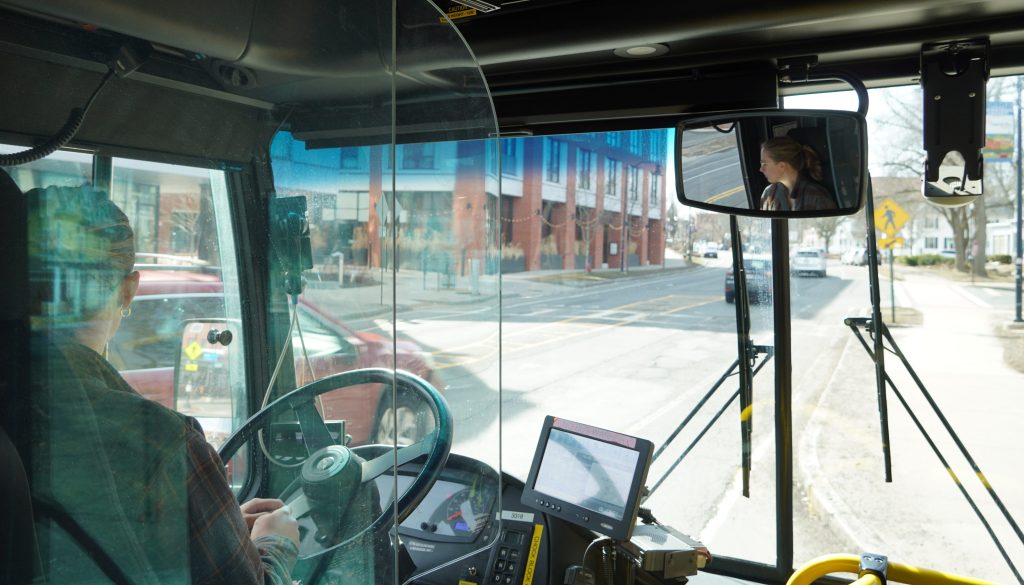
The Pioneer Valley Transit Authority’s Route 38 bus begins its southbound journey in the heart of UMass Amherst’s sprawling campus. It heaves and winds through verdant hill country, making stops at nearby schools and some roadside bus stops, before terminating at Mount Holyoke College, about 11 miles away, and looping its way back north.
Riders unfamiliar with transit operations in the Amherst area may have been surprised — perhaps a bit concerned, certainly intrigued — to find Ash Larner, a friendly, flannel-wearing 22-year-old with an arts degree, behind the wheel on a recent March afternoon.
“I’d drive around and see my professors get on my bus,” recalls Larner, a recent graduate who began driving as a student several years ago. “And I’d be like, ‘Hi! I’ll be in your class in 15!’”
Larner’s unorthodoxy is far from unusual at UMass Transit, the university service that runs and maintains most Amherst-area bus routes for the Pioneer Valley Transit Authority (PVTA) .
The bulk of the roughly 250-person operation — tasked with driving, dispatching, training, and so on — is staffed by current UMass students and recently-minted alumni, according to the school’s tallies. Many of the 13 full-time adult staffers on payroll first joined the institution as impressionable undergrads, earning their stripes behind the wheel.
UMass Amherst is among a nationwide cohort of universities that entrusts the late teens and early twenty-somethings in its classrooms with an integral part of campus life: getting around safely, efficiently, and — in UMass’ case — largely fare-free. Students at UC Davis, the University of Iowa, and the University of Georgia also drive buses through and around their campuses.
UMass Transit, in the school’s telling, traces its origins to a three-bus campus shuttle service created in 1969. The service grew and rebranded before the PVTA absorbed the operation following the regional transit authority’s creation in the mid-1970s (the PVTA did not return multiple requests to comment on this story).
Today, UMass Transit operates 10 fixed bus routes for the PVTA — some circulating through campus, some threading through downtown Amherst, some venturing into neighboring municipalities. Only the B79, which links the UMass campus to Worcester, requires a fare.
The organization has a fleet of 35 buses — including three New Flyer electrics and two sixty-foot bendy buses — to service these routes throughout the day. The buses clocked about three million total passenger trips in fiscal year 2025, according to the school.
UMass Transit’s central nervous system is housed in a complex of large, pale buildings at the northwestern edge of campus. The main hive of offices containing some program supervisors, the dispatch center, and a break room connects to a vast and expanding bus garage. Another building with more offices, meeting rooms, and garage space is located across the lot.
Though the complex possesses the trappings of a serious transit service, it’s also evident that the place is largely run by college kids, and it bears many of the markings of your typical student club.
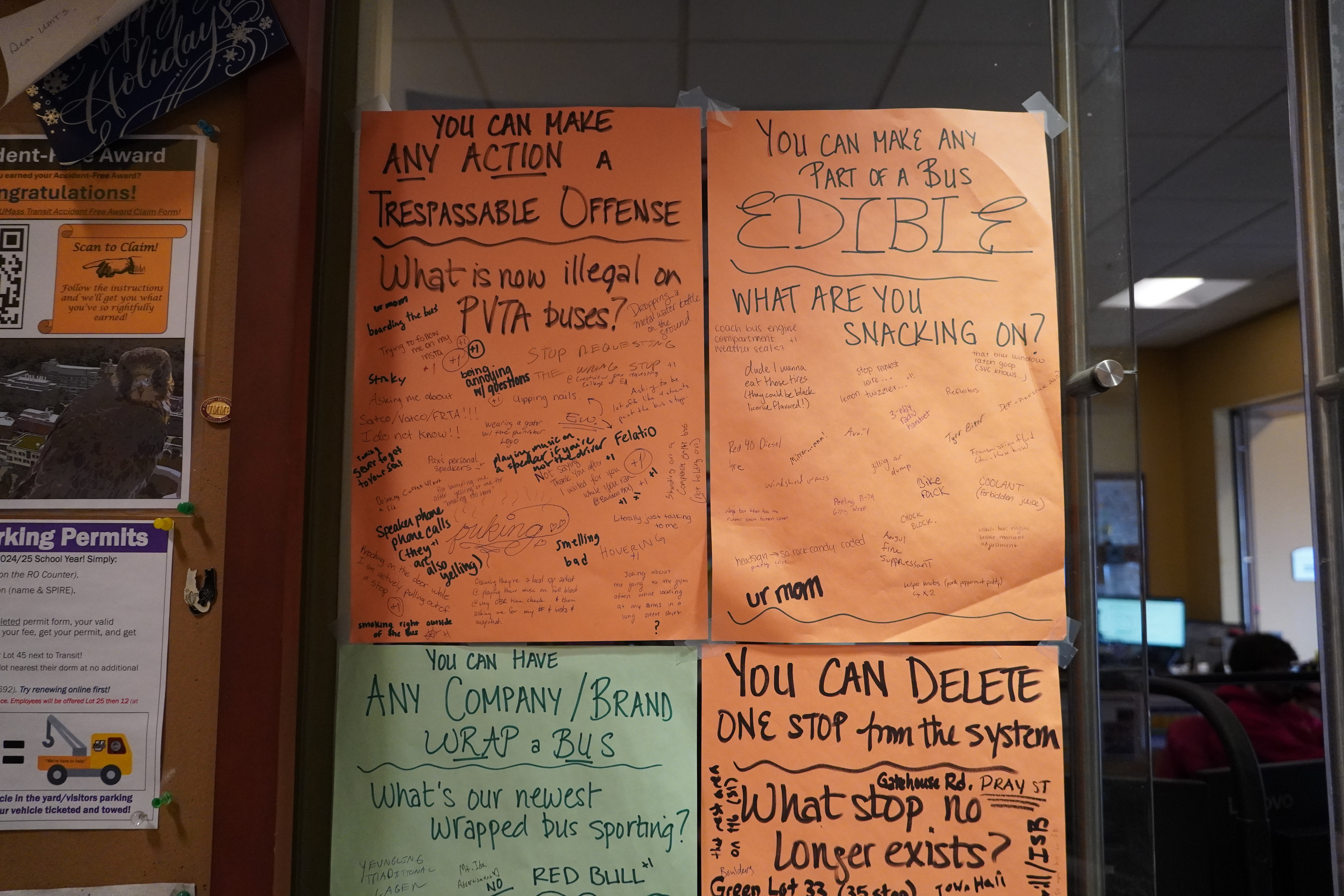
An orange paper taped to the window of the dispatch office asks employees what part of the bus they would snack on if it were edible. One anonymous respondent wrote the tires; another pined for the bike rack. One nonconformist scrawled “ur mom” in black marker.
Pay is a strong draw for prospective student workers; the starting wage for bus drivers is $21 per hour, an apparently impressive rate as campus jobs go at Amherst, multiple employees told StreetsblogMASS.
For others, getting hands-on experience in transit is also a realization of deeper passions and aspirations. Alexia Minkin, a supervisor for UMass Transit’s accessible van service, graduated from UMass Amherst last year with a specialization in disability studies. Cameron Smith, an undergrad working as a radio operator for the dispatch team, says he’s studying urban planning, in hopes of one day working in transportation.
“I’d love to just get my masters and go work at the MBTA or somewhere,” Smith said.
Plenty of UMass Transit alumni have landed full-time gigs at transit agencies. Jeffrey Gonneville, the former deputy general manager of the T (who now heads the public transportation bureau for the Connecticut Department of Transportation), drove UMass buses in the late nineties, according to his LinkedIn.
Jeffrey Donovan, the star of the TV drama Burn Notice, also ranks among the program’s more recognizable alumni, according to the actor’s Apple TV bio.
Time behind the wheel and good performance can lead to pay bumps and promotions to other roles in the organization, including jobs with the dispatch office and the service team.
Among the many service team duties mentioned to StreetsblogMASS: sweeping the garage, topping off vehicle fluids, checking tire pressure, painting office walls, and mounting TVs.
“There’s not one good word to describe it,” said assistant service manager and UMass graduate Dana Kurpaska, when asked to describe his team’s work. “Just do a lot of stuff.”
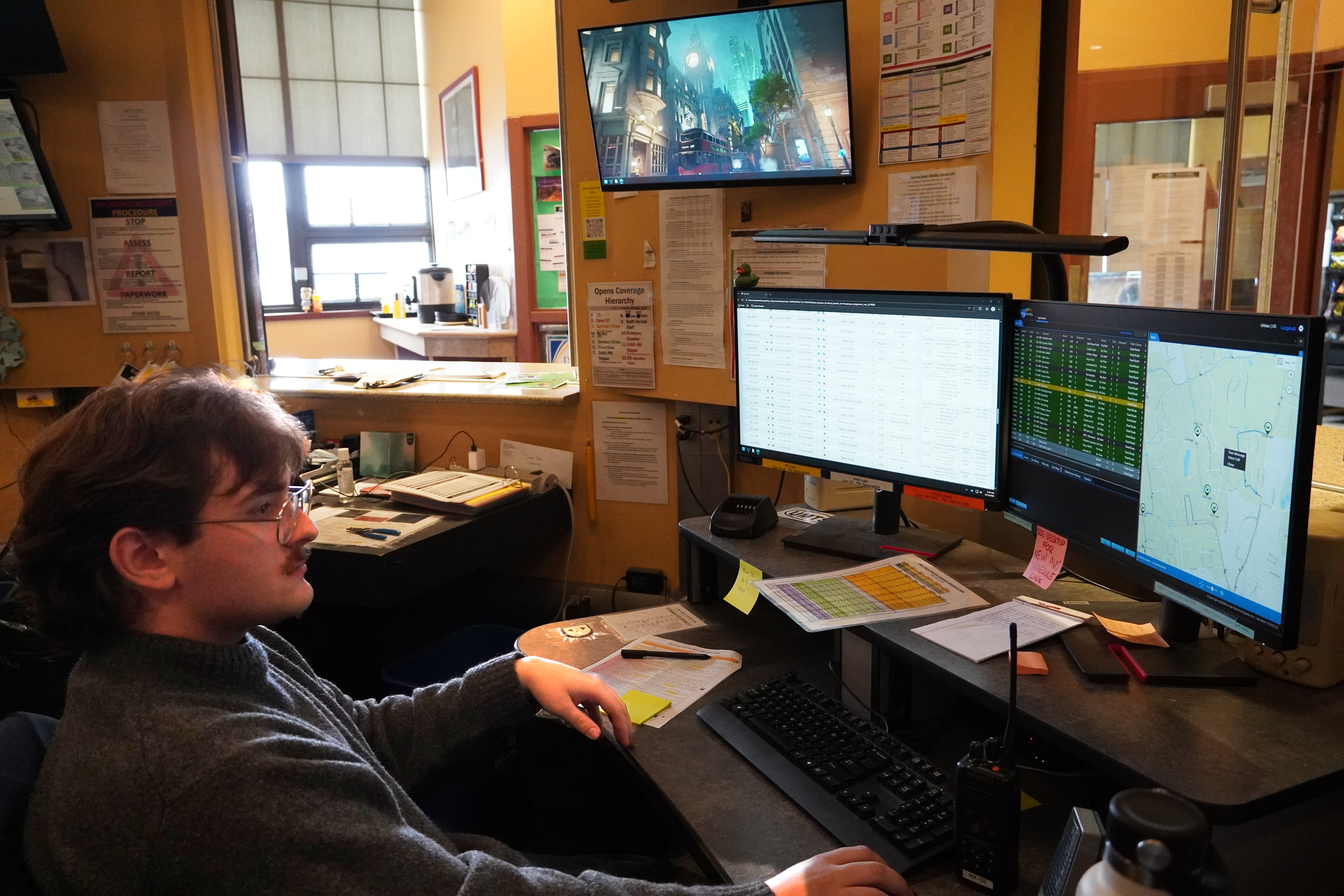
Meanwhile, the dispatch team keeps close tabs on the progression of service and helps drivers deal with any miscues on the road from an office with monitors and radios.
Driver training, said UMass Transit assistant director Jordan Tedoldi, is rigorous. Drivers must obtain a commercial driver’s license and pass route familiarization tests. But mistakes still happen.
“Don’t assume people know what they’re doing,” said Joe Ignacio, a recently-graduated history major with a mustache and aviator glasses working in the dispatch office.
It’s not uncommon for bus driving and related responsibilities to imbue college students with a sense of confident maturity, says Don Chapman, UMass Transit’s training and safety coordinator.
“People who couldn’t do their own laundry when they got here are now running this place — because they’re here, and that’s awesome,” said Chapman, standing in the doorway of his office.
Over the course of more than two decades at UMass Transit, Chapman, 62 with a friendly yet steady demeanor, reckons he’s interviewed thousands of driver candidates and coached countless students through their CDL exams. He says he began driving buses as an undergraduate in his thirties, around the turn of the century — and never left.
“I just keep making bus drivers, ad infinitum,” Chapman said.
Chapman says he has a fondness for recruiting outcasts.
“I like to hire the weirdest kids I can find,” he explained. “I think it’s good for them to be out on the road, and to be piloting this giant vehicle around and have the confidence to do that. And I think it’s good for the public to see that.”
In explaining his role and career, Chapman described the deep, almost parental gratification that arises when he watches new drivers hit their stride.
“They have that moment of: ‘I can do this,’ and they’re not scared anymore.” At that moment, he said, “they’re a bus driver.”

Read More:
Streetsblog has migrated to a new comment system. New commenters can register directly in the comments section of any article. Returning commenters: your previous comments and display name have been preserved, but you'll need to reclaim your account by clicking "Forgot your password?" on the sign-in form, entering your email, and following the verification link to set a new password — this is required because passwords could not be carried over during the migration. For questions, contact tips@streetsblog.org.