Even With $80 Tickets, MBTA Expects to Lose Money On World Cup Transit Service
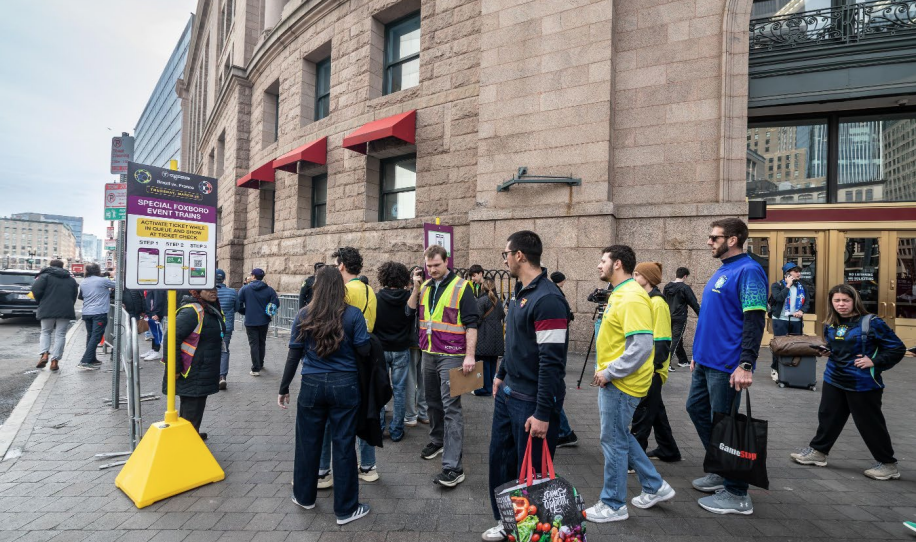
The MBTA’s plans to charge $80 for train rides between downtown Boston and Gillette Stadium for World Cup matches have prompted accusations of price gouging from international fan groups and soccer-obsessed locals.
But even at those prices, the T still expects to lose money on World Cup transit service, which is imposing massive and unusual logistical challenges for the agency.
And World Cup attendees won’t be the only ones paying: matchday trips to Gillette will suck up scarce rail resources, scrambling service across the rest of the commuter rail network.
On a typical weekday, fewer than a dozen trains travel from South Station to Foxboro, according to MBTA timetables.
Additional service between South Station and Gillette for special events isn’t new. The T often runs a handful of streamlined, roundtrip journeys between Boston, Providence, and Foxboro station for Patriots games, pro soccer matches, and some concerts — all for $20.
But the World Cup will be a much bigger undertaking.
For each of the seven World Cup matches set to be played at Gillette this summer, the T plans to run 14 express trains between South Station and Foxboro Station. The caravan will, in theory, accommodate up to 20,000 attendees for each game, just under a third of Gillette’s capacity.
A ticket on those trains will cost $80. All passengers — children, the elderly, and so on — must pay the full fare; there are no discounts.
Those tickets will also cover unlimited trips across the entire commuter rail network on matchdays, according to the T.
If the agency manages to sell 20,000 tickets for each of the 7 matches this summer, it would receive about $11.2 million in ticket revenue from World Cup spectators.
What it costs
But the T, by its own tallies, expects to spend over $35 million on its World Cup operations.
That bill doesn’t account for all of the hassles to riders caused by disruptions to the T’s regular commuter rail service.
Because the T doesn’t have 14 spare trains, the agency is revising its entire commuter rail schedule this summer and borrowing equipment from other lines to provide extra service to Foxboro.
That figure also doesn’t include another $35 million it’s spending on new station platforms at Foxboro station.
Here’s a breakdown of the T’s World Cup operating expenses, according to the agency:
| Expense Categories | Cost |
| Direct operations costs, bus bridges, planning, etc. | $17.9 million |
| Call centers | $0.2 million |
| Station wayfinding infrastructure | $7.5 million |
| Station attendants & ambassadors | $2 million |
| Safety & security | $7.8 million |
| Total | $35.5 million |
As of 8:30 a.m. on May 20, the T has sold 33,742 World Cup commuter rail tickets — about a third of the 100,000 tickets available for the first five matches at Gillette — for about $2.7 million in ticket revenue.
Congress, conscious of the financial stresses transit agencies will sustain during the tournament, set aside $100.3 million to help 11 host cities cover World Cup transit expenses. The government apportioned roughly $8.7 million for the T.
The T also received a slice of the roughly $46 million that the Federal Emergency Management Agency (FEMA) disbursed to Massachusetts for World Cup security expenses.
| Potential revenue sources | Expected revenue |
| Ticket sales (assuming sold-out trains) | $11.2 million |
| Federal transit subsidy | $8.7 million |
| Federal security funding | $3.3 million |
| Total | $23.2 million |
When asked about the MBTA’s losing money on its World Cup operations, an agency spokesperson told StreetsblogMASS that the T’s mission “is to provide access and mobility to the regions the MBTA serves, including for special events like the unique and historic opportunity that the World Cup offers.”
The spokesperson also noted that “neither the MBTA’s Operating Budget nor its CIP [the capital investment budget] are supported entirely by fare revenue, but rather by a variety of funding sources.”
Other agencies face similar economics
NJ Transit, the agency tasked with shuttling fans between New York City and MetLife Stadium, has also faced public blowback for the cost of its matchday rail tickets.
NJ Transit originally priced its roundtrip journeys between MetLife and Penn Station — about six miles apart — at $150. The agency, leaders explained, was spending $48 million on its World Cup operations.
A helping hand from private sponsors has helped bring down prices. Rail tickets to MetLife are now selling for $98.
Government officials in New Jersey (and elsewhere) have pilloried FIFA, soccer’s international governing body, for not doing enough to help localities manage the financial and planning challenges involved with hosting games.
Though FIFA expects to reap billions from the 2026 World Cup, the organization has left cities and their partners footing the bill for many operational costs, including transportation to and from match venues.
FIFA and Boston’s World Cup host committee did not return multiple requests for comment for this story.
This story was updated on May 29 to add details about the federal FEMA grant awarded to the MBTA to cover World Cup security costs.

Read More:
Streetsblog has migrated to a new comment system. New commenters can register directly in the comments section of any article. Returning commenters: your previous comments and display name have been preserved, but you'll need to reclaim your account by clicking "Forgot your password?" on the sign-in form, entering your email, and following the verification link to set a new password — this is required because passwords could not be carried over during the migration. For questions, contact tips@streetsblog.org.