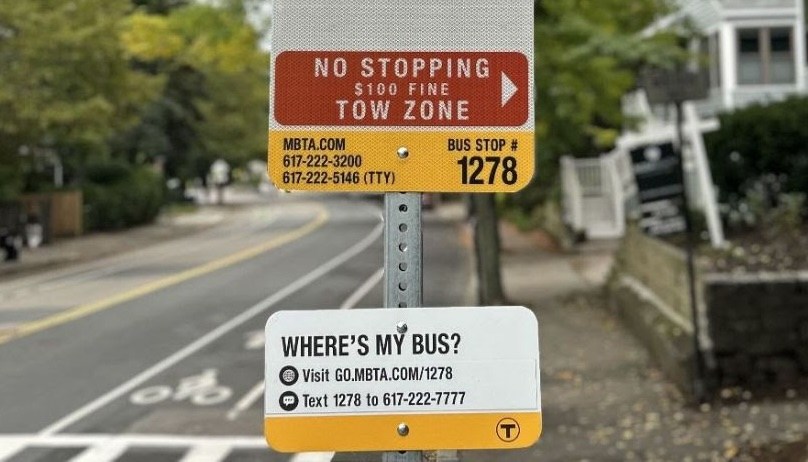
MBTA Adds More Bus, Subway Service With Winter Schedule Updates
The MBTA’s winter schedule updates will deliver a 3 percent increase in bus service and shorter waits between trains on three subway lines starting on Sunday, December 14th.

The T typically adjusts its public transit schedules four times a year, in response to budgetary constraints, worker availability, impacts from construction projects, and other factors.
This winter’s increases in transit service reflect years-long efforts at the T to staff up its workforce of bus drivers and fix decades’ worth of deferred maintenance problems in its the subway network.
Faster rails, more trains
On the MBTA’s “heavy rail” system – the Red, Orange, and Blue lines – the MBTA has added hundreds of additional daily trips since spring 2024, when dozens of slow zones still afflicted the subway system.
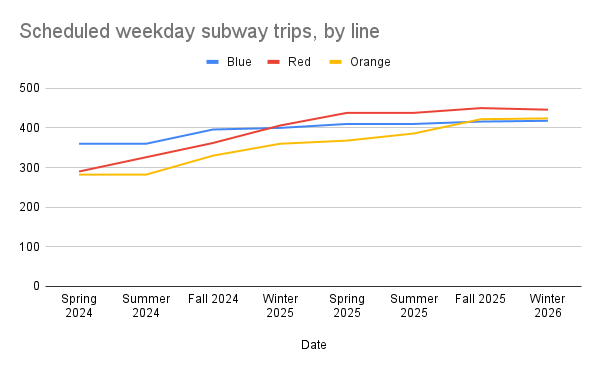
With subways operating at full speed for the first time in decades, every train can now complete more trips per day.
“As we have been able to recover runtimes, you can see how we were able to, over the course of a year and a half or so, drastically improve our rail service,” said Deirdre Habershaw, the MBTA’s Deputy Chief Operating Officer, at a November 20 MBTA board meeting.
Within the same period, the T has been able to retire some of its oldest subway cars – which suffered from frequent breakdowns and mechanical problems – with new trains from CRRC.
According to roster.transithistory.org, the T now owns 148 new Orange Line cars, with just 4 remaining to be delivered from CRRC’s Springfield factory.
The T also now has 48 new CRRC Red Line cars, with two to four additional cars arriving from Springfield each month.
The new trains are replacing the Red Line’s oldest trains, some of which date to the Nixon administration.
“On the Red Line, we continue to see improvements in reliability as we accept new Red Line trains into service… the CRRC cars are outperforming, and we have better resiliency with that fleet,” said Habershaw.
In the MBTA’s original 2014 contract with CRRC, the order of 152 new Orange Line train cars was supposed to have been finished by January 2022, and all 252 new Red Line cars were due by September 2023.
Closing in on pre-pandemic levels of bus service
MBTA also continues to make progress on filling long-vacant positions in its bus operator workforce.
As of November 5th, the agency had 1,740 active bus operators – 81 more than it had at the end of June, according to an MBTA spokesperson. An additional 105 new bus operators were in training programs
With more drivers available, the winter 2026 schedule plans to add 1,426 weekly service-hours for the MBTA’s bus routes – 3 percent more bus service than it offers in the current fall 2025 schedule.
That’s roughly equivalent to putting 10 more buses on the region’s streets for 20 hours a day, 7 days a week.
The new bus schedule will offer a cumulative total of 49,009 hours of bus service per week. That represents 99.4 percent of the T’s fall 2019 level of bus service, before the Covid-19 pandemic cut into transit ridership and the T’s workforce.
Upgrades to key bus routes
The T will add incrementally more bus service on the 32 (Forest Hills to Hyde Park), the 39 (Forest Hills to Back Bay), the 57 (Kenmore to Watertown), the 66 (Longwood to Harvard), 71 (Watertown to Harvard), 73 (Belmont to Harvard), 77 (Arlington to Harvard), and the Silver Line’s 1, 3, and 5 routes to bring them all up to the T’s new “frequent-service” standard.
“Frequent-service” bus routes feature buses that arrive every 15 minutes or better from 5 a.m. to 1 a.m. Monday through Saturday, and from 6 a.m. to 1 a.m. on Sundays.
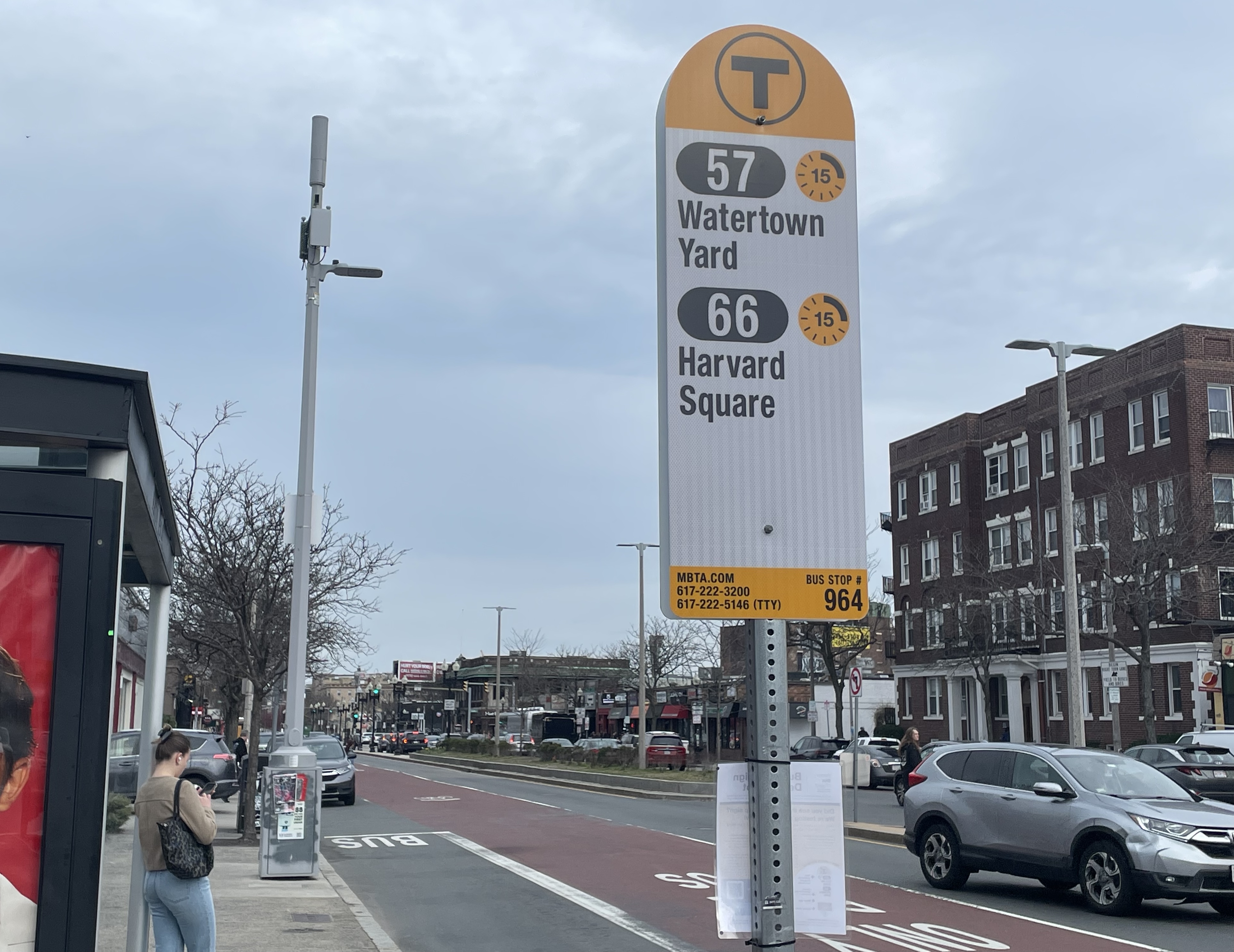
Most of these routes were already close to meeting that standard, and had already been identified as frequent-service bus routes at bus stop signs and on the T’s official map.
“Some key routes are further from the (frequent-service) standard than others, and will require more added service to run buses every 15 minutes or better. Other routes are very close to the standard, and don’t need much added service,” an MBTA spokesperson explained.
Increasing traffic congestion is also forcing bus drivers to waste more time in traffic, which means that a 3 percent increase in the number of service hours will likely not produce a 3 percent increase in the number of buses that actually show up at bus stops.

Streetsblog has migrated to a new comment system. New commenters can register directly in the comments section of any article. Returning commenters: your previous comments and display name have been preserved, but you'll need to reclaim your account by clicking "Forgot your password?" on the sign-in form, entering your email, and following the verification link to set a new password — this is required because passwords could not be carried over during the migration. For questions, contact tips@streetsblog.org.