See MassDOT’s Plans for a New Highway Interchange on the Cambridge Riverfront

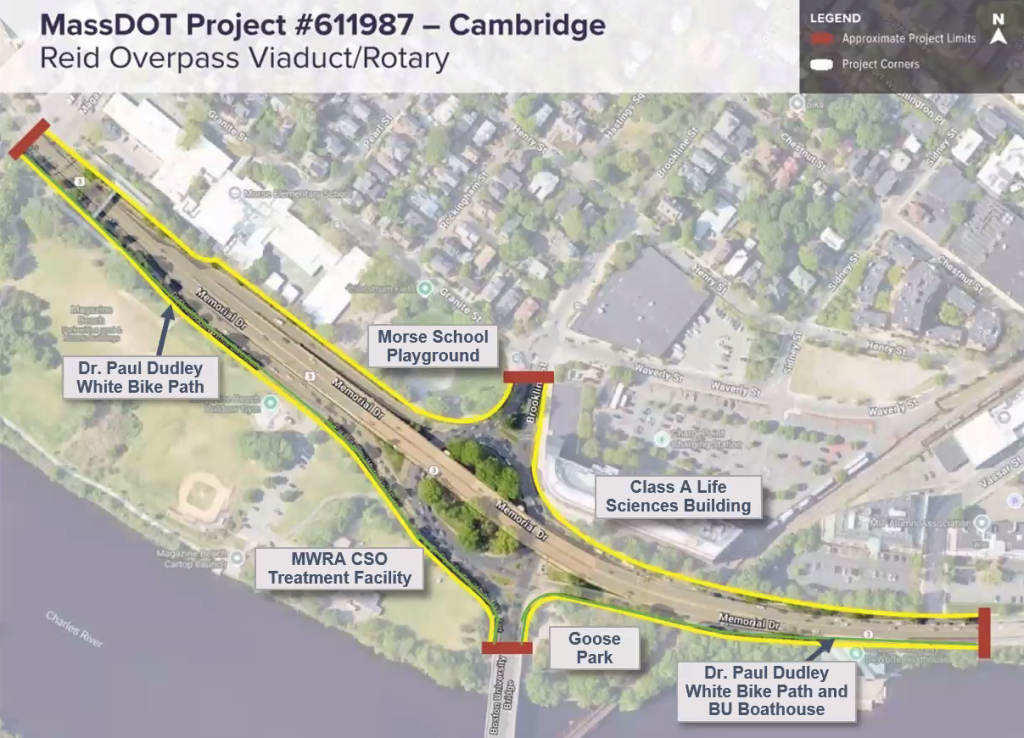
On Tuesday night, MassDOT hosted a virtual public meeting to unveil their six competing designs for replacing the crumbling William Reid Overpass, located near the B.U. Bridge on the Cambridge side of the Charles River.
“The goal of the project is to create a safer, more efficient, and modernized transportation solution that meets both current and future mobility needs,” MassDOT project manager Joshua Bartus said.
This project will involve several agencies, including the City of Cambridge, which controls the local streets connecting to Memorial Drive, the Department of Conservation and Recreation (DCR), which controls most of Memorial Drive and the surrounding parklands, and MassDOT, which owns the bridges in the area, and will serve as the project lead.
An ‘outdated’ overpass
The Reid Overpass and the traffic circle around its base were originally built in 1940, a time with lower traffic volumes and fewer roadway standards.
“The overall geometry remains outdated and no longer reflects current best practices for safety, efficiency, or multimodal access,” said Anthony Timperio of engineering consultant company Benesch.
A state inspection in 2021 found that the bridge structure is now in poor condition.
The existing rotary and viaduct are deteriorated, outdated, and geometrically inefficient. Removal or reconstruction is required to meet modern design standards and long-term transportation needs.”
MassDOT project manager Joshua Bartus
Just east of the rotary lies another bridge, which was built in 1906, that carries Memorial Drive over the Grand Junction Railroad. This railroad bridge has also undergone a series of repairs, and is slated to be replaced in the same project.
MassDOT met with the City of Cambridge and DCR in coordination meetings in November 2025, completed a traffic count program (that included pedestrians and bicycles), and completed preliminary structures reports for both the Reid Overpass and the Grand Junction Railroad Bridge. MassDOT also briefed the Cambridgeport Neighborhood Association at a meeting in October 2024.
Next, the team will engage in a more detailed evaluation and analysis phase to determine whether each concept aligns with the overall project goals, prioritizing functionality, community values, and long-term viability.
MassDOT’s alternatives
MassDOT, DCR, and the Federal Highway Administration, as the project owners, examined six screen alternatives, falling into either “Approach A: At-Grade Alternatives” (roads or paths cross at the same level) or “Approach B: Grade-Separated Alternatives” (one route goes over or under another).
After a preliminary evaluation, MassDOT has selected four possible designs for more detailed analysis: the partial displaced left turn (Alternative A3), the grade-separated single-point intersection (Alternative B1), the grade-separated multi-lane roundabout (Alternative B2), and the grade-separated tight diamond intersection (Alternative B3).
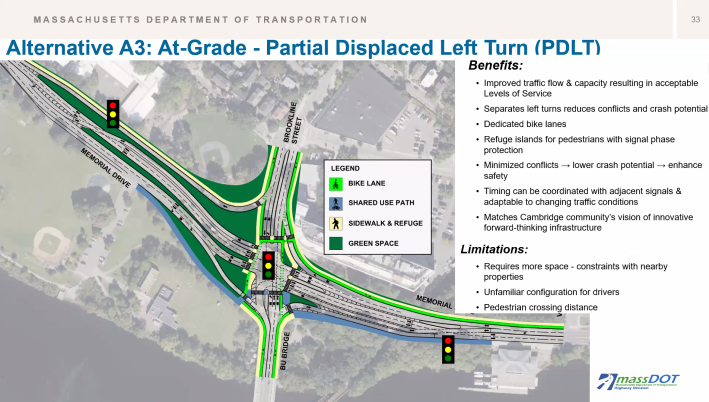
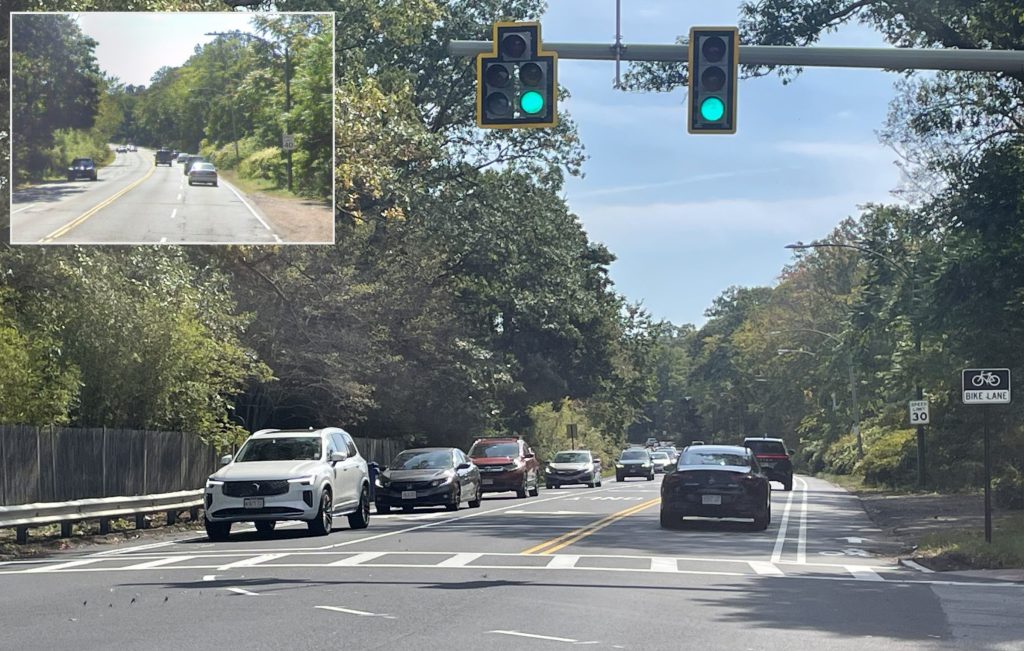
Alternative A3, the partial displaced left turn, or the PDLT, would add two new traffic lights a few hundred feet on either side of Brookline Street to separate left-turning traffic out of the way from the main intersection at the end of the B.U. Bridge.
MassDOT claims that this intersection design would allow for a more streamlined, safer flow of traffic compared to traditional left-turn operations, and be better equipped for high-volume intersections with heavy turning movements. According to MassDOT, this alternative would increase intersection capacity, improve multimodal access, and improve signal timing, while also avoiding the costs of a new bridge.
However, some drawbacks of this design are its right-of-way requirements – the proposal would widen Memorial Drive with 6 to 7 lanes – and a potentially confusing design where left-turning drivers would drive on the left side of Memorial Drive as they approach the B.U. Bridge intersection.
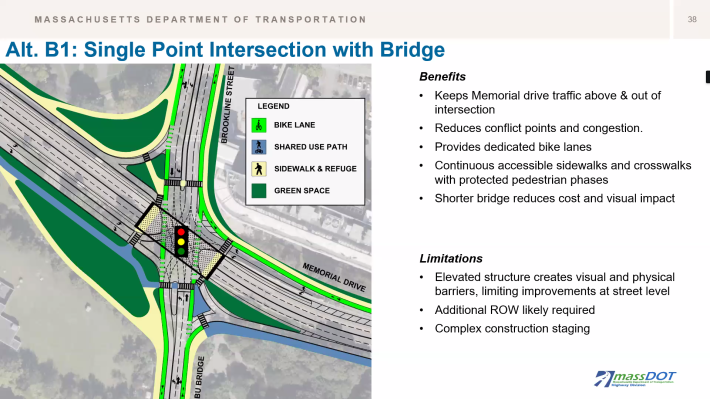
Alternative B1, the grade-separated single-point intersection, would build a new highway overpass for Memorial Drive over the Brookline Street/B.U. Bridge intersection. The new overpass would be shorter than the current Reid Overpass, roughly 150 feet.
Without direct interaction between Memorial Drive with the cross streets below, through traffic on Memorial Drive would flow freely while Brookline Street and the B.U. Bridge would connect to on- and off-ramps in a signalized intersection below.
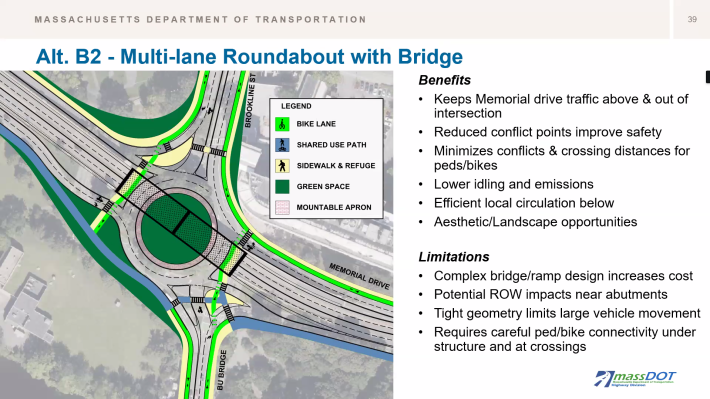
Alternative B2, the grade-separated multi-lane roundabout, would also construct a new highway overpass for Memorial Drive, with on- and off-ramp traffic that connects to the B.U. Bridge and Brookline Street in a large multi-lane roundabout instead of a traffic signal.
MassDOT notes that this plan would have a large footprint and could create some right-of-way challenges.
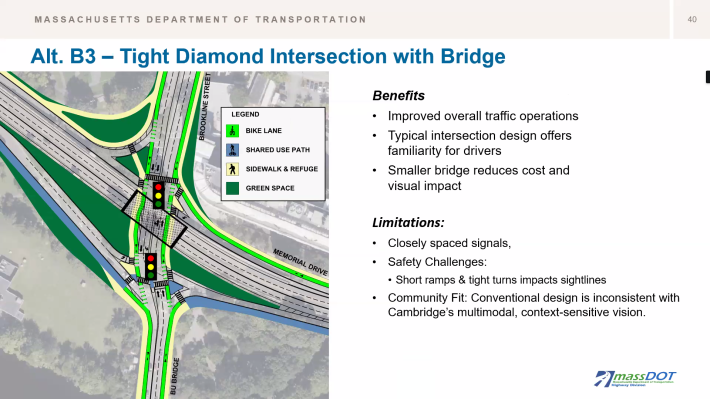
Alternative B3, the grade-separated tight diamond intersection proposal, features a smaller new Memorial Drive highway overpass elevated above two closely-spaced intersections with traffic lights.
The limitations of this plan include restricted sight lines, tight turns, and traffic queues at the lights.
MassDOT also acknowledges that it is a “conventional” highway design that doesn’t necessarily align with the region’s goals for the area.
What’s next
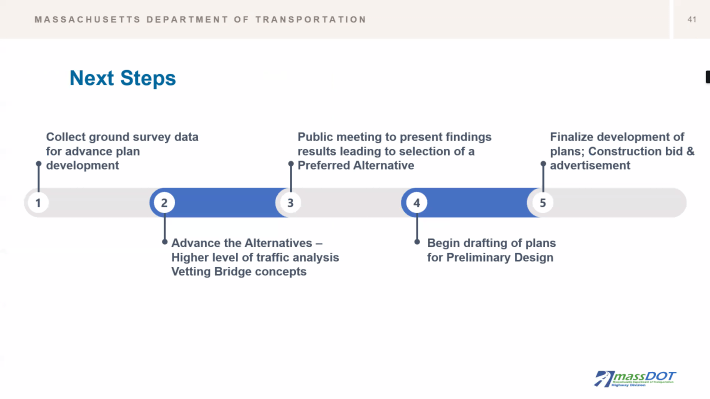
In the coming phases of the work, the project team will advance geometrics, perform high-level traffic analysis, further review bridge concepts, and propose a preferred alternative for public review. Once that is agreed, the work could move into preliminary and final design stages, and ultimately, construction.
After MassDOT’s presentation, members of the public had a chance to sound off on the proposals.
Meeting attendees expressed a strong emphasis on a few themes: protecting bikes and pedestrians from high-speed traffic, transit reliability, and reducing the size of the roadway.
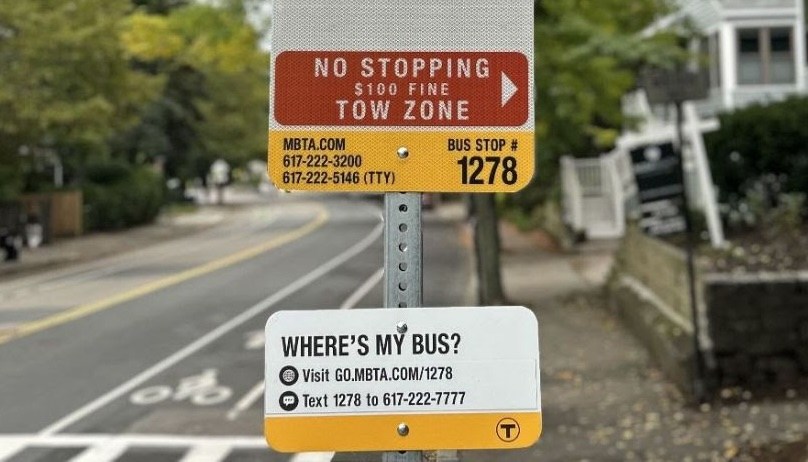
State Representative Mike Connolly, whose district is located a few blocks away from the intersection, noted that the area today is a barrier to environmental justice that impedes access between Cambridgeport and the Boston side of the river. He urged officials to prioritize riders of the 47 MBTA bus route on Brookline Street.
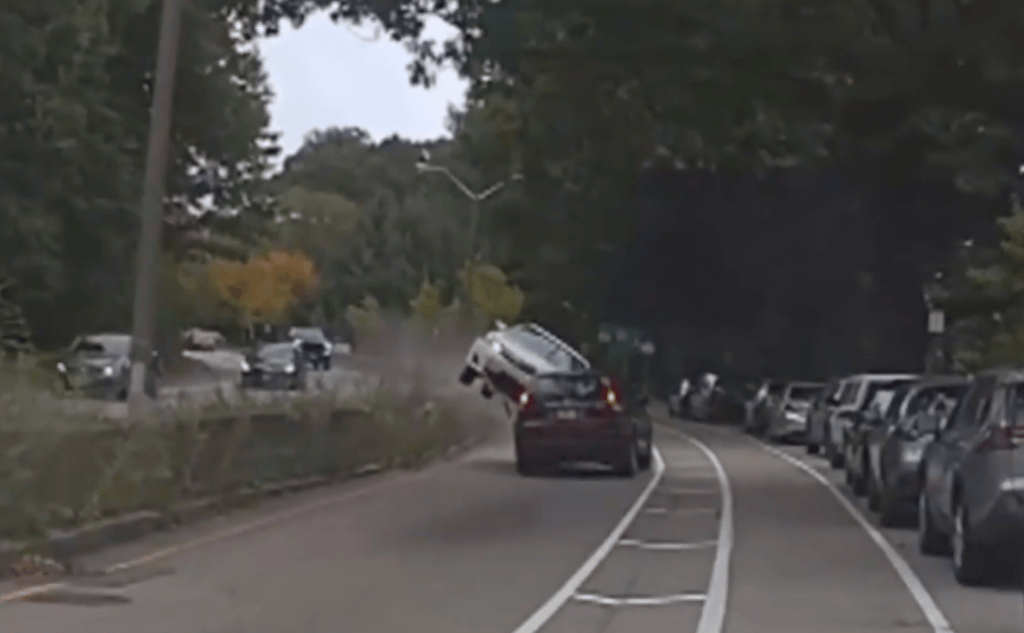
Citing last year’s killing of John Corcoran at this intersection, Connolly also urged MassDOT to improve safety and reduce vehicle speeds.
Wendy Landman, a former executive director of WalkBoston (now known as WalkMassachusetts), expressed her concerns about the unsignalized right-turn lanes in most of MassDOT’s proposals.
Designing intersections that let drivers move through a crowded intersection without stopping creates a “risky situation for pedestrians, especially when there’s heavy traffic,” warned Landman.
“I’m nervous that simply putting yield signs is not adequate, particularly when there’s a lot of traffic,” Landman said. “We’ve finally gotten some actual stoplights in this intersection, which makes it safer for pedestrians to cross, so I think it’s not moving forward to remove those.”
Others urged MassDOT to scale down the size of their proposals to improve safety and reduce costs.
Meeting participant Ned Codd advocated for a two-lane overpass rather than a four-lane one, as well as a single-point intersection, to “reduce the [roadway] footprint, reduce cost, and make Memorial Drive feel more like a parkway.”
For more information on this project, you can submit a comment to Carrie Lavallee, the Chief Engineer at 10 Park Plaza Boston, MA 02116 referencing “Major Projects, Project File number 611987”, or email cambridgereidoverpass@dot.state.ma.us.
MassDOT will also soon be launching a project website to host relevant resources and project updates.
Streetsblog has migrated to a new comment system. New commenters can register directly in the comments section of any article. Returning commenters: your previous comments and display name have been preserved, but you'll need to reclaim your account by clicking "Forgot your password?" on the sign-in form, entering your email, and following the verification link to set a new password — this is required because passwords could not be carried over during the migration. For questions, contact tips@streetsblog.org.