MBTA Teaming Up With Maryland to Procure New Battery-Electric Locomotives
The MBTA and the Maryland Transit Administration have issued a joint “request for proposals” to procure at least 25 new locomotives, more than half of which would operate on electric power from existing overhead wires on the MBTA’s Providence Line and the MARC Penn Line.
The procurement seeks 10 new battery-electric train engines that would run on the Providence Line, which already has overhead power lines for Amtrak’s electric Northeast Corridor trains.
The bid documents also propose options for the T to add up to 50 additional train engines – either powered by batteries or by diesel engines – to its order in the future.
“This is a major step forward for riders and for the future of the MBTA,” said Governor Maura Healey in a press release issued Wednesday afternoon. “Battery-electric trains mean quicker trips, quieter trains, and more reliable service… By investing in modern equipment now, we are improving the rider experience and building a transportation system that supports our workforce and our economy.”
Under the same procurement, Maryland would obtain an additional 5 battery-electric train engines on the same contract to run on the Penn Line, which is also part of Amtrak’s electrified Northeast Corridor.
Those engines would replace MARC’s existing HHP-8 electric locomotives, which are about 26 years old.
The MBTA currently runs diesel-powered trains on the Providence Line because it does not own any locomotives capable of tapping into its overhead power lines.
The MBTA’s new procurement also seeks another 10 new diesel-powered locomotives for the T to run on other regional rail lines where electric power infrastructure doesn’t yet exist.
Unlike many of its current locomotives, these new trains would be required to adhere to the Environmental Protection Agency’s stricter “Tier 4” smokestack emissions standards.
Advocates press for “multiple unit” technology
Technical specifications in the procurement documents describe how the new locomotives should be designed to pull the MBTA’s existing bi-level coaches, “with a locomotive at one or both ends” of each train.
Advocates from TransitMatters are encouraging the T to consider instead faster “electric multiple unit” (EMU) trains, where electric motors are incorporated on each car of the train.
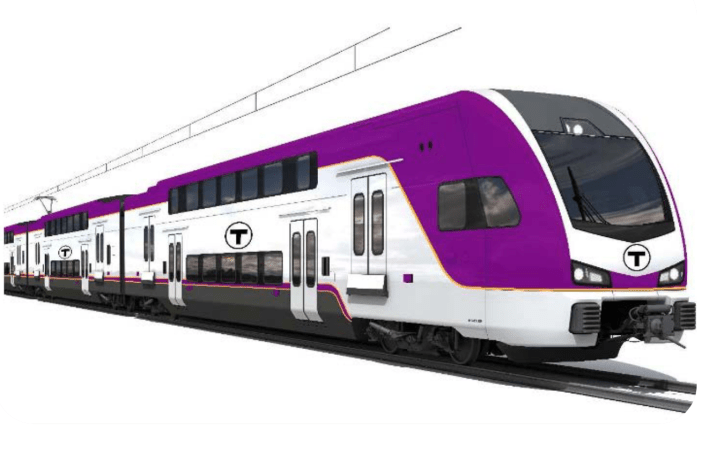
“Electric multiple units (EMUs), which can accelerate much faster than locomotive-hauled trains, are the gold standard around the world for regional rail systems, and are the best way to guarantee faster trips and improve service for riders,” argues Janet Cheung, the regional rail lead for TransitMatters.
Caltrain in the San Francisco Bay area debuted new EMU trains in 2024. The new trains reduced the trip time between San Francisco and San Jose by 24 minutes, which helped increase the line’s ridership by 57 percent in 2025.
The T is also reportedly pursuing battery-powered electric multiple units (BEMU) for the Fairmount Line.
Michael Muller, the Executive Director of Commuter Rail, told MBTA board members on Thursday that “we’re taking a phased approach to fleet replacement, and exploring different vehicle types depending on the availability of electrification infrastructure… There are some lines that would be best served by BEMUs, and BEMU options are also part of our fleet planning, along with different types of locomotives.”
The T’s need for new trains
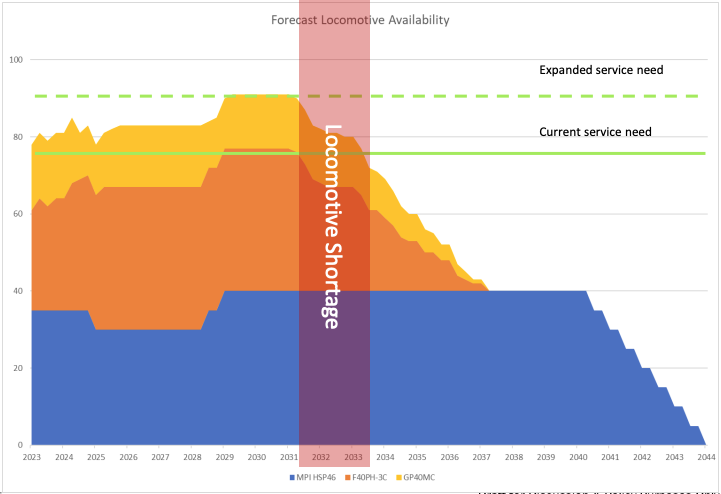
MBTA staff have recently been sounding the alarm about the aging locomotives in its commuter rail system. Some of the agency’s train engines were originally manufactured in the late 1970s.
As its older trains become less reliable, a lack of available engines could be a limiting factor in the T’s plans to improve regional rail service.
Those locomotives are a noxious source of air pollution along the T’s commuter rail lines. In 2010, the U.S. Department of Justice fined the T for excessive train pollution after finding that “a reduction in commuter locomotive idling by even one hour per day per locomotive, together with (a) fuel switch and new engines, could result in yearly carbon dioxide emission reductions of an estimated 800 tons… carbon monoxide reductions of about 80 tons, particulate reductions of 23 tons, and sulfur dioxide reductions of 1-2 tons.”
The T recently authorized a $253 million contract to overhaul 40 of its newest diesel locomotives to keep them operating through the 2030s (those locomotives are represented by the blue area in the chart above).
Electrifying the regional rail system
In 2019, the MBTA’s former governing board endorsed a plan to replace its slower, less reliable diesel trains with new electric trains capable of providing rapid-transit-style service throughout eastern Massachusetts.
The plan recommended that the T to upgrade electrical infrastructure and build new overhead wires along other rail lines in order to power a new fleet of electric trains. But to date, the T hasn’t actually built any of the overhead wires that would be necessary to power electric trains.
Instead, in 2024, Governor Healey announced a plan to electrify the T’s shortest commuter rail line, the Fairmount Line, with new battery-powered trains that would recharge themselves at South Station and at Readville, where they could plug into the Northeast Corridor’s existing power infrastructure.
Over a year ago, Keolis, the private company that operates the MBTA’s commuter rail system, issued a “request for proposals” (RFP) for new battery-electric trains to run on the Fairmount Line by 2028.
There have been no public updates on that project for more than a year. The T has argued that, as a private company, Keolis is not required to disclose its technical requirements or results of its procurement.
The public procurement documents released Wednesday suggest that the T is also considering using new battery-powered trains on some of the un-wired branches that connect to the Providence Line.
The RFP asks potential bidders to provide “technical preliminary simulations of the capability of the battery-catenary locomotive” on the Providence, Needham, and Franklin Lines.
Battery-equipped trains on those lines could theoretically draw power from their batteries for the outer parts of their journeys, then recharge themselves from catenary when they rejoin the Northeast Corridor in Boston.
The Needham Line runs on un-electrified tracks for about 8.6 miles between Needham Heights and Forest Hills station, then proceeds on the electrified Providence Line/Northeast Corridor for 5 more miles to South Station. The Franklin Line runs about 21 miles before rejoining the Northeast Corridor at Readville station.
However, until it installs new electric power infrastructure on other lines, the T will still need to rely on diesel trains elsewhere in its regional rail network.
This story was updated at 1:30 p.m. on Thursday Feb. 26 to add quotes from Janet Cheung of TransitMatters and Mike Muller of the MBTA.
This story was corrected at 11:45 a.m. on Thurs. Feb. 26 to clarify the emissions impacts of diesel trains in the 19th paragraph. A previous version inaccurately implied that diesel trains produced 800 tons of carbon dioxide pollution per hour.

Read More:
Streetsblog has migrated to a new comment system. New commenters can register directly in the comments section of any article. Returning commenters: your previous comments and display name have been preserved, but you'll need to reclaim your account by clicking "Forgot your password?" on the sign-in form, entering your email, and following the verification link to set a new password — this is required because passwords could not be carried over during the migration. For questions, contact tips@streetsblog.org.