MBTA Board Greenlights Quarter-Billion Dollar Contract for Diesel Trains
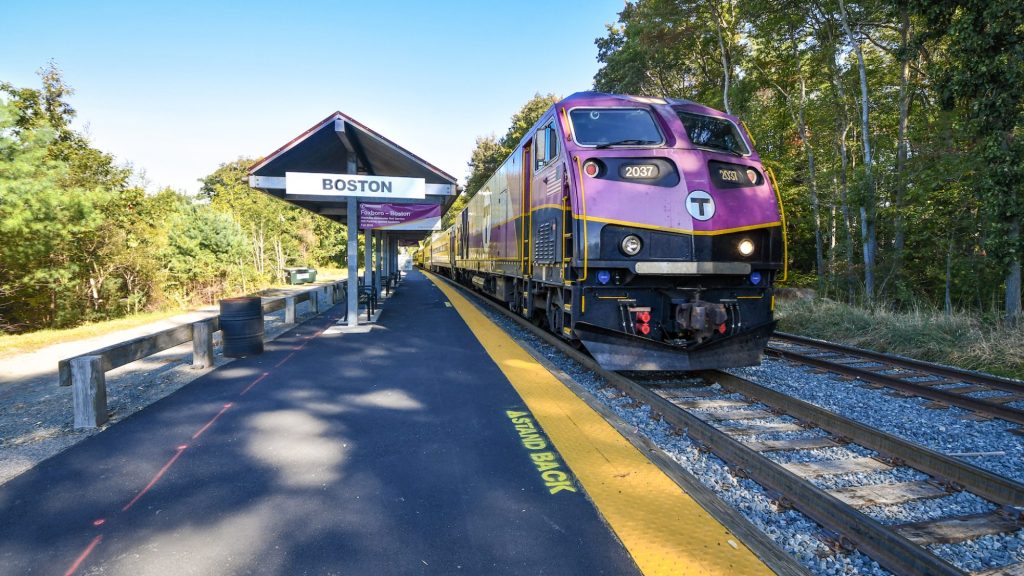
In another troubling sign for the Commonwealth’s goals to wean itself from fossil fuels, the MBTA Board of Directors in December authorized a $253 million contract to overhaul 40 diesel locomotives and keep them operating through the 2030s.
The overhaul will refurbish the “HSP-46” locomotives that first entered service in 2014, and are recognizable by their curved front end (see photo above).
Those engines are the newest locomotives in the MBTA’s commuter rail fleet; the T also owns another 69 older locomotives, some of which date to the early 1970s.
Over six years ago, the MBTA’s former governing board endorsed a plan to phase out diesel trains with new electric trains capable of providing faster, more reliable, rapid-transit-style service throughout eastern Massachusetts.
In 2024, Governor Healey announced a tentative step towards that goal with plans to electrify the T’s shortest commuter rail line, the Fairmount Line, with new battery-electric trains that would serve each stop every 20 minutes by the end of 2027.
Those new electric trains would replace diesel trains on the Fairmount Line, which currently uses three trains on a typical weekday.
But an MBTA spokesperson told StreetsblogMASS that “decarbonizing the Fairmount Line Commuter Rail Line does not reduce the need for diesel locomotives in the near term.”
“We’re looking at the future of battery-hybrid locomotives, but that’s not here, now,” said William Wolfgang, the T’s director of vehicle engineering, at the December 18 board meeting. “And we have this problem here and now, where if this was to be pushed off for, say, five years, then out of the 40 (locomotives), I can tell you that probably 10 are going to be parked because they can no longer perform, service will continue to degrade.”
Caitlin Allen-Connelly is the executive director of TransitMatters, the Boston-based transit advocacy group that’s been advocating for the T to switch to faster, more reliable electric trains since 2018.
“For us, this needs to be the last purchase at the T for diesel technology if the T is serious about moving forward with modernizing regional rail to a faster, more frequent and cleaner service,” Allen-Connelly told StreetsblogMASS. “We need to start investing in the projects that will improve service and improve people’s commutes, and that means electrification.”
Allen-Connelly notes that Caltrain recently electrified most of its single-line commuter rail system with trains that draw power from overhead wires instead of from on-board batteries.
Caltrain ridership subsequently increased by nearly 50 percent thanks to faster trains, increased capacity, and more frequent service.

Read More:
Streetsblog has migrated to a new comment system. New commenters can register directly in the comments section of any article. Returning commenters: your previous comments and display name have been preserved, but you'll need to reclaim your account by clicking "Forgot your password?" on the sign-in form, entering your email, and following the verification link to set a new password — this is required because passwords could not be carried over during the migration. For questions, contact tips@streetsblog.org.