Another Year, Another Budget Gap: Gov. Healey Still Needs A Long-Term Solution for Funding the T
The MBTA’s Chief Finance Officer and transit advocates are in agreement: the T will need a major, sustained infusion of state funds within the next two years to avoid major service cuts, and the higher-than-expected “Fair Share” transportation funding that rescued the T’s budget last year won’t be enough.
Last week, the T’s budget chief, Mary Ann O’Hara, delivered her first budget presentation of the year to the MBTA’s Board of Directors.
O’Hara revealed that the T expects to end the current fiscal year (ending June 30th) with a $239 million deficit, which it will cover with its reserve funds.
Worse, that deficit is expected to bloat to $648 million next year, and $837 million by 2028, barring any major changes to state budget policies.
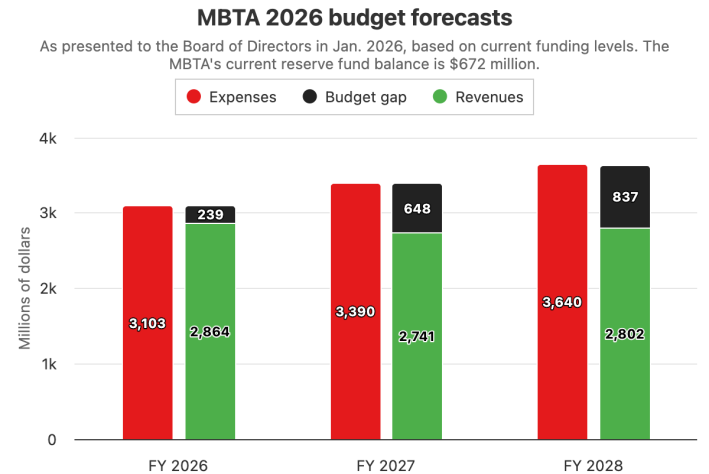
Those shortfalls would wipe out the remainder of the T’s reserves sometime next year, and force the agency to plan for major service cuts unless state lawmakers come up with new sources of funds.
On Wednesday, Transportation for Massachusetts (T4MA), a statewide coalition of transportation advocacy groups, issued a joint report with MassBudget that came to similar conclusions.
“The Commonwealth will not be able to count on stepped-up federal support, and we are not dedicating sufficient resources to meet the transportation challenges ahead,” the organizations warn.
Fair Share, tapped out
Last year, when the T faced a budget deficit of roughly $700 million, Governor Healey was able to tap unspent “Fair Share” revenues from the state’s new, higher tax rate on household incomes over $1 million.
The higher Fair Share income tax rate took effect near the end of fiscal year 2023. For the first couple years of its existence, state budget planners dramatically under-estimated how much money they would collect from it.
This year’s forecast of $2.7 billion from Fair Share revenue is much closer to actual tax collections from the past couple of years. But it’s considerably less than the $3.7 billion in Fair Share funding that lawmakers had at their disposal for last year’s budget:
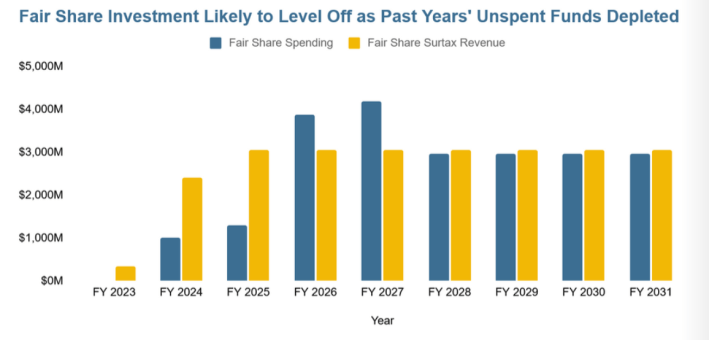
“The high level of Fair Share spending in FY2026 (was) the result of unspent, previously-collected funds from prior years that exceeded projections, (and) is highly unlikely to be fully sustained,” warn MassBudget and T4MA.
An incomplete task
The T’s budget writers have been warning about a structural budget deficit for years. What was once supposed to be the T’s main source of state funding – a dedicated one-cent carve-out from the state’s sales taxes – hasn’t kept pace with inflation.
Meanwhile, the T’s payroll expenses have grown considerably in recent years as the agency tries to repair and recover from the disastrous era of disinvestment and safety failures during Governor Charlie Baker’s administration.
At the beginning of 2024, Governor Healey convened a statewide task force to consider “long-term transportation funding needs” and come up with “a comprehensive transportation finance plan” for the MBTA, MassDOT, and regional transit authorities.
But the task force’s final report, published last January, wasn’t comprehensive.
The final report mostly focused on a short-term fix, using the Fair Share windfall to “stabilize” the T’s finances through mid-2026. The group shied away from making any specific recommendations for additional revenue to fix the agency’s longer-term budget shortfall.
Tolls, taxes, and fees due for an update
The task force did, however, make some cogent observations about gas taxes, highway tolls, and vehicle registration fees in Massachusetts.
Their report noted that gas taxes, passenger vehicle registration fees, and per-mile toll rates here are all considerably lower than in other states, and haven’t been adjusted to account for inflation in over a decade.
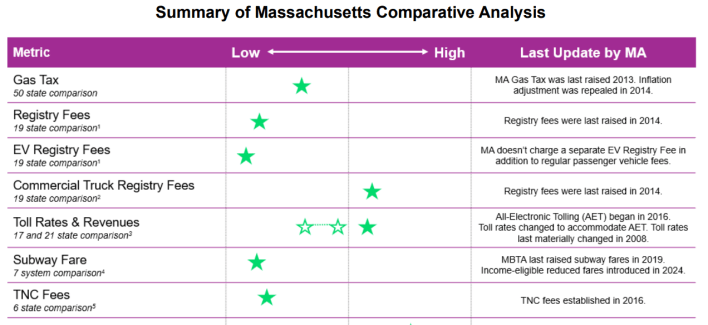
In their new funding report, T4Mass and MassBudget argue that “there is no shortage of solutions. The issue is more of political will.”
Those organizations noted that Governor Healey could, without any legislative action necessary, adjust highway tolls and Registry of Motor Vehicle fees to account for inflation and raise a considerable amount of new revenue.
Advocates also continue to press lawmakers to look at congestion pricing, especially now that the policy has proven itself as a massive success in neighboring New York (one that’s generating $550 million each year for transit improvements, like a new subway line in Harlem).
Under the state Constitution, Governor Healey has to submit a budget bill to the State House by the 4th Wednesday of the month (which falls on the 28th this year).

Read More:
Streetsblog has migrated to a new comment system. New commenters can register directly in the comments section of any article. Returning commenters: your previous comments and display name have been preserved, but you'll need to reclaim your account by clicking "Forgot your password?" on the sign-in form, entering your email, and following the verification link to set a new password — this is required because passwords could not be carried over during the migration. For questions, contact tips@streetsblog.org.