Healey Budget Bill Would Balance MBTA Budgets for One More Year
Governor Healey has drawn up a plan to fix the MBTA’s budget problems for one more year with a stash of unspent Fair Share revenues – a plan that would postpone a more permanent budget solution until her re-election campaign ends later this year.
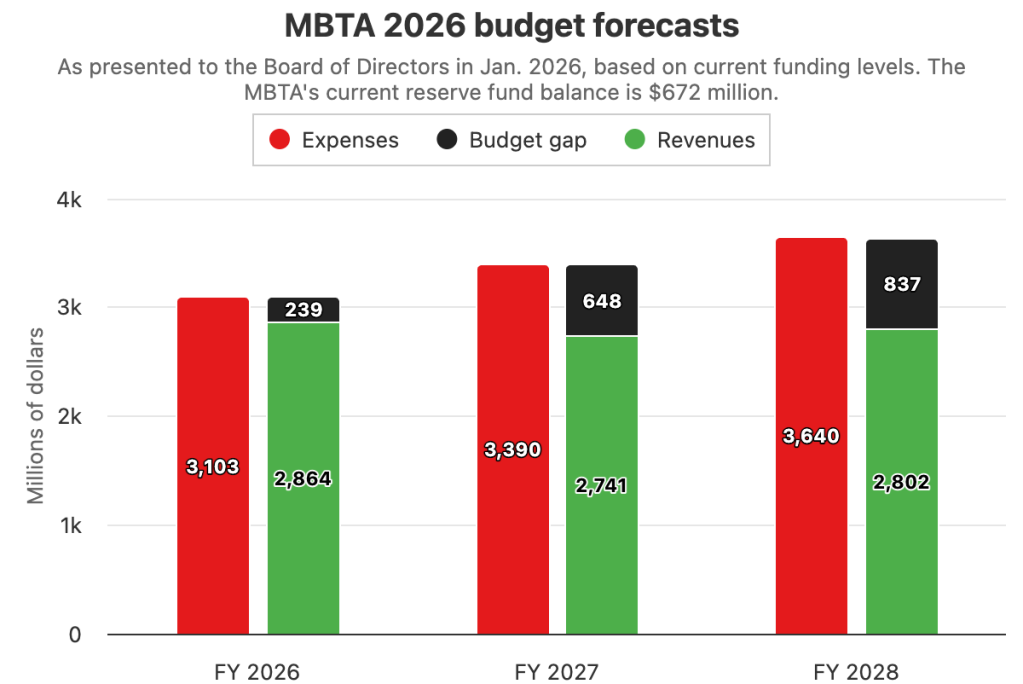
Earlier this month, MBTA budget officials warned that the agency could face a $648 million budget gap this summer, under current funding levels (see chart above).
On Wednesday, Governor Healey delivered her fiscal year 2027 budget proposal to the Massachusetts State House – giving us our first look at her plan to solve the T’s budget problems without service cuts, as she had promised during last week’s State of the Commonwealth address.
Healey’s main budget bill, H. 2, would flat-fund the T’s main source of state funding with a $470 million transfer from the Commonwealth Transportation Fund – the same amount authorized in last year’s budget law.
But the Governor also submitted a “supplemental” budget for $1.15 billion in surplus “Fair Share” tax revenue that the state had collected – but not yet spent – from fiscal year 2025.
In 2025, when the Fair Share tax was still relatively new, lawmakers dramatically under-estimated how much revenue it would produce. The FY2025 budget law planned for $1.05 billion in Fair Share revenue; in fact, high-income households paid more than twice that amount.
The Governor’s supplemental budget would give the T an extra $523 million to balance its FY27 operating budget, plus an additional $122 million to replenish its reserve funds (which are going to be depleted after the T pays off a $239 million budget shortfall this year).
“If it’s implemented as she drew it up, it would solve the T’s budgetary challenges,” Brian Kane, the executive director of the MBTA Advisory Board, told StreetsblogMASS on Wednesday. “So I think it’s great, and she deserves a lot of credit for keeping her pledges to fix the T.”
However, a windfall of unspent Fair Share money is fairly unlikely to recur next year, when the T forecasts an even bigger $837 million budget deficit.

Read More:
Streetsblog has migrated to a new comment system. New commenters can register directly in the comments section of any article. Returning commenters: your previous comments and display name have been preserved, but you'll need to reclaim your account by clicking "Forgot your password?" on the sign-in form, entering your email, and following the verification link to set a new password — this is required because passwords could not be carried over during the migration. For questions, contact tips@streetsblog.org.