Globe Report Implicates Mayor Michelle Wu In Street Safety, Transit Project Cancellations
A story reported by Niki Griswold for the Boston Globe this weekend alleges that Mayor Michelle Wu is personally intervening to block long-planned street safety and transit improvement projects across Boston, putting millions of dollars in state and federal funding at risk and undermining the morale of the professionals in her Streets Cabinet.
Griswold’s report relies on 11 current and former City Hall employees, who requested anonymity for fear of retaliation from the mayor’s office.
Although the sources are anonymous, the allegations comport with the extensive project delays and lack of official communication from City Hall since the mayor issued her so-called “30-day review” of street projects last year.
For Ben Siegel, a Forest Hills resident who has been begging the city to implement planned safety improvements on Hyde Park Avenue, the Globe’s report aligns with his own conversations with city staff, who agree in private conversations that Hyde Park Avenue is a dangerous roadway that needs a redesign.
“She’s micromanaging,” Siegel told StreetsblogMASS on Monday morning.
“When the mayor was in her first term, she put so many competent, intelligent, skilled people on these projects. And then she disempowered them and decided that her politics were more important than their professionalism. And it’s not surprising to me that so many of them have left,” Siegel said.
Since last fall’s election, former Chief of Streets Jascha Franklin-Hodge has resigned from City Hall, as well as his Deputy Chief for Infrastructure and Design Julia Campbell. Vineet Gupta, the longtime Director of Planning for the Boston Transportation Department, announced his retirement last month.
Among the projects and initiatives that the Mayor has delayed, cancelled, or otherwise blocked in the past year, with little to no public communication:
- Last September, the Trump administration cancelled a $20 million grant intended for three major streets in Roxbury after the Wu administration neglected to secure a formal grant agreement to obligate the funds before the end of the 2025 fiscal year.
- The Wu administration has consistently ignored neighborhood petitions to implement planned safety improvements on Hyde Park Avenue in the wake of a fatal crash outside the Forest Hills T station in 2024. The mayor’s office has ignored multiple emails and phone calls from StreetsblogMASS requesting details on the city’s plans.
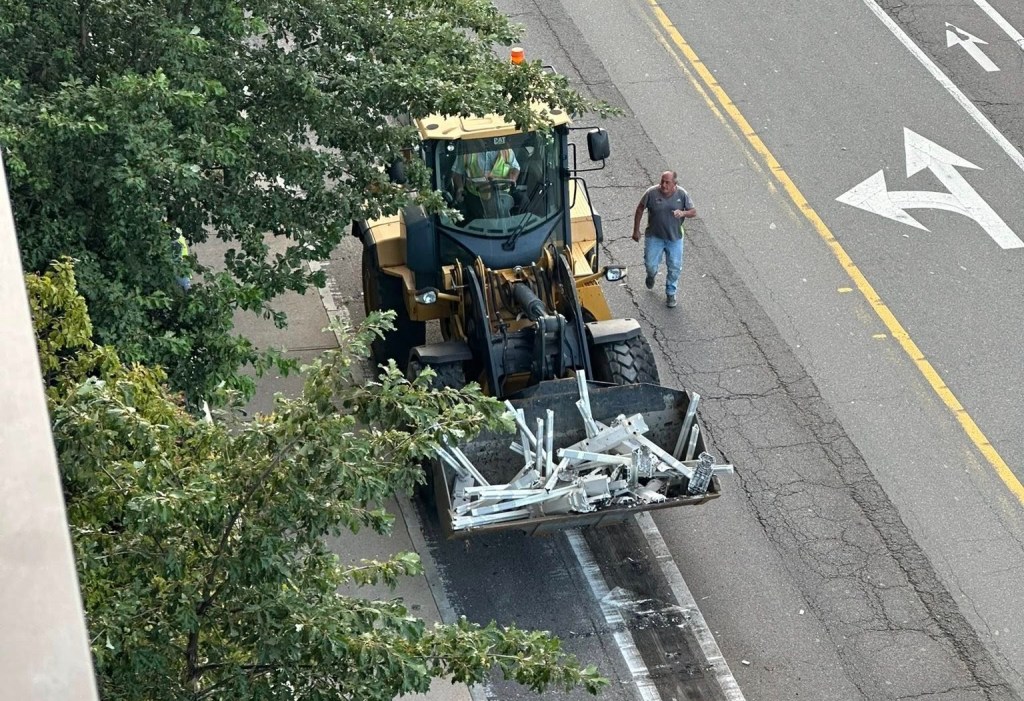
- In summer 2025, with no public notice, the Wu administration removed a bus lane on North Washington Street in downtown Boston that benefitted roughly 15,000 daily bus riders – the vast majority of whom are lower-income and Hispanic riders who ride the 111, one of the MBTA’s busiest bus routes.
- During the mayor’s “30-day review” of street safety projects in early 2025, hundreds of constituents reached out to City Hall to request participation in the review’s rumored neighborhood meetings. The Wu administration dismissed virtually all of those requests with a copy-and-paste email from Mohammed Missouri, the mayor’s Senior Advisor for Strategy, and City Hall continues to ignore our public records requests for information about those meetings, and whether any of them actually happened.
- When we reported on Congress’s appropriation of an additional $80 million for Boston’s Blue Hill Avenue project earlier this month, the mayor’s office did not respond to our requests for comment, even though Mayor Wu’s signature appears on a March 2025 memorandum of understanding that endorses the project. The Globe’s story suggests that the mayor is now discouraging her staff from collaborating with the MBTA on the project.
- The mayor’s “safety surge” of speed hump installations appears to have been mothballed. In 2023, the mayor promised to install up to 500 new speed humps on an annual basis on smaller neighborhood side streets. But in 2025, the city installed fewer than two dozen, and the mayor’s office has ignored requests for a progress report.
- In spite of defeating her challenger in a landslide last fall, Mayor Wu has repeated misinformation that his campaign promoted about bike lanes, and dramatically slowed implementation of new protected bikeways across the city. Last April the Mayor told listeners on GBH that “it is a citywide concern right now, that the cycle lanes have been causing traffic, or causing inconvenience, or hurting economically.”
- Mayor Wu’s professional staff in the Streets Cabinet have empirical data that refute those claims, and in fact demonstrate how protected bike lanes are helping reduce automobile traffic on streets like Boylston Street in Back Bay. The City of Boston published an analysis of this data last November on the city’s bike projects website. However, within a few days, someone at City Hall removed that link, effectively hiding the report (the file is still available on the city’s servers). Wu’s office has declined to answer our questions about why the link disappeared.
Since Mayor Wu took office in February 2022, drivers have killed at least 43 people in the City of Boston, and injured an additional 11,364 victims.
Under Mayor Marty Walsh, the city adopted a “Vision Zero” initiative that aimed “to eliminate fatal and severe traffic crashes in the City by 2030.”

Read More:
Streetsblog has migrated to a new comment system. New commenters can register directly in the comments section of any article. Returning commenters: your previous comments and display name have been preserved, but you'll need to reclaim your account by clicking "Forgot your password?" on the sign-in form, entering your email, and following the verification link to set a new password — this is required because passwords could not be carried over during the migration. For questions, contact tips@streetsblog.org.