Boston Data Show New Bike Lanes Successfully Shift Traffic, With Fewer Cars and Way More Bikes
The City of Boston’s traffic counts show a “significant” increase in bike trips alongside a modest decrease in motor vehicle traffic on streets where Mayor Wu’s administration built new bikeways in 2024, according to a new City of Boston analysis.

“We can conclude that Better Bike Lanes projects built in 2023 and 2024 resulted in immediate and substantial increases in bike trips,” the city’s report concludes.
In the summer and fall of 2024, the City of Boston Transportation Department installed new bollard-separated bike lanes on several streets in downtown Boston, Back Bay, Allston, and Brighton.
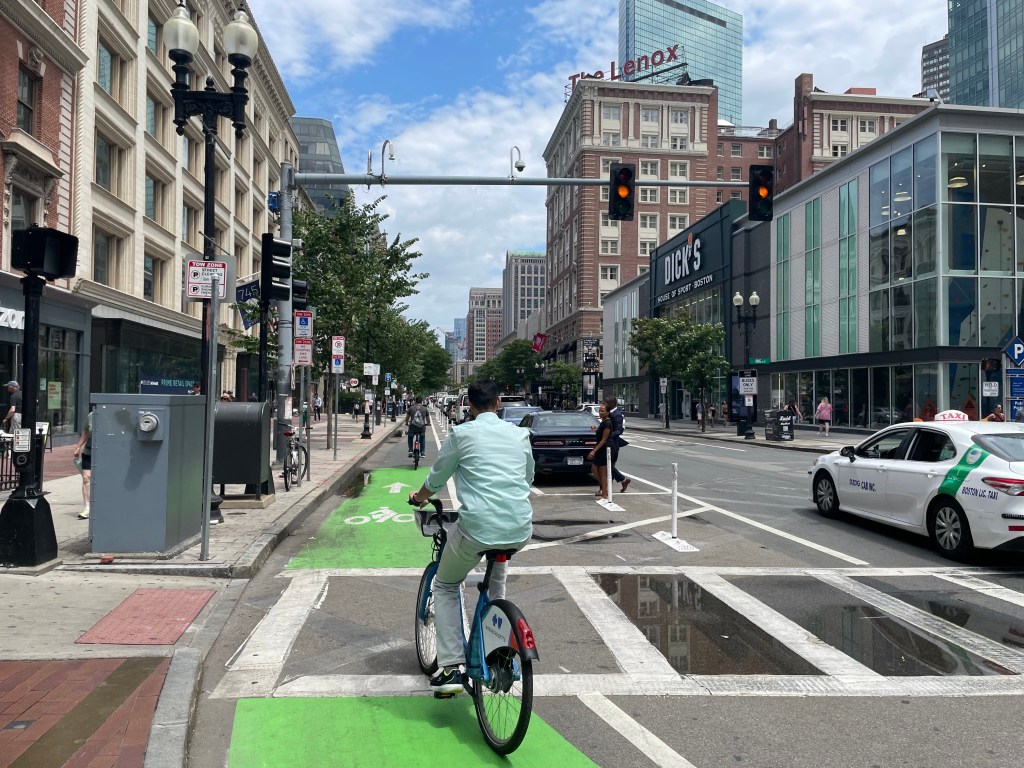
The projects included a new one-way parking-protected bike lane on Boylston Street in Back Bay (pictured above), an intersecting pair of one-way bike lanes on Arlington and Berkeley Streets, a bikeway on Milk Street between Downtown Crossing and the waterfront, and new bike lanes on Beacon Street, Western Avenue, and Winship Street in Allston/Brighton.
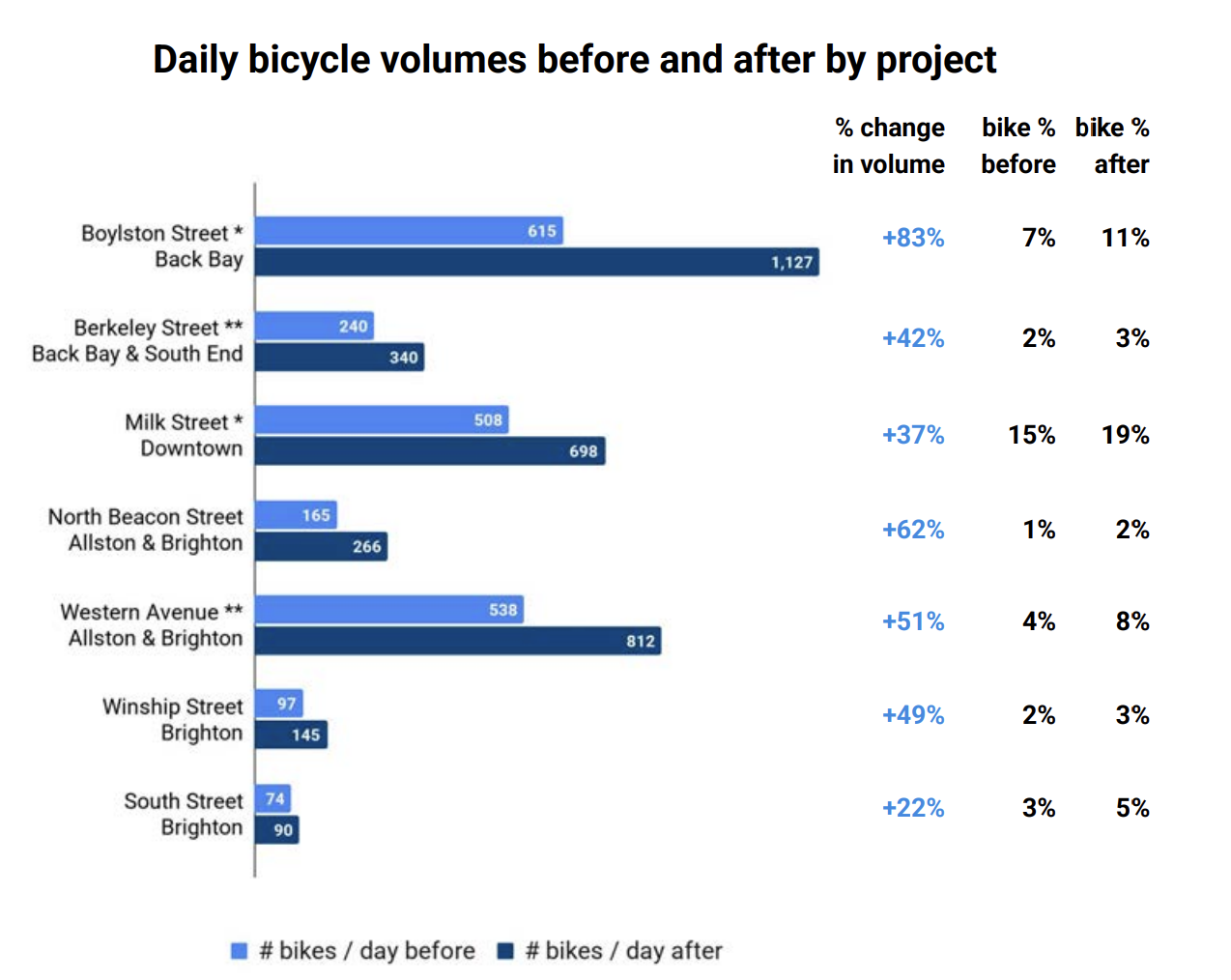
The report compares traffic count data from September 2022 – the same month when Mayor Wu initially announced her administration’s plans to expand the city’s bike lane network – and from four separate counts in June and September 2025, about a year after the city’s installation of the new facilities.
The city hired a third-party vendor to collect the data with automated counters.
Bikes now account for 11 percent of Boylston Street traffic
Among the projects analyzed in the report, the most dramatic shifts in traffic were found on Boylston Street, where the city built a new parking-protected bike lane between Massachusetts Avenue and the Public Garden in summer of 2024.
The route traverses one of the city’s densest neighborhoods. Even before it had a safe bike lane, traffic counts recorded hundreds of daily bike trips on Boylston Street in 2022.
But after the city eliminated one of the street’s three motor vehicle lanes to create a protected bikeway in the summer of 2024, bike traffic increased by an average of 84 percent across three count locations.
At the same time, car traffic declined: by 9 percent from September 2022 and September 2024 near Fairfield Street, and by 14 percent near Arlington Street (the third count location, near Dalton Street, was under heavy construction in 2022).
Two blocks away on Commonwealth Avenue, where there had been no changes to the street’s layout, traffic counts for bikes and cars were relatively steady over the same period, which suggests that traffic wasn’t merely shifting to parallel routes.
The city found double-digit growth in bike traffic at each of the six other bike projects it analyzed.
On Western Avenue in Allston, bike traffic increased by 51 percent, and car traffic declined by 15 percent. On Milk Street in downtown Boston, bike counts increased by 37 percent, with no change in car traffic.
“Protected bike infrastructure works,” said Tiffany Cogell, executive director of the Boston Cyclist’s Union, in an email to StreetsblogMASS earlier this week after we asked her for her thoughts on the report.
The city’s bike lane projects, Cogell says, are “reducing crashes, improving predictability, and expanding mobility options without increasing congestion. This is exactly the kind of evidence-based policymaking our city needs.”
A city spokesperson told StreetsblogMASS that “while some projects in the initial plan have been delayed due to the need for additional community engagement, we have surpassed the projected total of protected bike lanes at 15 miles. Our ‘Better Buffer Program’ will help transition these lanes into permanent infrastructure that better serves all street users.”
The missing link
The City of Boston published its analysis in November with a link posted on the city’s bike projects website.
But at some point before the Thanksgiving holiday weekend, someone at City Hall removed the link, although the file itself is still available on the city’s servers at the time of our publication of this story.
The city’s press office did not address our questions about why the link disappeared.
The city’s apparent reluctance to publicize the successes of its bike lane projects mystifies advocates like Cogell.
“It’s confusing. We don’t know where the city stands, and that’s not good for anyone,” Cogell told StreetsblogMASS in a phone call this week. “We have all offered ourselves up in good-faith partnership to find people-centered solutions that will work for everyone, but especially to address fatalities and other issues on our streets. And confusion can be mitigated if there were communication.”

Read More:
Streetsblog has migrated to a new comment system. New commenters can register directly in the comments section of any article. Returning commenters: your previous comments and display name have been preserved, but you'll need to reclaim your account by clicking "Forgot your password?" on the sign-in form, entering your email, and following the verification link to set a new password — this is required because passwords could not be carried over during the migration. For questions, contact tips@streetsblog.org.