Policy Riders In Governor’s Budget Proposal Would Legalize Speed Enforcement Cameras, End Debt-Based License Suspensions
Riders in the the new budget bill that Governor Healey introduced this week could legalize the limited deployment of speed limit enforcement cameras and end the state’s practice of taking away drivers’ licenses for unpaid debts – two big priorities for transportation advocates.
The budget proposal that Governor Healey released on Wednesday includes a number of “outside sections” – non-budgetary policy proposals that the Governor bundles in with the state’s annual financial plan.
The outside track
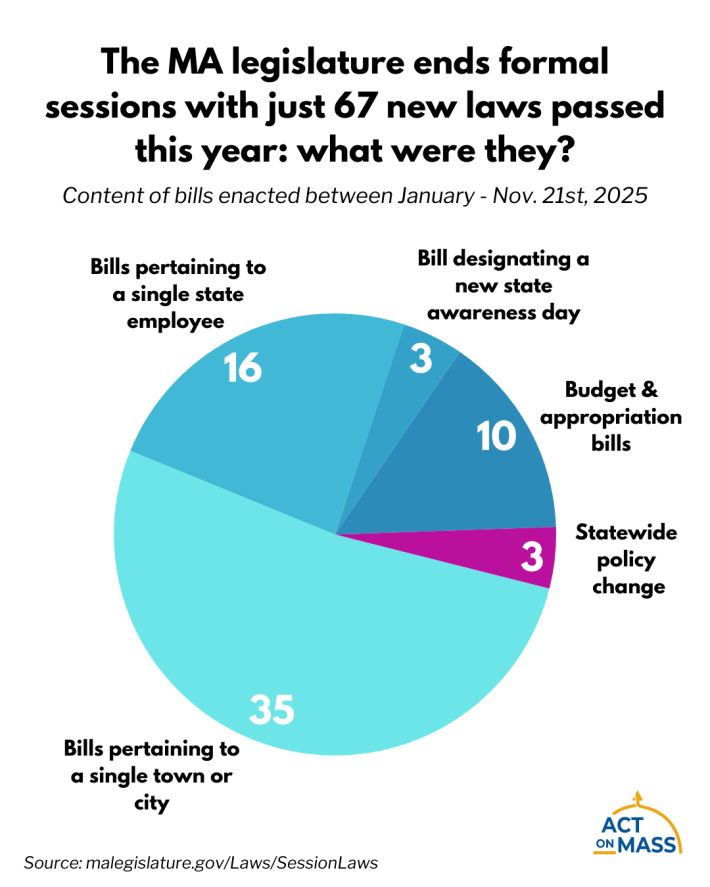
Under the typical legislative process, individual bills have requirements for public hearings and committee votes before they face a roll call vote before the full legislature.
However, the State House’s current crop of lawmakers hasn’t been able to accomplish very much through the typical legislative process (see chart at right).
Outside sections tacked onto the budget bill offer lawmakers a fast-track to enact new policies, because lawmakers need to pass a budget every year, on a deadline (for more detail on outside sections, read this article by Tara Myslinski for the Boston Bar Association).
Speed safety cameras
As she did in last year’s budget, Governor Healey is once again proposing an outside section to legalize automated speed limit safety cameras in this year’s budget bill. Unlike last year’s proposal, this year’s budget language would only allow the technology in construction zones and school zones.
The Governor’s proposal would require a warning for a first offense (with a 2-year lookback period) and a $25 fine for subsequent violations. Drivers recorded going over 25 mph above the speed limit would receive a $100 fine, and the bill also outlines appeal processes by which drivers can contest their fines.
To assuage fears of government surveillance, the proposal would also prohibit cameras from capturing “a frontal view photograph of a motor vehicle operator… or other occupants of a vehicle,” prohibits cameras from using facial recognition technology, and requires that photographs and videos “shall be destroyed not more than 48 hours after the final disposition” of a violation.
Governor Healey’s proposal is considerably more limited than another automated safety enforcement bill making its way through the legislature.
House bill 3754, “An Act relative to traffic regulation using road safety cameras,” along with its companion Senate bill 2344, both share some similar language with the Governor’s proposal.
However, these bills would allow cameras to be used more broadly, not just in school zones and work zones. And in addition to fining speeders, these bills would also let municipalities use cameras to fine drivers who run red lights or “block the box” at intersections.
The Massachusetts Vision Zero Coalition and Families for Safe Streets are planning a “Day of Action” next Tuesday, Feb. 3rd to lobby for the legislature to pass safety camera legislation.
Ending debt-based license suspensions
Several other “outside sections” in the Governor’s budget proposal would end the Commonwealth’s practice of suspending drivers’ licenses and vehicle registrations as punishment for unpaid parking tickets, fines, taxes, and other debts.
The practice of taking away a driver’s license to enforce compliance with laws that are unrelated to their ability to drive safely has come under fire from civil liberties groups like the ACLU and from transportation advocates like the LivableStreets Alliance and Transportation for Massachusetts.
The current law, they note, disproportionately targets poor people, pressures people to drive without a license, and makes it even more difficult for people to pay their taxes and fines.
Lawmakers in the State House have also been working on their own proposal to end debt-based license suspensions (S. 2874), but, like the automated enforcement bill, it’s been stalled in committees for most of the past year.

Read More:
Streetsblog has migrated to a new comment system. New commenters can register directly in the comments section of any article. Returning commenters: your previous comments and display name have been preserved, but you'll need to reclaim your account by clicking "Forgot your password?" on the sign-in form, entering your email, and following the verification link to set a new password — this is required because passwords could not be carried over during the migration. For questions, contact tips@streetsblog.org.