Mass. Law Enforcement Data Show Dramatic Decline In Speeding Tickets
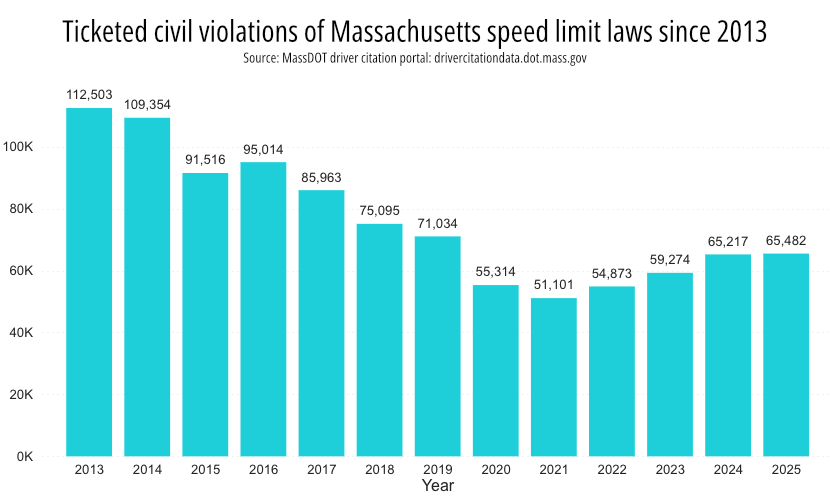
Massachusetts police are writing significantly fewer speeding tickets compared to a decade ago, even as speeding has been cited as a contributing factor in an increasing number of lethal crashes over the same period.
Data from a comprehensive statewide database for traffic tickets and citations (located at drivercitationdata.dot.mass.gov) indicate that police enforcement for the state’s speed limit laws declined precipitously in the years preceding the Covid-19 pandemic, and have leveled out around 65,000 citations a year for the past two years.
That works out to around 1 speeding ticket for every 75 licensed drivers in the Commonwealth last year.
In 2013, by contrast, police issued an average of one speeding ticket for every 42 licensed drivers.
Speeding a rampant problem
Other data sources and anecdotal experience all indicate that the decline in the number of speeding tickets does not reflect a real-world decline in speeding.
Automatic tolling cameras on the Massachusetts Turnpike in Newtonville show that more than half of the drivers on that highway are violating the 55 mph speed limit on a typical day. On weekends, when there’s less traffic congestion to slow people down, over 90 percent of drivers are breaking the speed limit.
Data from the federal Fatality Analysis Reporting System (FARS) database also show that the number of Massachusetts fatal crashes that involved a speeding driver has been on an upward trend over the past decade.
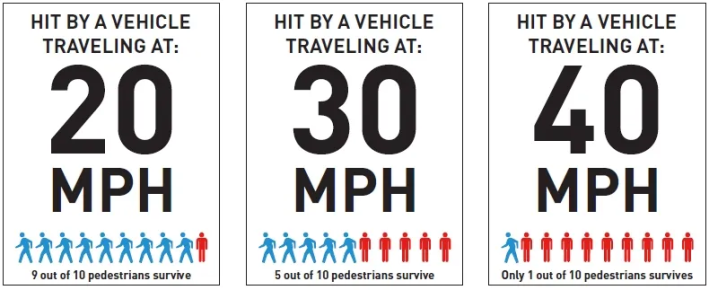
Speed is a major risk factor in determining whether a crash will result in a serious injury or death. According to the European Transport Safety Council, a driver who hits a pedestrian while going 20 mph has a 5 percent chance of killing their victim.
But the likelihood of death increases to 45 percent at 30 mph, and 85 percent for drivers going 40 mph – and those risks increase considerably for children and older adults.
‘There are no consequences’
Police say they’re no longer able to enforce traffic laws the way they used to.
Speaking at the Massachusetts State House earlier this month, Sgt. James Foley, the Worcester Police Department’s traffic unit supervisor, admitted that his colleagues could not monitor his city’s streets on a consistent basis.
“In Worcester alone there are 208 traffic signals,” Foley said. “Effectively monitoring even a fraction of those intersections through traditional enforcement is simply not feasible.”
For Emily Stein, an activist with Massachusetts Families for Safe Streets, the ticketing data confirm her day-to-day experience with reckless drivers.
“You see it every day when you’re driving,” Stein told StreetsblogMASS. “People are not following the laws because there are no real consequences.”
“This data from MassDOT is not surprising – it matches the sentiments we’re hearing from people on our roads throughout the Commonwealth,” said Galen Mook, the executive director of MassBike.
MassBike and the Families for Safe Streets are among the organizations lobbying in the State House alongside other safety organizations for “An Act Relative To Traffic Regulation Using Road Safety Cameras” (Senate bill 2344 and House bill 3754) on Beacon Hill this year.
The bill would authorize cameras like the ones that collect tolls on the Massachusetts Turnpike to automatically issue tickets to drivers who flagrantly violate speed limits or run red lights, with fines ranging from $25 to $150.
The Senate’s transportation committee recently endorsed its version of the bill, but the House side has yet to take action.
Last week, StreetsblogMASS reached out twice to the office of Rep. James Arciero, the House Chair of the Transportation Committee, to ask what his committee has been doing to address the speeding problem, and why his committee hasn’t yet taken action on the House version of the safety camera bill.
Rep. Arciero and his staff never responded to those questions.
“Police say they’re understaffed, and traffic enforcement seems to be a low priority for them. But speeding traffic is a real fear that people have,” says Stein. “People might want to walk or bike in their neighborhoods, but when you see drivers blowing through red lights and speeding down residential streets, nobody feels safe.”

Read More:
Streetsblog has migrated to a new comment system. New commenters can register directly in the comments section of any article. Returning commenters: your previous comments and display name have been preserved, but you'll need to reclaim your account by clicking "Forgot your password?" on the sign-in form, entering your email, and following the verification link to set a new password — this is required because passwords could not be carried over during the migration. For questions, contact tips@streetsblog.org.