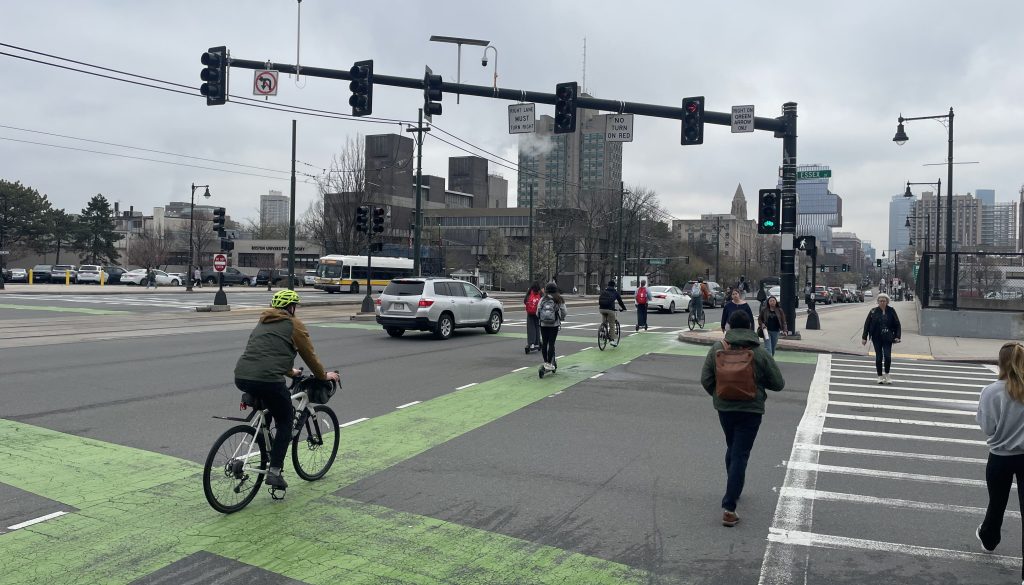
T Threatens Recalcitrant City Hall With Eminent Domain to Ban Cars From Summer Street On World Cup Match Days
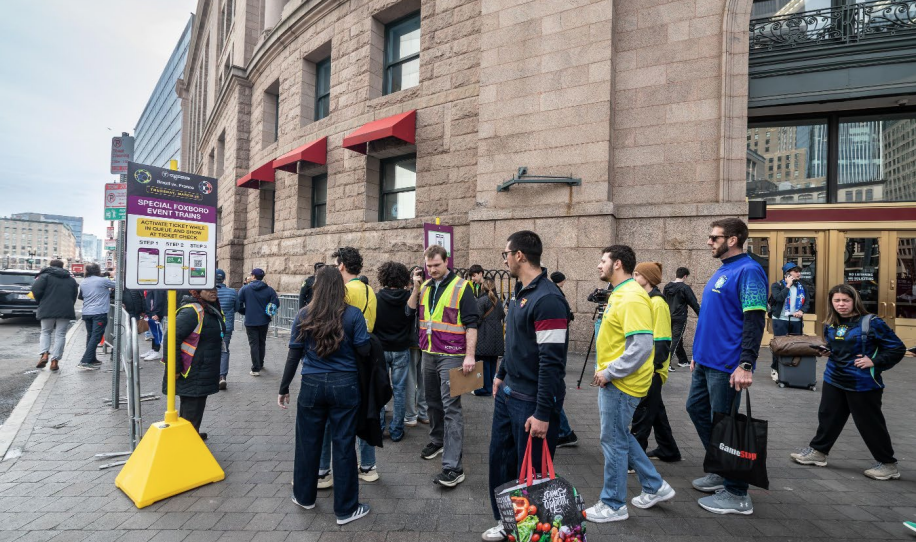
MassDOT and the MBTA will take the highly unusual step of exercising eminent domain over the City of Boston to accommodate crowds on Summer Street outside South Station during World Cup match days next month.
A May 15 letter from MassDOT Secretary Phil Eng to to Nick Gove, Mayor Wu’s interim Chief of Streets, indicates that City Hall’s transportation department is resisting the MBTA’s planning efforts to manage crowds during World Cup events.
It’s the latest incident in a pattern of missed deadlines, failures in coordination, and deterioration in public transit service that have plagued Mayor Wu’s administration in the past year, ever since the mayor began to personally intervene to delay dozens of transportation initiatives.
Mayor Wu’s sudden embrace of much more conservative transportation policies will face a critical test next month.
The T is expecting huge crowds of up to 20,000 soccer fans per match to ride its special event trains from Boston’s South Station to the World Cup stadium in Foxboro.
In order to manage those crowds, the T needs to have more pedestrianized space around South Station on match days, and the agency has been planning to prevent motor vehicle access to two blocks of Summer Street, from Atlantic Avenue to Dorchester Avenue.
“As we have shared with your team, it is imperative that a limited portion of Summer Street near South Station is closed to traffic. This is a matter of necessity given the expected increase in foot traffic near the station,” wrote MassDOT Secretary Phil Eng in a May 15 letter to Nick Gove, Mayor Wu’s interim Chief of Streets at Boston City Hall.
Eng goes on to note that the pedestrianization of Summer Street on match days “comes at the strong recommendation of the Massachusetts State Police and the MBTA’s public safety personnel, as well as numerous public safety organizations.”
State could exercise eminent domain over city street
Eng went on to inform Gove that under section 5C of Chapter 79 (the eminent domain chapter) of the Massachusetts General Laws, “the MBTA intends to acquire the temporary right to occupy [a] portion of Summer Street … for the purpose of accommodating public safety in connection with the upcoming World Cup matches.”
The state would exercise those rights for 10-hour access periods on each match day.
Eng’s letter (read it in full here) served as the required 30-day notice of the Commonwealth’s plans to exercise eminent domain.
StreetsblogMASS reached out to the city’s press office to ask if there are any substantive reasons why the city would object to the MBTA’s crowd management plans.
City Hall’s press office did offer any answer to that question (we’ll update this story if they do).
In a statement to the Boston Globe on Tuesday, a spokesperson for Mayor Wu said that “the City opposes this inappropriate use of eminent domain to bypass the permitting process for roadways under local jurisdiction, and we urge the Commonwealth to withdraw the filing while plans are being reviewed.”
It’s better in… Texas?
Most other host cities across North America have already announced ambitious plans to welcome large World Cup crowds by pedestrianizing major streets, and in some cases, entire neighborhoods.
On match days, Seattle plans to pedestrianize roughly 20 blocks around Pioneer Square, a downtown district located near its main soccer stadium.
Even the two host cities in Texas are taking a more progressive approach to transportation planning.
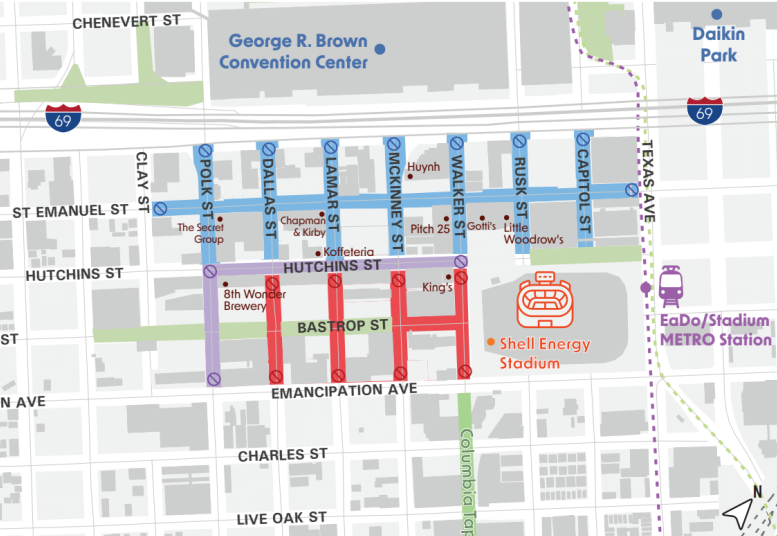
Dallas is planning to pedestrianize several downtown streets next to to its fan festival zone and its World Cup broadcasting center, even though its World Cup games will be 17 miles away at a suburban football stadium.
Houston plans to pedestrianize roughly 30 blocks of streets near its soccer stadium (see map at left) for daily World Cup “fan festivals” in June and July.

Read More:
Streetsblog has migrated to a new comment system. New commenters can register directly in the comments section of any article. Returning commenters: your previous comments and display name have been preserved, but you'll need to reclaim your account by clicking "Forgot your password?" on the sign-in form, entering your email, and following the verification link to set a new password — this is required because passwords could not be carried over during the migration. For questions, contact tips@streetsblog.org.