T Offers New Details and a Delayed Timeline for Electrified Fairmount Line Trains
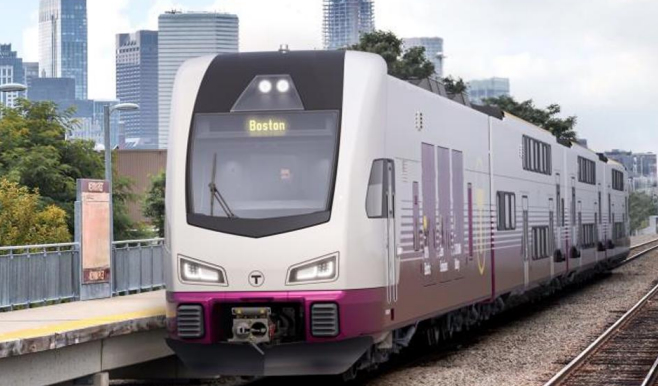
The MBTA is getting close to selecting a train manufacturer to deliver on its promises for faster, more frequent service on the Fairmount Line, but the project’s timeline has been delayed several years and the new trains likely won’t start carrying passengers until 2030.
Two years ago, Governor Healey and MBTA officials pledged to electrify and add significantly more service on the the Fairmount Line in Boston, which runs between South Station and Readville, by 2028.
The plan hinged on a new technology: “battery-electric multiple unit” trains that would run on battery power for most of their trip, then recharge themselves at South Station and at Readville (at those stations, the Fairmount Line intersects with the Providence Line, which already has overhead wires to power Amtrak’s electric Northeast Regional and Acela trains).
Unlike existing commuter rail trains, which are pulled by diesel-powered locomotives, the new BEMU equipment would have electric motors on every car for faster acceleration, more like a subway.
At Thursday’s board meeting, MBTA officials said that they had found a prospective manufacturer for the new trains: Stadler, the company that built new electric trains (albeit without batteries) that debuted on the Caltrain system in 2024.
Terms of the contract are still under negotiation, but Michael Muller, executive director of the MBTA’s commuter rail system, told board members that the agency hopes to acquire 7 four-car trainsets for the Fairmount Line.
The contract would include options to purchase up to 24 additional trainsets (96 cars) for use on other commuter rail lines if the equipment is successful.

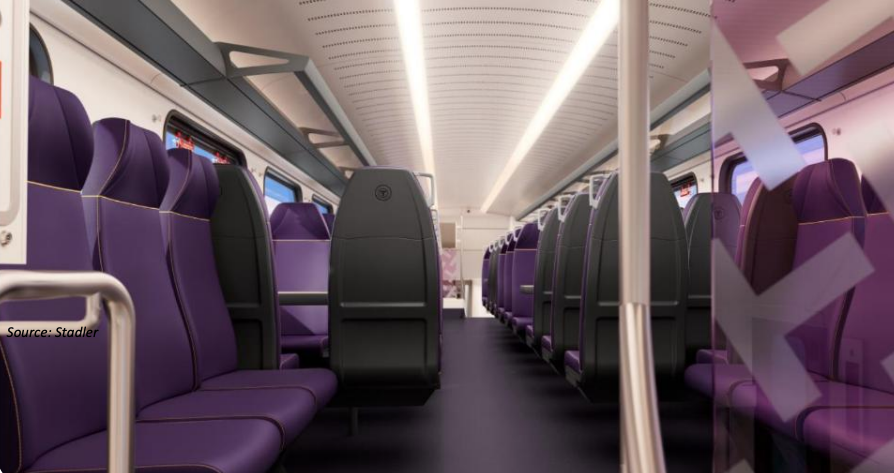
Each four-car trainset would consist of one battery car at one end of the train with no passenger seating, plus three bi-level passenger coaches. All four cars would have motors to propel the train at speeds up to 79 mph.
At times of peak demand, the T could link two trains together to form an 8-car trainset.
Faster trains, slower timeline
In previous discussions about the project, the T had said it hoped to begin operating the new trains every 20 minutes starting in 2028.
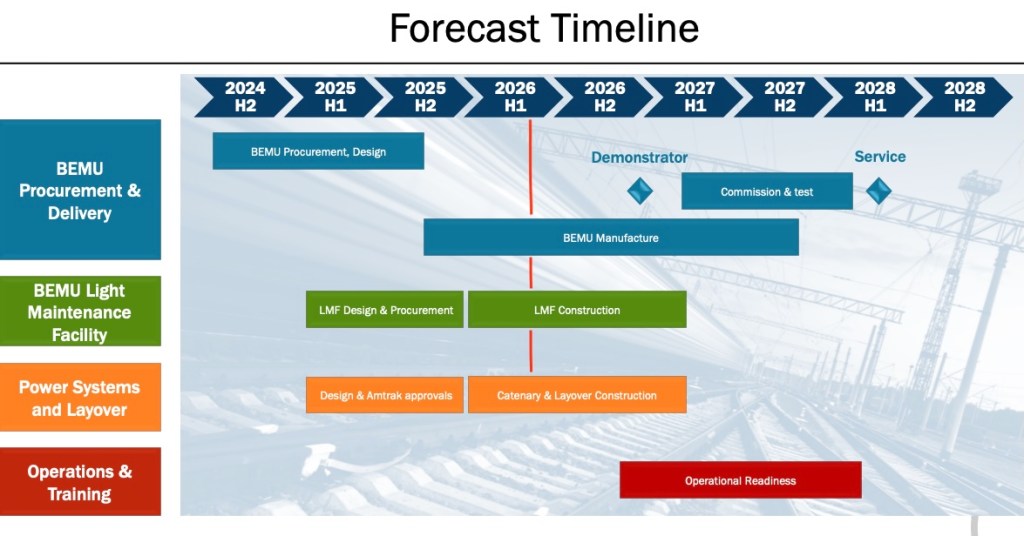
But meeting that timeline would have required the T to begin construction on the new trains and new maintenance and layover facilities this year (see the timeline below from summer 2024). None of that work has started yet.
Stadler “actually did propose a vehicle design that was responsive to our requirements, that could have been delivered for revenue service in 2028,” Muller said.
However, that original proposal would have met a less-restrictive accessibility standard, where only one car per train would have been wheelchair-accessible.
“Customers with disabilities have ADA-accessible seating on all coaches on that line today, so changing to a vehicle that reduces the amount of accessible seating on a train to just one passenger car, instead of all passenger cars, would be a step backwards for accessibility that would be unacceptable to us,” Muller explained.
“So we required a stricter accessibility standard and essentially requested a design modification to ensure accessible seating in all three of the passenger vehicles of these battery-electric multiple units.”
The T also hasn’t started work yet on a new light maintenance and charging facility for the new trains at Readville. Those facilities, plus additional layover tracks, will need to be in place before any new trains arrive.
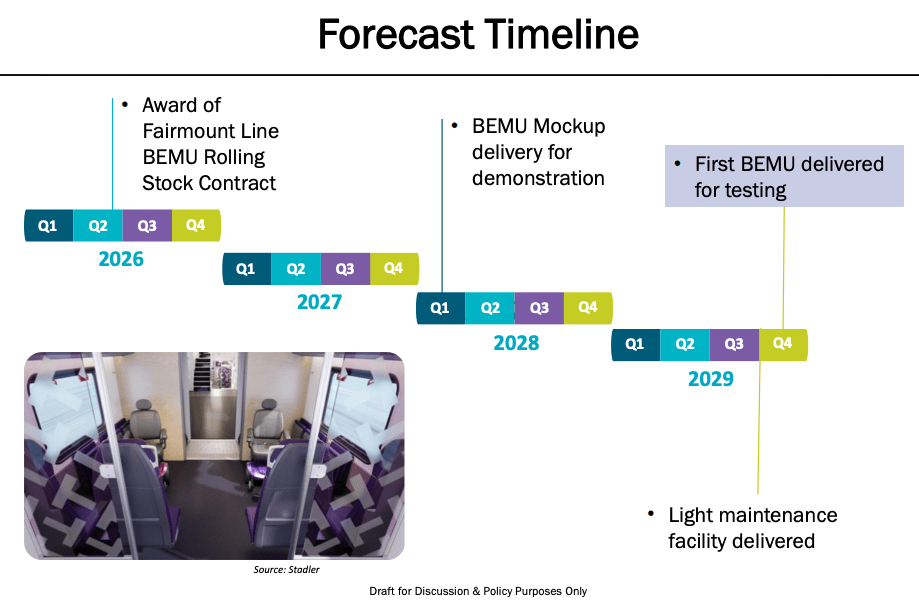
Under a new timeline that Muller shared with board members on Thursday, the first new BEMU train won’t arrive in the Boston region until the end of 2029.
Batteries keep getting better
One silver lining to the delay is that battery technology keeps improving.
Muller said that in 2024, the T had planned to install up to three miles of new catenary (the overhead wire that powers electric trains) along the 10-mile Fairmount Line to charge the new trains’ batteries.
“We now know that we don’t need any additional catenary,” continued Muller. “The battery life is good for 40 to 50 miles, which means that with charging infrastructure at both ends of the line, these vehicles can more than capably operate without catenary.”
Still, two board members had critical questions about the proposed battery technology. Board member Robert Butler struck a particularly skeptical tone.
“If the battery fails, do we pay for that battery?” asked Butler.
Alistair Sawers, Senior Director of Rail Modernization, clarified that the batteries would be under warranty under the terms of the contract.
Butler also asked “Are they heavier or lighter than the old trains?”
Sawers answered that “even the battery front-end piece (i.e., the car with no passenger seating) is lighter than our current HSPs” (the diesel-powered HSP locomotives that currently operate throughout the commuter rail system).
Director Chandra Smart asked how long the batteries were expected to last.
“We’re looking at 8 years,” said Sawers. “That’s the current provision. However, a lot of the experience recently with the same kind of chemistry is, actually, they last a lot longer than that. So, we’ve provided for the worst case, and that’s the basis of the warranty, and there’s a fund that’s built up to pay for that.”
The T is also proposing a sophisticated financial arrangement to bring the new trains to Boston without directly paying for or owning the equipment. A financial asset management company would buy and own the equipment, then lease it back to Keolis, the private company that operates the commuter rail system.
That arrangement would move the costs of the new trains out of the T’s over-subscribed capital budget and into its annual operations budget.
The details of how the deal will work – including how much it will cost the T – are still under negotiation, but Muller said they hope to bring a proposal to the board of directors soon.
The T has previously estimated that it would reduce diesel fuel consumption by 1.6 million gallons annually by electrifying the Fairmount Line.
“Our plan, once the commercial negotiations with the selected financier and vehicle manufacturer are complete and ready for a place to bring to the board, we’ll come back to the board possibly as soon as next month to seek approval of the contract,” Muller said.

Read More:
Streetsblog has migrated to a new comment system. New commenters can register directly in the comments section of any article. Returning commenters: your previous comments and display name have been preserved, but you'll need to reclaim your account by clicking "Forgot your password?" on the sign-in form, entering your email, and following the verification link to set a new password — this is required because passwords could not be carried over during the migration. For questions, contact tips@streetsblog.org.