Regional Transit Authority Ridership Is Way Up, Thanks to Fare-Free Service
Ridership on the Commonwealth’s 15 Regional Transit Authorities – the agencies that provide public transit services outside of the MBTA region – is 14 percent higher than it was before the Covid-19 pandemic, and fare-free operations deserve much of the credit, according to a recent MassDOT report to the Massachusetts Legislature.
In a press release that the Governor’s office issued Monday afternoon, Gov. Maura Healey said that “these strong ridership numbers show that when we invest in public transportation and remove barriers to access, more people use it. Fare free service is making a real difference for communities and local economies across our state.”
In the fiscal year 2025 budget law, which took effect in the summer of 2024, included a $30 million grant program to fund fare-free operations at most of the state’s Regional Transit Authorities (RTAs).
The law also directed MassDOT to “submit a report to the joint committee on transportation and the house and senate committees” of the Massachusetts legislature on the new program’s results.
MassDOT submitted that report in March, and shared it with StreetsblogMASS (read it here).
Among the key findings:
- Total RTA ridership has more than doubled since the 2020-2021 pandemic year
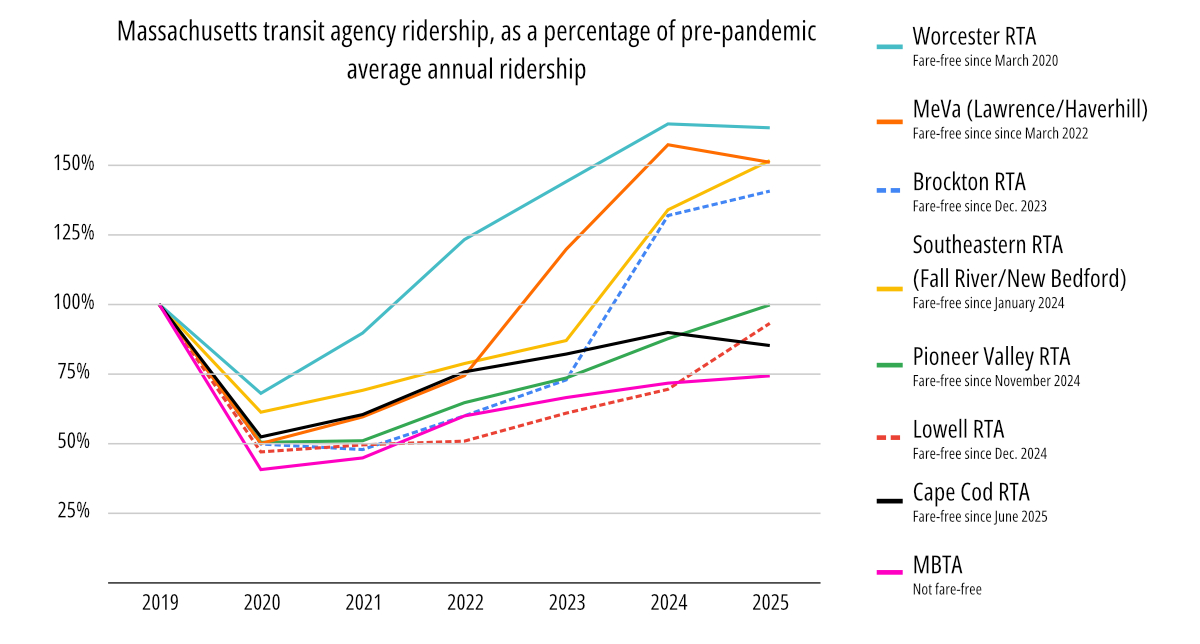
- Agencies that have offered fare-free service for more than three years – the Franklin RTA in the Greenfield region, the Worcester RTA, and MeVa in greater Lawrence and Haverhill – have experienced the strongest and most sustained ridership gains since 2020
- Data indicates that ridership spikes after the initial introduction of fare-free operations, and is continuing to grow even at agencies that have already more than exceeded their pre-pandemic ridership levels (see chart above)
The report acknowledges that other factors also influence ridership – particularly service improvements and the addition of new bus routes, which have also received new funding from the Massachusetts legislature in recent years.
“At the same time that we eliminated fares, thanks to increased investment from the Governor and Legislature, MeVa has also been able to increase the frequency and hours of service, make routes more direct, add passenger amenities, and lean into improving the customer experience,” said MeVa Administrator Noah Berger.
Still, experience from two agencies that were late adopters of fare-free policies helps illustrate how much of an impact the policy can have on ridership.
There were two RTAs that opted not to pursue the state’s new funding for fare-free operations in 2024: the Cape Cod RTA and the Greater Attleboro-Taunton RTA (GATRA).
Compared to their peers, those two agencies have shown some of the weakest rates of ridership recovery since the Covid-19 pandemic.
In the Legislature’s 2026 budget law boosted funding for fare-free RTA operations to $35 million. It also added language to prohibit any RTA from charging fares for local buses and paratransit.
Cape Cod’s RTA finally implemented fare-free operations in June 2025, and GATRA followed suit in October.

Read More:
Streetsblog has migrated to a new comment system. New commenters can register directly in the comments section of any article. Returning commenters: your previous comments and display name have been preserved, but you'll need to reclaim your account by clicking "Forgot your password?" on the sign-in form, entering your email, and following the verification link to set a new password — this is required because passwords could not be carried over during the migration. For questions, contact tips@streetsblog.org.