Redesigning the Redesign: The T Tweaks Its Bus Network Plan With 11 New Route Adjustments

Two years into its network-wide redesign of its bus network, the MBTA is responding to rider feedback and making adjustments to a handful of bus routes.
The MBTA is proposing updates to 11 bus route groupings as part of its Bus Network Redesign (BNR) project, modifying its bus network redesign plan to preserve and restore critical bus pathways while adding additional service and connectivity to others.
The Better Bus Project
The Better Bus Project is a series of initiatives that the T, MassDOT, and local municipalities partnered on to improve bus service, transit priority infrastructure, bus stop enhancements, bus facilities and operations, and community updates.
Outside of bus service initiatives, this has looked like adding bus stop e-ink signs and other sign improvements, bus electrification, bus facility modernization, redesigning Blue Hill Avenue, and studying new routes through the Longwood Medical Area, a major transit destination that doesn’t have any subway stations and therefore relies heavily on buses.
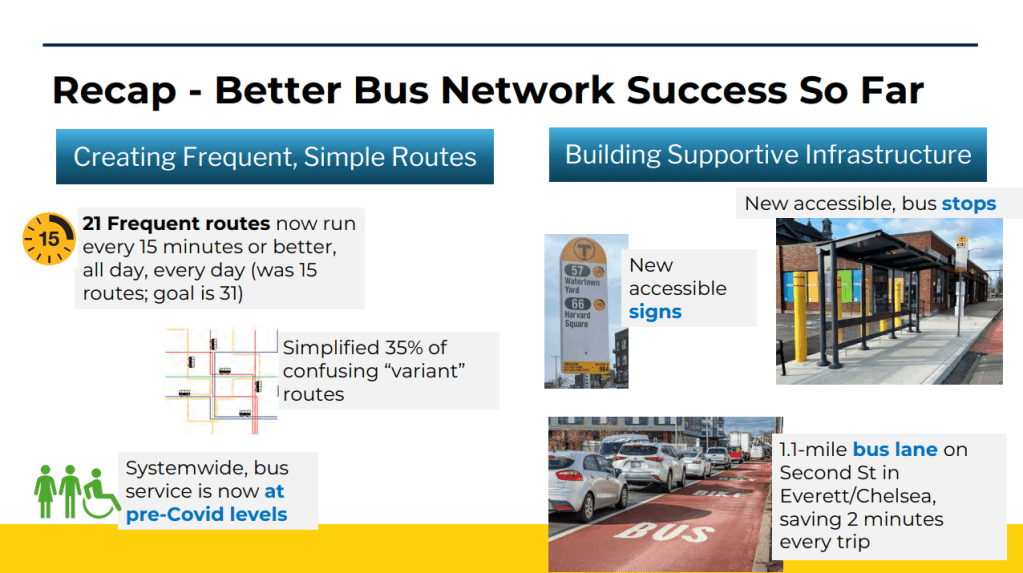
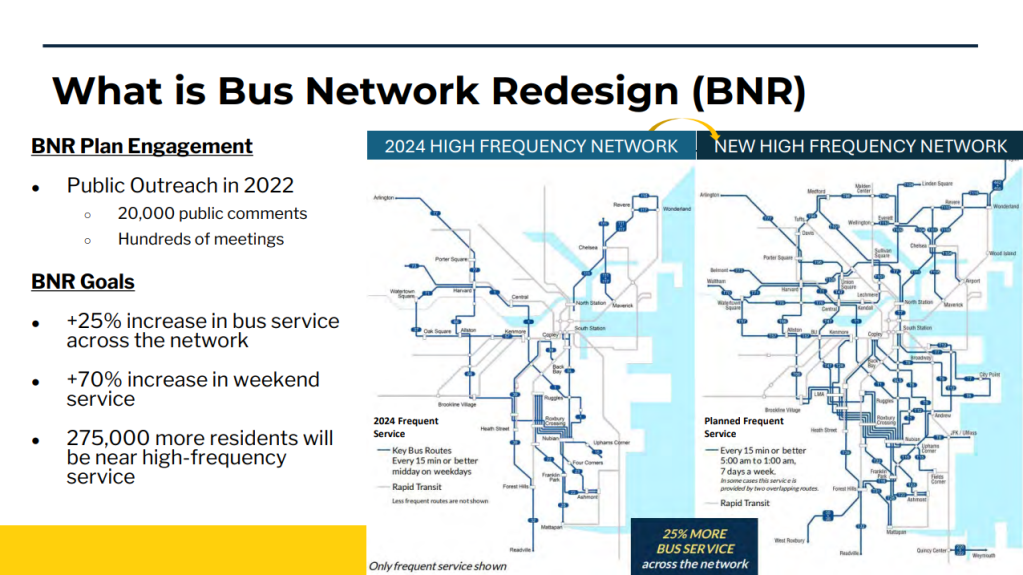
As a core part of the Better Bus Project, the Bus Network Redesign aims to create frequent bus routes that run every 15 minutes every day from 5 AM to 1 AM, to build a more robust local network, expand weekend and late-night options, and align the network to where people live and work.
In order to make an inclusive, comprehensive, and effective overhaul of the Greater Boston’s bus network, the T has been collecting feedback from riders, researching best practices and routes, and implementing service updates across the system since 2022.
Bus Service Changes
Over the last few years, the redesign has taken shape across the Greater Boston Area, focused on creating new “high frequency” bus routes on high-ridership streets.
A “phase one” group of service changes in late 2024 added new high-frequency routes in northern gateway cities like Malden, Everett, Revere, and Chelsea. The new routes extend from Harvard Square to the airport, Wonderland, and Maverick Blue Line stops, with service every 15 minutes or better.
By summer 2025, the T set its sights on updating other high-ridership routes like the 1, 15, 22, 23, 28, and 31 along core city streets like Blue Hill Avenue, Mass Ave., and Warren Street.
This past December, service improvements focused on the Silver Line, with added frequency to the SL1, SL3, and SL5. In the spring of this year, routes like the 87 and 350 were updated, and the CT2 and 85 buses merged into a single route from Ruggles to Assembly.
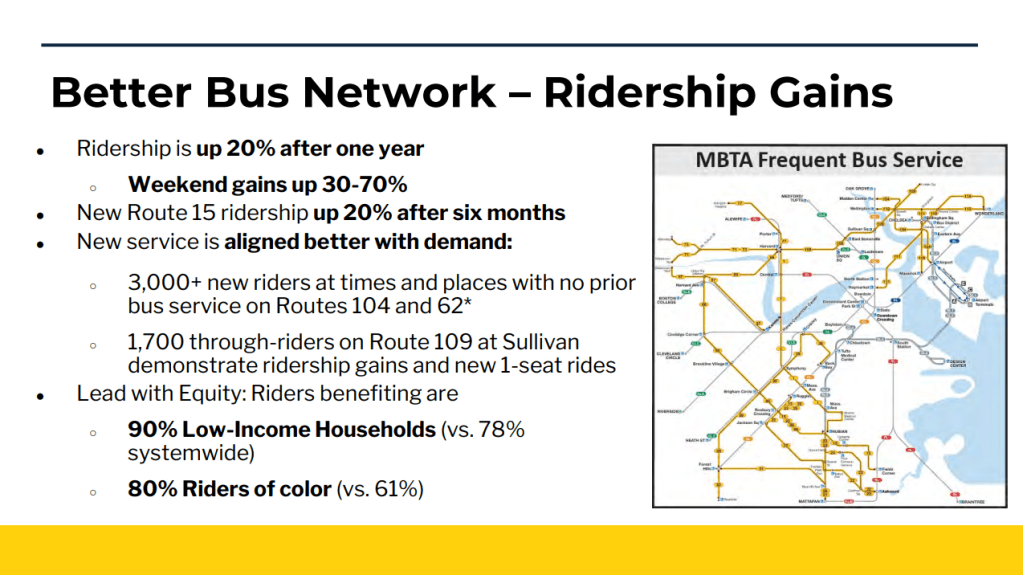
The result has been largely positive, with the T seeing ridership gains of 20 percent after one year, and weekend gains of 30-70 percent.
Equity as a central factor in BNR design has reflected as a result, with riders from low-income households growing from 78 to 90 percent, while riders of color have increased from 61 to 80 percent.
“We’ve seen progress with operator hiring, seen the success of regaining bus riders as we’ve improved service, and seen continued demand for new and more service,” shared Katie Calandriello, Community Engagement Specialist on the Bus Transformation team.
“Through implementation,” Better Bus Network Director Becca Wolfson shared, “we’ve recognized minor changes that needed to be made based on street conditions, rider patterns, and shifting of operational constraints… We’ve also gotten feedback about possible unintended negative impacts to riders from starting early in the BNR process, some of which were natural trade-offs, but some of which we hope to address (through the proposed BNR changes).”
Now, the T is seeing and responding to post-pandemic travel patterns and rider feedback by adjusting some lower-ridership routes around its service area. The changes aim to maintain and but extend its services at non-peak hours, increasing frequency, extending routes, preserving connections to key transit corridors, and restoring previous routes that were once on the chopping block.
The 11 proposed updates (that in reality affect 21 routes) include the following:
- Routes 411, 426, 442, and 455 in Revere
- Routes 119, 120, 712, and 713 in Winthrop
- Route 85 in Boston, Cambridge, and Somerville
- Routes 67, 80, 94, 96, and 350 in Medford, Cambridge, Somerville, and Arlington
- Routes 11 and 42 in South Boston
- Route 43 in Back Bay
- Route 504 in Boston and Newton
- Route 44 in Roxbury
- Route 202 in Dorchester
- Route 18 in Dorchester
- Routes 435 and 465 in Danvers
Project staff hosted a virtual public meeting on June 15th where they unveiled these proposals to the public.
With 233 people in attendance, and nearly half of them interested in the Medford routes in particular, MBTA staff provided a recap of the BNR, unveiled the proposed updates, outlined next steps, and moderated a Q&A.
Reps. Sally Kerans and Jeff Turco were present, as well as Malden and Winthrop city councilors Steve Winslow and Joe Romano. The slides shared and a recording of the presentation can be found here.
Maintaining access
While previous rounds of the bus network redesign focused on high-ridership, frequent-service routes, many of the changes being proposed now are focused on maintaining access on lower-frequency bus routes.
For instance, the T proposes maintaining Saturday service to support weekend travel on both Route 18 in Dorchester and Route 504 express route from Boston to Newton and Watertown.
In Winthrop, instead of cutting service beyond the Winthrop Ferry Terminal as was originally planned, the new 119 and 120 that are set to replace the 712 and 713 will remain a connection that continues all the way to Point Shirley, which will allow for the continued access for Winthrop residents.
Continuing along the coast, the proposal in Revere looks to extend Route 426 to the front doors of the retirement community Jack Satter House on Oak Island Street, rather than having residents walk to North Shore Road to catch a bus.
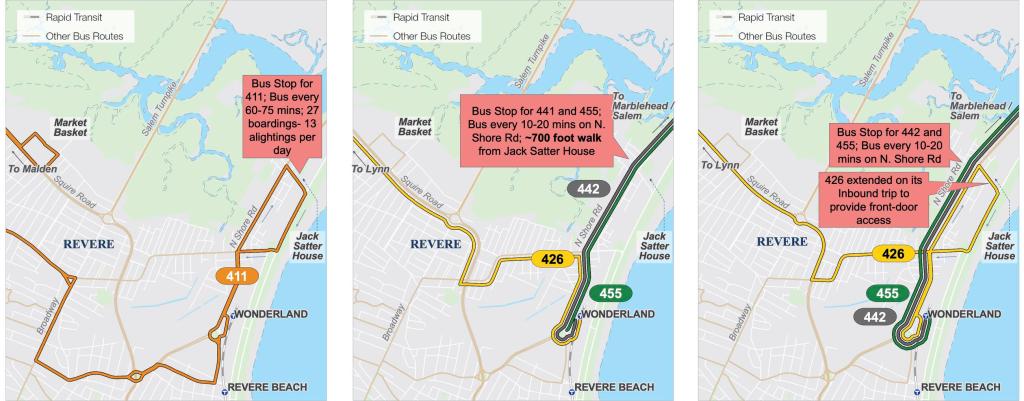
Ward 6 Councilor Steve Winslow of Malden also amplified constituent input regarding the desire to have routes that connect through Malden and Revere (e.g., the 411, 426, 430, 105) continue onto the Market Basket off of Route 60, ensuring other senior housing complexes and large apartment buildings in Malden as well as residents of the Jack Satter House can access a local grocery store.
Revisiting recent Bus Network Redesign changes
The T is also planning to tweak some of its recent bus network redesign changes.
The 85 route, which as of April this year was combined with the old CT2 line to run as far south as Roxbury and as far north as Assembly Square in Somerville, will see added weekend service to increase frequency and connectivity between Boston, Cambridge, and Somerville.
In a reversal of some early-stage Bus Network Redesign ideas, the T also plans to bring back service that was eliminated between 2020 and 2021.
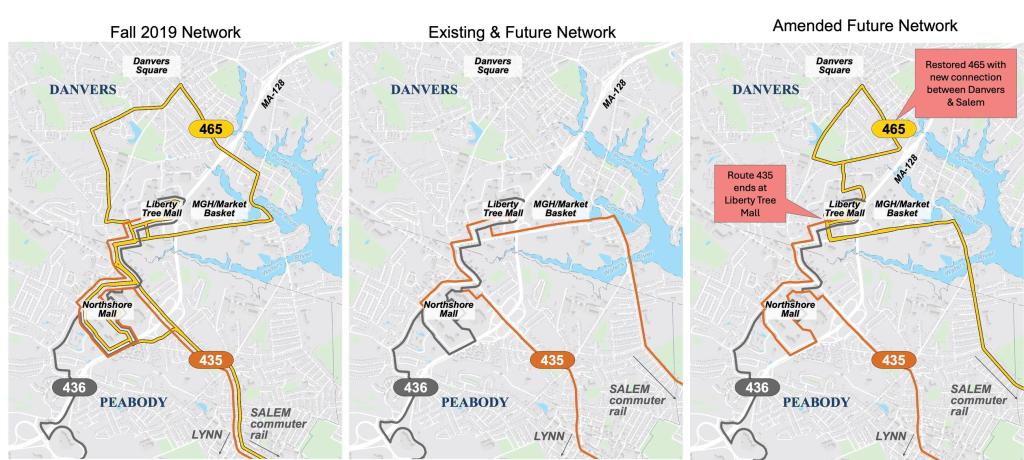
For instance, the T plans to bring back route 465, which hasn’t operated since the Covid-19 pandemic, to restore service to Danvers Square.
Reinstating the Danvers Square connections will bring access back to an underserved area and connect riders between Danvers, Salem, and Lynn.
The T also plans to restore midday and evening service for the 202 in Dorchester, which would have positive impacts on riders moving between Fields Corner and Ashmont.
Improved connections to transit hubs
Where one route may not get a rider all the way to their destination, preserving connections to key transit stations is the next best option.
For the T, this looks like extending Route 42 by adding two-way service on A St to improve connectivity to South Boston and the Seaport, maintaining the 43 bus’s route along Tremont Street to allow riders to reach adjacent Orange and Silver Line stops like Tufts Medical Center, and reversing a previous plan to keep Route 44 along Humboldt Ave. in Roxbury as a direct, no-transfer line to Ruggles.
Improving transit connections along Boston Ave. in Medford has proved to be one of the more complex goals of the most recent bus route changes.
The T’s original plan had been to eliminate Route 94, and move Route 96 off of Boston Ave., but that would have created a gap by the Medford/Tufts Green Line Extension station.
Three different proposals are being considered as a response: extending Route 80 to Arlington Heights, keeping Route 94 in Medford, or rerouting Route 96 away from George Street to Boston Ave. and upgrading it to a frequent bus route.
“The 94 is a valuable connection as it offers a one-seat ride from Medford Square to communities along Boston Avenue. One of the main reasons people are upset about the changes is that they lose that one-seat ride.” – Stefano Lazara, transit rider
The Medford breakout room in last month’s virtual meeting, with a total of 103 participants, was particularly lively, weighing in on the three different proposals.
Many favored Package B to retain Route 94, worried that its elimination would cut off key areas from West Medford to Medford Square from major transit hubs; others made a case for Package A in favor of a high-frequency route along Boston Ave. to simplify daily commutes.
Riders were concerned about losing direct access to destinations like Harvard Square and getting stuck in gridlock in traffic circles along I-93. And though the breakout room was about routes affecting Medford, the impact extended into neighboring cities like Somerville, Arlington, and Malden, highlighting how these routes are lifelines for gateway cities and suburbs to connect to each other as well as the region’s urban core.
As for underserved populations like seniors, families with young children, and those with mobility or other accommodations, riders raised concerns and considerations like the danger of lack of snow removal on connecting bridges, ADA accessibility challenges due to steep hills around the Gilman Square T station, and loss of access to Mass General Hospital.
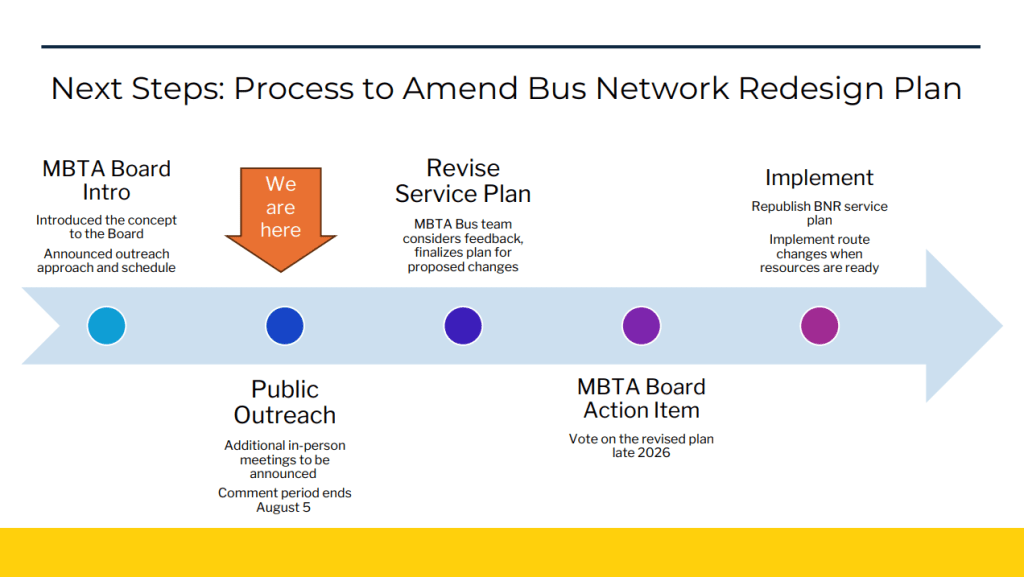
Between now and August 5th, the T welcomes feedback on all of the updated proposals. Riders have various avenues to engage, between taking this survey, sending feedback via email to betterbusproject@mbta.com, or weighing in by mail to the Better Bus Project Team at 45 High St, Floor 5 Boston, MA 02110.
Additionally, throughout the summer, there will be in-person opportunities to speak to project staff at open houses and pop-ups at train stations and bus stops.
Following this public comment period, the project staff will review all of the feedback, finalize recommended changes, conduct an impact analysis, and present the final proposed changes to the MBTA Board of Directors at the end of this year.
In implementation, approved changes will be rolled into the full plan, and take place over the next five years as part of the broader BNR implementation plan. Route changes will start after the relevant communities are engaged, staff is trained, and relevant resources are developed.
For more information on future updates and events, sign up for email updates.
Streetsblog has migrated to a new comment system. New commenters can register directly in the comments section of any article. Returning commenters: your previous comments and display name have been preserved, but you'll need to reclaim your account by clicking "Forgot your password?" on the sign-in form, entering your email, and following the verification link to set a new password — this is required because passwords could not be carried over during the migration. For questions, contact tips@streetsblog.org.