MBTA Making Moves in Medford As Part of the Bus Network Redesign

Last month, residents and neighbors of Medford came out in droves to discuss the parts of the Bus Network Redesign (BNR) that would go into effect in their city, and affect their connections into neighboring cities like Malden, Cambridge and Somerville.
In a crowded virtual room, MBTA staff Regan Checchio, Melissa Dullea, and Becca Wolfson presented the options that the MBTA is considering for its Bus Network Redesign in Medford.
At present, the MBTA is working toward implementing its 2022 approved plan, which replaces the Route 96 bus on Mass Ave.
Now informed by bus route ridership data and the goals of the Better Bus Network project, the T is considering several possible adjustments to its original proposal.
The T’s Proposals
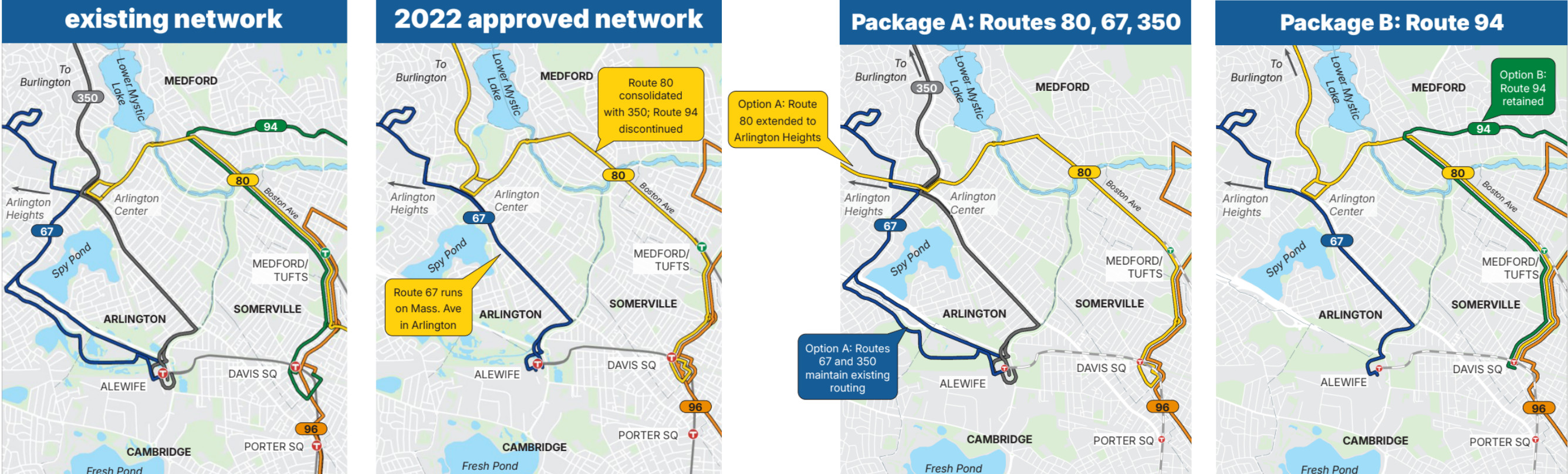
Package A sees the structure extend 80 to Arlington Heights instead of consolidating with the 350 bus to Burlington, retaining the existing 350 Burlington-Alewife route, and the 67 via Pleasant Street. The 80 to Arlington Heights would connect more of Mass Ave to the Green Line, but Davis would lose direct trips to Burlington, and Turkey Hill would lose stops on Mass Ave.
Package B would retain Route 94, providing an alternate approach to service frequency improvement along Boston Ave as opposed to Package A, and connect residents near High Street in Medford to the Green Line and Red Line, versus having to transfer to Route 95 (which runs every 20-30 minutes all day). Some 94 riders would divert to 96, a Frequent Bus Route service. However, this plan would result in lower overall frequencies on Boston Ave. with separate 80 and 94 for similar investment due to difficulty coordinating routes, and inherent bunching.
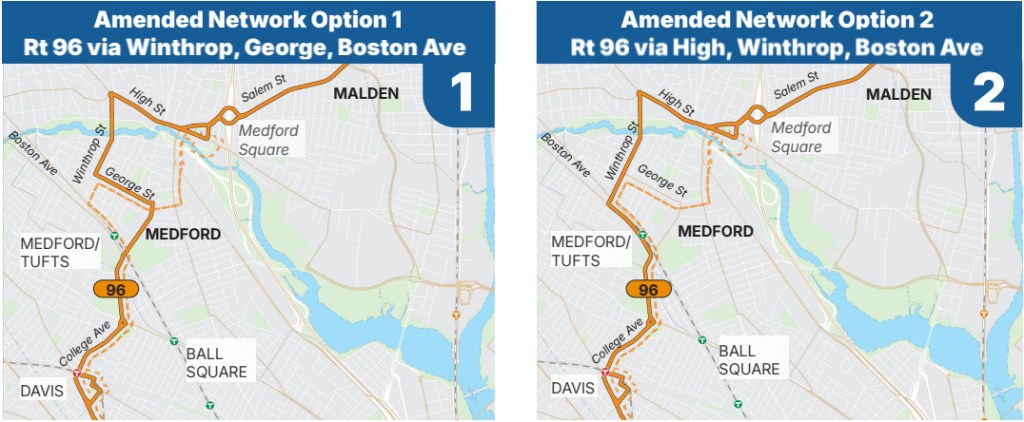
Package C modifies Route 96 to serve Winthrop Street and High Street either by way of George Street in Option 1 or Boston Ave. in Option 2, and terminating at Union Square instead of Harvard, although it would retain a connection to the Red Line in Davis Square.
Public Discussion
For many participants at the meeting, the most contentious proposal involves eliminating Route 96 service between Davis and Harvard, rerouting the bus from Davis down Elm Street and Somerville Ave. to terminate at Union Square’s Green Line station, instead of the Harvard Red Line stop.
Many participants raised concerns about losing direct access to Harvard, though MBTA staff assured that options to connect between Davis and Harvard remain between the two neighborhoods due to the high-frequency 77 bus and the Red Line.
MBTA staff also explained that the agency wants to prioritize a new frequent bus route through Union Square in Somerville – a neighborhood that currently lacks frequent service.
“You have options to go from a frequent bus to another frequent bus with the overall wait time should be time competitive,” explained Melissa Dullea, the T’s Senior Director of Service Planning at MBTA “Especially on weekends and off-peak times, we expect that the overall trip time would actually be better than the trip time today because of the frequency that’s expected on the new frequent bus route 96, along with existing high frequency 77 and/or Red Line, depending on which people are able to use.”
The second major debate focused on how Route 96 will wind through Medford near the Medford/Tufts Green Line station.
Julia, a 76 year-old rider, shared how walking up Boston Ave. for an alternative stop can take 15 minutes, and even more when she’s carrying groceries or traveling during the winter.
“I live in Medford, and I take the bus 96 every single day on George Street,” she said “I don’t have a car… and I use the MBTA for everything. And there are a lot of us who are like me… we all depend on that bus route 96.”
Dullea, acknowledging that her feedback would be considered in the T’s final decision, shared that all proposals will maintain a connection to the Medford/Tufts Station. But the detailed route will come down to choosing two streets out of High Street, George Street, and Boston Ave, and it may require a newly-constructed stop on College or Boston Ave.
Another potentially impacted route is the 94 bus, which was another hot topic of discussion.
The 94 today connects Davis Square, Tufts University, and Medford Square in a hook-shaped route that includes Boston Avenue and High Street.
Participants like Ben cited the need for the 94’s service along High Street, and its connectivity to the Green and Red Lines, and a person named Dana wrote in concern regarding Medford High students that don’t have yellow school bus service and rely on the MBTA to get to school.
Dullea assured that High Street would not be left without service, and that riders between Winthrop Circle and West Medford would be able to either walk to the 80 or the 96 routes, or make a transfer to the updated 95, which in this work is slated to be improved to “every 20 minutes or better” for most of the day, seven days a week, with every 30-minute service after 10 PM.
Pairing this 20-minute transfer on Route 95 with frequency improvements on Route 96 will allow riders to still access the Red and Green Lines, and the T to invest into better frequency on other areas of the network as the trade-off.
“The expected total trip time is slated to be faster than the total trip time with today’s lower-frequency 94,” explained Dullea.
In regards to the students, Dullea explained that beyond the 95 and the 134 that also reach the school, the T may consider special school period services to prevent multiple regular trips from getting bypassed, and retain those special purpose trips in the future network.
The 80 route will now terminate at Davis, while the 96 will continue down past Davis (similar to the 87), ending near Somerville Station due to being unable to turn around at Union Square.
Dullea shared the opportunities present with the accessibility of Medford Square, with two frequent-service route upgrades (the 96 and the 101), connecting to the Orange Line at Malden Center and Sullivan Station, the Green Line at Lechmere, and the Red Line at Kendall Square.
“So there would be two [buses] every 15 minutes, which you can sort of just walk up without really needing to consult the schedule for that kind of frequency,” said Dullea.
People will make “not just work trips, but a lot of trips on weekends, evenings, at all different hours because people are keeping just much different schedules now than they did even five and six years ago when we had been starting some of the plans,” Dullea explained.
Several other participants expressed concerns to other proposed route changes, expressed a desire for new bus routes, and asked the T to provide better bus shelters – especially if the new bus network requires them to transfer more frequently between bus lines.
“We are trying to simplify the network and provide people more access to more places with better frequencies… one of the trade-offs is sometimes people will have to transfer,” admitted Becca Wolfson, a project manager for the T.
But Wolfson assured the attendees that the T will try to make the experience less painful by assessing ridership and transfer activity to install bus shelters where they can.
Timeline
Participants asked about the timeline of the work and when these routes will go into effect, some out of fear of a quick change that will affect various populations in the city.
“I think a lot of us are afraid it’s going to happen immediately,” Medford resident Julie chimed in.
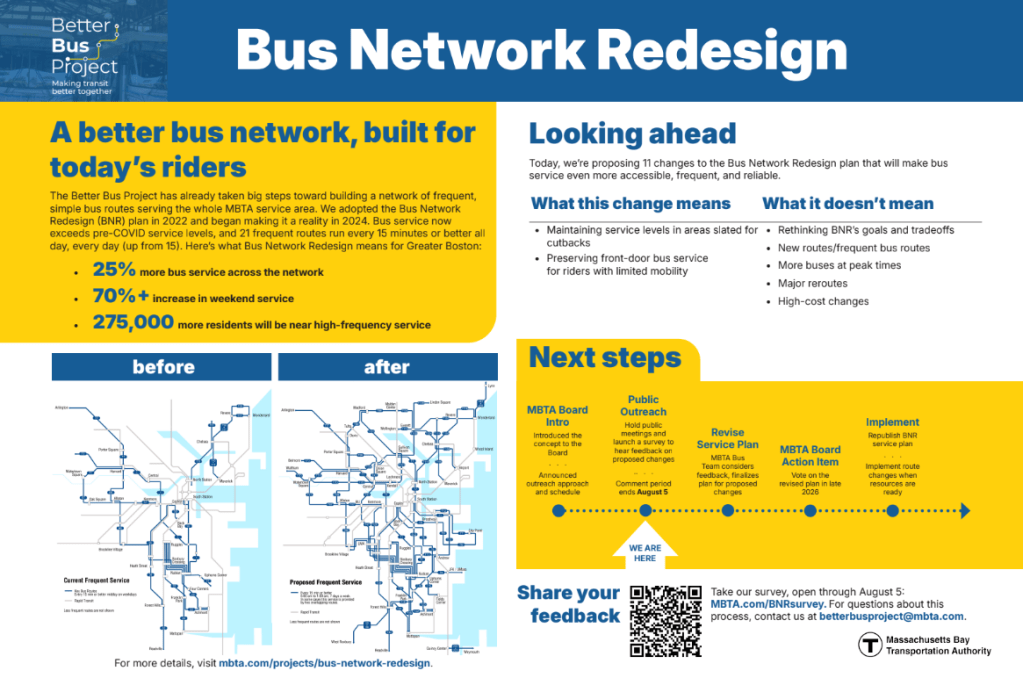
Though when asked when changes can be anticipated, Wolfson clarified that there is no specific timeline presently. While she hopes that by the end of 2026 there will be clarity on the proposed changes, Wolfson does not anticipate the changes taking place before 2028 at the earliest.
“There are so many changes expected in the Bus Network Redesign that we haven’t even started the initial planning process for,” Wolfson explained.
While staff assigned to Route 96 are getting started on research and planning, capital investments will need to be made to launch the route as envisioned under the redesign. “We definitely wouldn’t be ready to open that, you know, before two to three years from now.”
Comments on the proposed changes remain open until September 8th. Following this, the T will take in and assess all of the information, and make some updated decisions that need to be approved by the agency’s board.
To review the proposed network, riders can explore the T’s interactive map, which displays all of the proposed route changes and approximate frequencies in a searchable side panel. To weigh in on the BNR proposals, take the T’s survey. For questions about this process, contact betterbusproject@mbta.com.
Streetsblog has migrated to a new comment system. New commenters can register directly in the comments section of any article. Returning commenters: your previous comments and display name have been preserved, but you'll need to reclaim your account by clicking "Forgot your password?" on the sign-in form, entering your email, and following the verification link to set a new password — this is required because passwords could not be carried over during the migration. For questions, contact tips@streetsblog.org.