Minding the Gaps: Boston City Council Gets Updates On City’s Bike Network
On Thursday afternoon, Boston’s City Council Committee on Planning, Development, and Transportation held a hearing on truck safety and the status of Boston’s citywide plan for a connected network of safe bike routes.
In recent months, the City Council has used committee hearings to take a more active oversight role over Mayor Wu’s administration of key transportation safety and transit improvement projects, after a poorly-managed election-year “review” of the city’s transportation programs last year produced an effective blackout in public communications about key projects, and undermined the city’s ability to deliver street improvement projects.
Frustration with Mayor Wu’s apparent disregard for safety problems on the city’s streets boiled over this summer, when a truck driver struck and killed Louisa Gag, a well-known safety advocate and City Hall transportation planner.
In the wake of Gag’s homicide, Mayor Wu demoted Nick Gove, her former Chief of Streets, and recruited Chris Osgood, who had previously served the same role during Mayor Marty Walsh’s administration, to take his place.
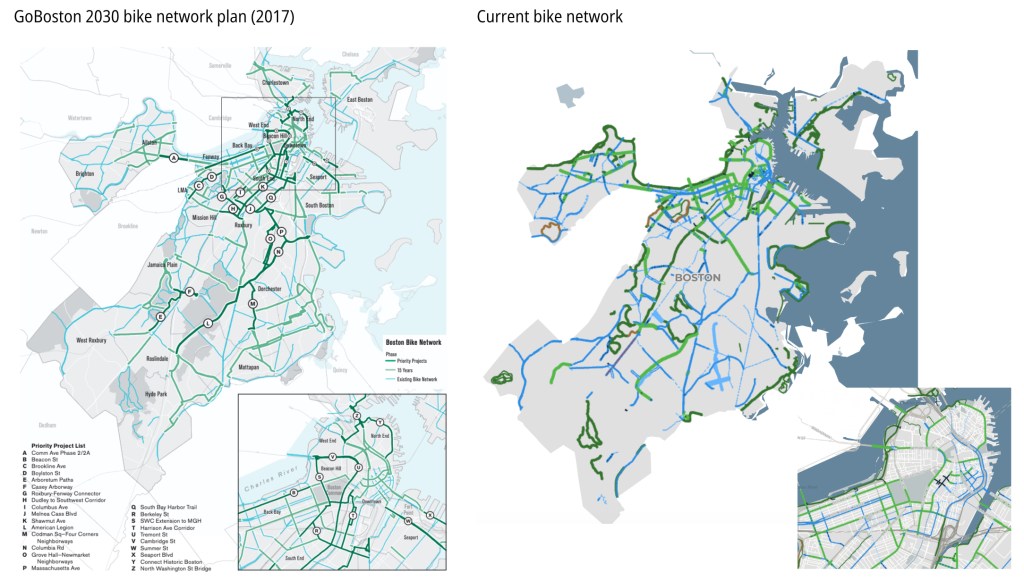
Under Walsh, Osgood took the lead in implementing the early stages of Boston’s then-new Go Boston 2030 plan, which included a vision for a citywide network of protected bike routes (see map above).
A decade later, many of those routes have been improved, at least partially, with some protected bike infrastructure.
But many of those routes do not connect to each other, and on many streets, protected bike lanes disappear at busy intersections, where they’re needed most.
“Part of what we need to do to make sure all of our key bikeways work best is to address some of the missing links that persist in some of these areas,” Osgood admitted. “Areas like Charles Street South, to be able to connect someone who might be cycling on Tremont Street in the South End and connect them to the Public Garden and Boston Common.”
Osgood also stressed that, in spite of its shortcomings, the improved bike network is having positive effects on safety and mobility.
“Since this work started, we have been taking annual bike counts since 2016, we’ve seen about a 60 percent increase in (bike) ridership and a 23 percent reduction in bike crashes since that time,” said Osgood.
“The work we do to make the road safer for cyclists has the co-benefit of making the road safer for everybody,” he later added.
Councilors press for details on delayed projects
Councilors seized the hearing as an opportunity to get answers from Osgood about the status of promised street safety projects, after the Wu administration had all but ceased any public hearings on transportation initiatives over the past year.
Committee chair Durkan asked about the status of the city’s promised Dartmouth Street bikeway, which had been envisioned as a connection between Copley Square and the Paul Dudley White bike path on the Charles River.
Currently, only half of that bike route has been completed, from Back Street to the unprotected paint-only bike lanes along the median of Commonwealth Avenue.
Osgood said that the remaining blocks from Commonwealth to Boylston Street would be built out in 2027. But Durkan expressed frustration that the project was taking so long, with so little public communication from City Hall.
“I actually got a support letter from the neighborhood association of the Back Bay, on bike infrastructure,” said Durkan. “When I fight for things, and I put my name on the line for things, and I put my political career on the line for bike lanes and safety infrastructure, I just want it to be delivered on.”
“I think that we only focus on community process when we’re listening to a certain voice.”
Councilor Sharon Durkan
Osgood also told councilors that his cabinet would soon be reviving a comatose project from Mayor Walsh’s administration, to connect the Southwest Corridor path to Franklin Park via Egleston Square.
“That is something which we do expect to move forward on and we expect to have some community conversations in the next few weeks,” said Osgood.
‘Community process’
Committee Chair Durkan also pressed Osgood for answers about his cabinet’s unexpected decision to delete a long-planned, privately-funded protected bike lane on Bennington Street, a dangerous multi-lane truck route in East Boston, against strong objections from neighbors.
“I wanted to get into a conversation about previously-approved bike infrastructure that is not being delivered, even outside my district. In what cases does the city decide to not move forward with something that is part of a development project, part of PIC (Public Improvements Commission) review? Why is that happening?” asked Durkan.
Osgood responded that “we are continuing to work on what the right design is on that very short stretch, but that link, that overall connection is one that we still anticipate delivering, and want to figure out” (editor’s note: it was unclear whether Osgood was talking about the Day Square bike lane, or a different bike path, built as part of the city’s Old Colony public housing redevelopment plan, that the city had recently ripped out).
Durkan pushed back.
“For a lot of us who weigh in on these processes at different points, especially for people who are here who bike everywhere, they don’t know that those conversations are going on,” she said. “I just think that we only focus on community process when we’re listening to a certain voice, and not more of a ‘yes’ voice… The people who ride on our streets are critical to that conversation. It feels like when we talk about ‘community voice’ we’re talking about a very specific set of individuals, and we need to hear from everyone.”