Failures of Communication and Accountability Plagued Mayor Wu’s Election-Year ‘Review’ of Transportation Department
An internal “30 day review” of city transportation projects that Mayor Wu requested during her re-election campaign last year was supposed to improve the public’s trust in the city’s ability to manage street safety and transit improvement projects.
“Through this review and recommendations, the Streets Cabinet can establish better project communications and engagement moving forward, which will enable the City and committed neighborhood leaders to work effectively together,” wrote Mike Brohel, the Superintendent of Basic City Services and the primary architect of the 30-day review, in an April 2 memorandum.
But a new public records release of hundreds of internal emails from that process demonstrates conclusively that the mayor’s review failed, and in fact demonstrably undermined those goals.
The emails reveal extensive failures in internal communications, dysfunctional working relationships, and an erosion in employee morale.
And the records also help explain why progress on dozens of transportation infrastructure projects has ground to a halt during Mayor Wu’s second term.
The ’30-day review’
In February of 2025, Josh Kraft, an inexperienced suburban politician with billionaire backers, launched a campaign to challenge Mayor Wu’s reelection with a platform that focused on his personal grievances against bike lanes.
“Our neighborhood streets have become jammed up by poorly conceived, hastily installed bus and bike lanes that all too often have increased congestion,” claimed Kraft.
The claim was dubious: less than 5 percent of Boston’s streets have bike lanes, and the handful of new bikeways that had been installed during Mayor Wu’s first term came on the heels of extensive shoe-leather outreach in their surrounding neighborhoods.
Kraft’s grievances never got much traction with Boston voters.
Nevertheless, just days after Kraft’s campaign launch, Mayor Wu announced that she would launch a 30-day review to rethink the city’s recent transit and safety improvement projects.
The review aimed to restore public trust in the mayor’s office and “demonstrate how community input shapes post-project followup,” according to a city memo dated February 21st.
But from the very beginning, the review sparked skepticism with an opaque process that offered limited opportunities for public engagement or oversight.
For the past year and a half, StreetsblogMASS has been pestering the city’s public records office to release emails and meeting details about the 30-day review, and to learn who was allowed to participate in it.
Those requests have yet to be honored, in violation of the state’s public records law.
But earlier this year, the city finally fulfilled a separate public records request from Benjamin Siegel, a resident and safe streets advocate from the Forest Hills neighborhood.
StreetsblogMASS has posted an abridged and annotated copy of those records that trims out hundreds of pages’ worth of redundant calendar RSVPs and duplicated email threads.
These emails offer, for the first time, a detailed look at how the mayor’s office conducted the 30-day review, who was allowed to participate, and its adverse effects on the day-to-day operations of Boston’s transportation department.
Flexposts disappear, accountability fades
One of the key revelations is that the 30-day review process created a duplicate layer of authority over the city’s transportation projects – one that fomented confusion and created opportunities for project opponents to stall safety projects indefinitely without accountability.
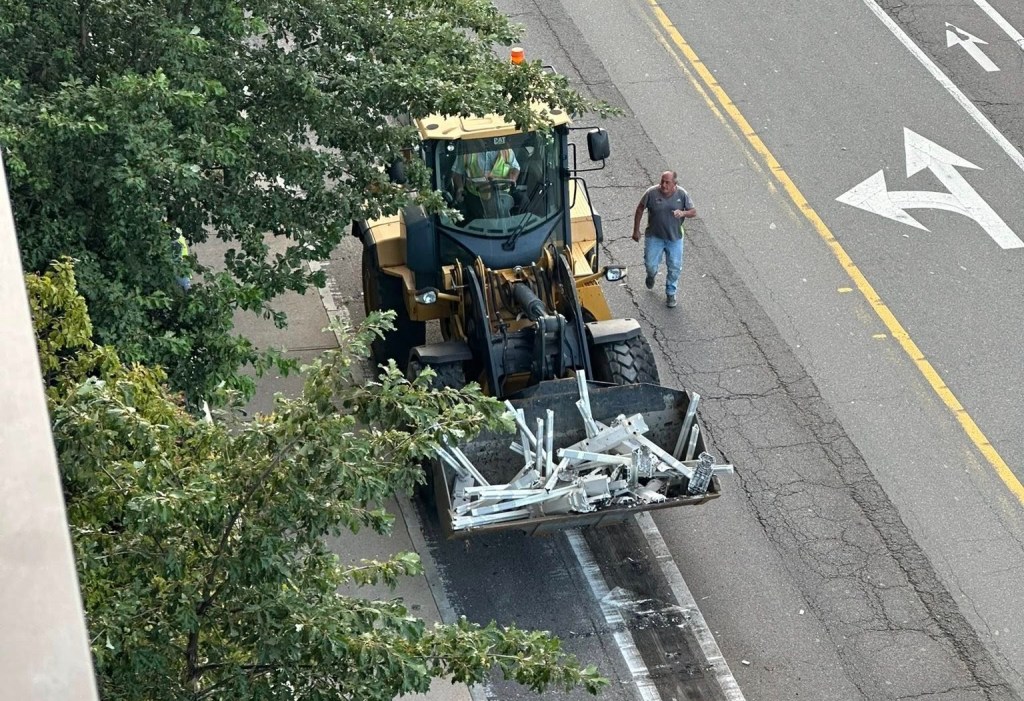
An early example of this dynamic came in early March 2025, when, while the review was still ostensibly underway, city crews abruptly removed protective bollards and curbs on several of the city’s recently-installed bikeways.
On the morning of Monday March 4, then-Chief of Streets Jascha Franklin Hodge engaged in a lengthy back-and-forth with Superintendent of Basic City Services Mike Brohel in a struggle to try and find out what was going on.
“A number of flexposts were removed on Arlington St without authorization. Trying to understand by whom, and what sequence of events lead to their removal,” wrote Franklin-Hodge.
Brohel initially denies any knowledge of the issue and dismisses the inquiry. But later that day, after the mayor’s press office got involved to try and answer an inquiry from StreetsblogMASS, Brohel acknowledged that the city had started removing flexposts – but pointedly avoided saying who was responsible.
“Like many areas of the city, (flexposts may) be broken/damaged by way of cars, trucks, plows and the like. They are collected from time to time,” Brohel wrote in a 2:10 p.m. email that he cc’ed and forwarded to the city’s press office, the mayor’s chief of staff, Chief of Streets Franklin-Hodge, and several other senior Wu administration officials.
Based on Brohel’s account, city’s press office ultimately told StreetsblogMASS that the flexpost removals were “previously discussed work” and that “flexposts are removed or replaced for a variety reasons, such as damage from vehicles” (we included this statement in our March 5 article on the controversy).
But internally, Franklin-Hodge warned the press office that their statement was “not accurate,” and asked to revise the statement in a way that would distance himself from the decision.
“I would suggest: ‘Flexposts on Mass. Ave. were removed as part of the 30-day project review. The City intends to re-install barriers in locations on Mass. Ave. where they are necessary to ensure pedestrian, cyclist, and driver safety,'” wrote Franklin-Hodge.
The mayor would later admit that the removal of flexposts was “a mistake” on a Boston Public Radio appearance in April 2025, and she promised that they would be replaced with more durable materials “soon.”
As of July 2026, that promise has yet to be fulfilled on most of the city’s bike lanes.
‘Vitriolic reply-alls’
The newly-released records also reveal two incidents where Mike Brohel attempted to leverage his new authority to elevate minor parking disputes to the mayor’s inner circle.
Brohel reports to Mayor Wu’s Chief of Staff, and is supposed to serve as “a connective tissue” between the mayor’s office and various city departments, according to a city spokesperson.
On March 13, Brohel emailed Julia Campbell, then a Deputy Chief of Streets, to inform her that an unidentified West Roxbury business owner was upset about the loss of on-street parking in a construction zone on Belgrade Avenue.
The Belgrade Avenue work was a routine bridge repair project that lasted from December 2024 to March 2025.
Brohel chastised Campbell because several posted “no parking” signs in the construction zone had an expired permit. Instead of contacting Campbell directly, he also copies his complaint to ten other senior members of the Streets Cabinet.
“Needless to say this is an embarrassment for the city, given our current engagement,” Brohel complains. “Never mind the Belgrade work being a point of active contention and acrimony.”
Brohel then forwarded the same complaint in a separate email thread to Mayor Wu’s top advisers: Tiffany Chu, the Chief of Staff, Mike Firestone, Chief of Policy and Strategic Planning, Ricardo Patrón, Chief of Intergovernmental Relations, and Mohammed Missouri, the mayor’s Director of Stakeholder Engagement.
In his message to the mayor’s inner circle, Brohel added a final note: “We continue to build distrust in our neighborhoods and our business districts. Really not sure what else to say at this point.”
A few minutes later, Chief of Streets Franklin-Hodge responds to debunk Brohel’s complaints.
“I am not aware of the Belgrade bridge work being ‘a point of active contention and public acrimony’ save for the concerns you’ve raised from West On Centre (restaurant) about the temporary loss of ~5 on-street parking spaces. Our team has not received negative feedback on this project,” wrote Franklin-Hodge.
“As a point of basic professionalism, if you believe the work of my team is ‘an embarrassment to the city,’ it is appropriate to bring it directly to my attention,” Franklin-Hodge continued. “Vitriolic reply-alls are not an appropriate or constructive way to do business.”
A similar argument occurs on March 27, when Brohel intervenes on behalf of a resident who had illegally parked in a bike lane in a school zone on American Legion Highway.
In the email thread, another city staffer explained that the perpetrator had “reported to one of our phone bank agents that she parks there daily picking her daughter up for school. This is exactly why it is so important to uphold our enforcement efforts and the compliance process – to curb illegal parking behavior.”
But instead of accepting the city’s laws, Brohel implies that his City Hall colleagues are actually to blame.
“There can be no other place for parents to handle pick up and drop off,” he claimed.
He cc’s his complaint to multiple senior Streets Cabinet staff, while making it clear that he blames them for creating the bike lane: “Adding folks Nick (Gove), John (Romano, the Boston Transportation Dept. Director of Operations), and Jascha (Franklin-Hodge) here as well for awareness on the condition that’s created this situation.”
Then, just as he did in the Belgrade Avenue dispute, he forwards the entire thread to Chu, Firestone, Patrón, and Missouri in the mayor’s office, “for awareness.”
StreetsblogMASS reached out to the City of Boston’s press office on Monday to learn whether adjudicating minor parking disputes is part of Brohel’s official job description.
A city spokesperson said that as Superintendent of Basic City Services, Brohel is supposed to coordinate responses to quality-of-life concerns, and ensure that municipal services are delivered efficiently.
Whose opinions count
When she announced her 30-day review of the city’s transportation programs in February 2025, Mayor Wu’s administration said that the process would gather feedback through “one-on-one and small group neighborhood meetings.”
With this week’s public records release, we finally know the select few who were actually included in those meetings.
In a series of emails delivered on the evening of April 2, Brohel thanked roughly two dozen individuals and organizations for volunteering their time, and sent them copies of the memorandum with his final recommendations.
Recipients included large business groups like the Longwood Collective and the Newmarket Business Association, a few small business owners, and a number of wealthy homeowners who hold executive positions in various neighborhood organizations.
A number of them – like Meg Mainzer-Cohen, Executive Director of the Back Bay Association, had been well-known critics of bike and bus lanes.
“How did they decide who to meet with?” asked TransitMatters executive director Caitlin Allen-Connolly after reviewing the emails on Tuesday. “The advocacy community reached out repeatedly, collectively and individually, and we got absolutely no response until we got some press on it – and that’s a problem.”
But while the mayor’s office was having personal meetings with a small number of politically well-connected individuals, they were also receiving hundreds of messages from ordinary Boston residents who also wanted to weigh in.
And the vast majority of those people were telling the mayor that they wanted her to preserve and expand her administration’s street safety and traffic-calming initiatives.
“I urge you not to be swayed by the loud voices of a minority of people who believe their right to dangerously drive… surpasses the rights of the rest of us to walk, bike, and live safely,” warned Susan Sheffler of Roslindale.
“I now feel comfortable biking… I sincerely hope that you continue this effort,” wrote Dorothy Pazin of Jamaica Plain.
“We need more protected bike lanes and traffic calming to make our city better and help everyone get around faster,” wrote Anthony Roulier of Dorchester.
Mohammed Missouri, the mayor’s Director of Stakeholder Engagement, responded to the vast majority of those emails with a cut-and-paste form letter.
“The City will review all comments received,” Missouri promised.
But the final memorandum that Mike Brohel published on April 2, at the conclusion of his review, pointedly omitted any mention of the hundreds of people who had reached out to express their support of the city’s safer streets initiatives.
In that final memo, Brohel alleged – falsely – that there had been “consistent feedback that project communications and community engagement were inadequate.”
Brohel then delivered this verdict to summarize his private meetings:
“Many felt that their feedback was given insufficient attention… We heard feedback that the tone of some engagements was very heavy-handed, and relevant information was not shared, questioning the veracity of the process.
The fallout
The public records discussed in this article span the period from early March to early April 2025. They are not comprehensive – StreetsblogMASS was cc’ed on over 200 emails from safety advocates who wrote to Brohel during this period, and only a few of those are included in this package. Nor do they reveal anything about what happened inside City Hall after the 30-day review was finished.
But we do know some of the outcomes.
Jashca Franklin-Hodge and Deputy Chief of Streets Julia Campbell both resigned after Mayor Wu’s reelection, as did Sarah Anders, the Streets Cabinet’s Chief of Staff. Vineet Gupta, the department’s longtime Director of Planning, announced his retirement this winter after 37 years at City Hall.
Dozens of transportation projects across the city have been cancelled, delayed, or lost federal funding, with little explanation.
In summer 2025, with no public notice, the Wu administration removed a bus lane on North Washington Street in downtown Boston that had been speeding up transit trips for roughly 15,000 daily bus riders on the 111, one of the MBTA’s busiest bus routes.
In March of this year, Streetsblog obtained other internal emails that revealed how the mayor’s new Chief of Streets, Nick Gove, explicitly instructed his employees to stop meeting with the MBTA in order to arrest progress on the long-planned Columbus Avenue busway project, which had been scheduled to begin construction this spring.
And last week, after a truck driver struck and killed Louisa Gag on Tremont Street in Mission Hill, we also learned that City Hall’s leadership had also shelved plans for safety improvements on several streets and intersections near the scene of the homicide.
On Monday, after the city’s emails became public, StreetsblogMASS asked Mayor Wu whether she really believes that trust and communication have improved since the 30-day review.
At the time of publication on Wednesday afternoon, the mayor had not responded to that question (we’ll update this story if and when she does).
Caitlin Allen-Connolly of TransitMatters was more forthright.
“Where is the mayor in all this, and who’s in charge?” she asked. “It’s not the mayor’s fault that Louisa died. It’s no individual person’s fault. But we can clearly see that there’s been a collective failure in all these projects, where there’s been a clear breakdown in communication and in the chain of command inside City Hall.”

Read More:
Streetsblog has migrated to a new comment system. New commenters can register directly in the comments section of any article. Returning commenters: your previous comments and display name have been preserved, but you'll need to reclaim your account by clicking "Forgot your password?" on the sign-in form, entering your email, and following the verification link to set a new password — this is required because passwords could not be carried over during the migration. For questions, contact tips@streetsblog.org.