The Green Line’s Future Relies On A $2 Billion Bet With President Trump
Over the past few years, MBTA officials have been working on a multi-billion-dollar plan to upgrade the Green Line with new, higher-capacity trains capable of moving more people, more quickly, on newly-renovated tracks through the nation’s oldest subway.
The agency calls the initiative the Green Line Core Capacity program, and the agency is already spending millions of dollars on preliminary design and engineering work in preparation for construction at the end of this decade.
There’s just one potential problem: the T is counting on the federal government to put up half of the program’s $4 billion cost.
President Trump and his cabinet, who have been reluctant to fund transit projects anywhere in the U.S., currently have the final say over whether the MBTA will receive that funding.
Big spending for bigger trains
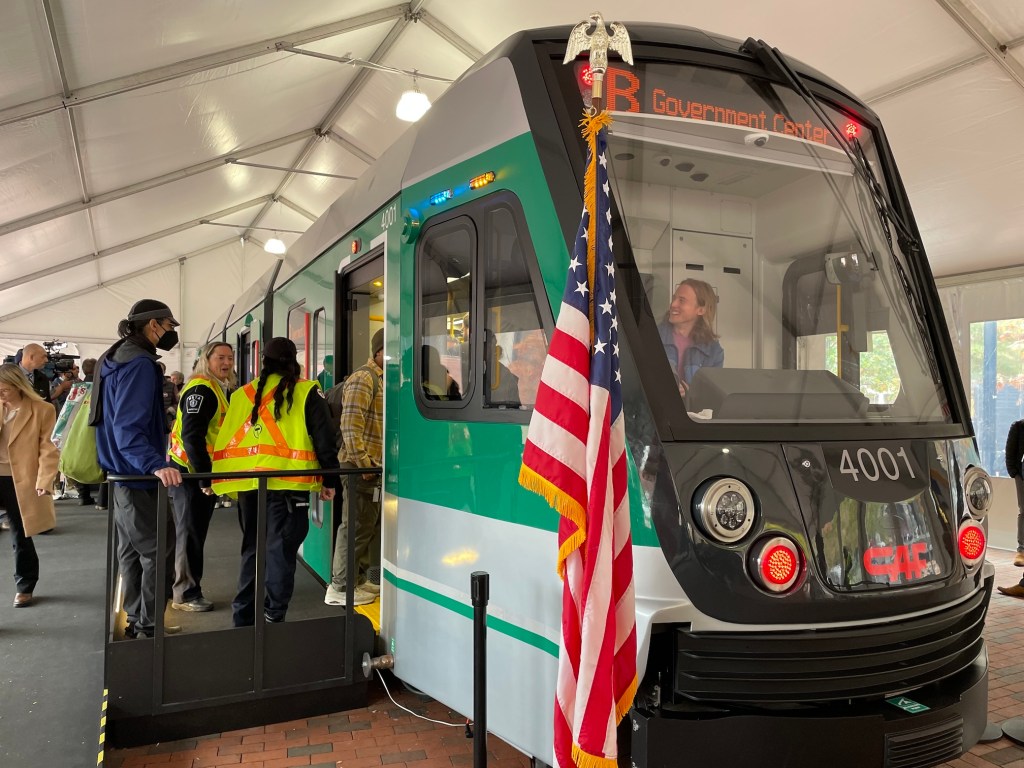
In 2022, the T inked a $810 million deal to start replacing its Green Line fleet with accessible, higher-capacity “Type 10” trains, like the prototype pictured above.
These bigger trains won’t fit into some of the Green Line’s existing tracks and stations, which were originally designed for much smaller 19th-century streetcars.
So to prepare for the new trains’ arrival, the T is also planning an additional $4 billion suite of projects including new tracks, signal and power system upgrades, station renovations, and reconfigurations of its major maintenance facilities and yards.
In 2022, when Joe Biden was still the president, the Federal Transit Administration (FTA) invited the T to apply for a grant to finance half of the necessary work.
This funding would come from the FTA’s Capital Investment Grants (CIG) program, which is how Washington funds big-ticket rapid transit projects nationwide.
The T had hoped to have final approval for its grant application by April 2027, when its first Type 10 cars are ready to enter service.
But since President Trump’s return to the White House in January 2025, approvals for CIG grant applications nationwide have slowed to a trickle.
Last month, the Trump administration added more uncertainty with a proposal to change the rules for CIG grants – a change that could jeopardize the Green Line Core Capacity project’s ranking in the CIG program.
At the end of last week, the FTA did offer a measure of relief to the MBTA by allowing the the Green Line application to start its final engineering phase, the final step before construction and a full funding grant agreement.
In a press statement, the FTA’s Associate Administrator for Communications and Government Affairs, Connor Torossian, said that “by advancing the Green Line’s modernization into the Engineering phase, we are backing a smart, practical upgrade to a historic corridor that moves nearly 95,000 people every day.”
But under current rules, the FTA can’t actually approve the grant and send the money to Massachusetts until the President includes it in his executive budget.
In the past 22 months, Trump’s FTA has approved just one CIG grant agreement – a $149 million grant for side-running bus lanes on Vermont Avenue in Los Angeles.
The T isn’t waiting alone. Dozens of other transit agencies have major projects in limbo as a result of the Trump administration’s obstruction.
“The new guidance is a part of the Trump administration’s systematic campaign to reduce or eliminate funding for new transit projects,” Yonah Freemark, principal research associate at the Urban Institute, told StreetsblogUSA. “It’s basically a crisis for transit agencies.”
Next step: Trump’s desk
Because of the risks involved in complex projects and the massive amounts of funding involved, the FTA requires a great deal of expensive due diligence from transit agencies before it writes a check to begin construction.
A CIG project begins in “project development” – which the T initiated for its Green Line project in 2022.
During this phase, the transit agency must outline a scope of work, finish its environmental analysis, commit to a local financing plan, and complete early design and engineering work.
The T completed this work in early 2025, but Trump’s FTA took an unusually long time to give its stamp of approval. MBTA officials waited about 15 months for the FTA to make their announcement, last week, that the project could proceed to the engineering phase.
During the engineering phase, the applicant prepares more detailed design blueprints, and finalizes its schedules and cost estimates. The MBTA has already begun some of this engineering work as part of its most recent capital improvement plan (see below).
Crucially, all the work during these two planning stages are done at the transit agency’s own risk, although these costs are all count towards the required dollar-for-dollar local match for CIG funds.
Even if the T meets all of the FTA’s technical requirements, that won’t necessarily be enough to actually receive the funding.
Before any money can move out of the federal Treasury, a CIG grant agreement also needs to be included in the president’s annual budget.
“Including a project as a funding recommendation in the President’s budget is an executive branch prerogative,” according to the FTA’s policy guidance.
The Green Line’s core capacity projects
Even though the funding is uncertain, the T is already spending millions of dollars on detailed engineering plans for more than a dozen Green Line core capacity projects.
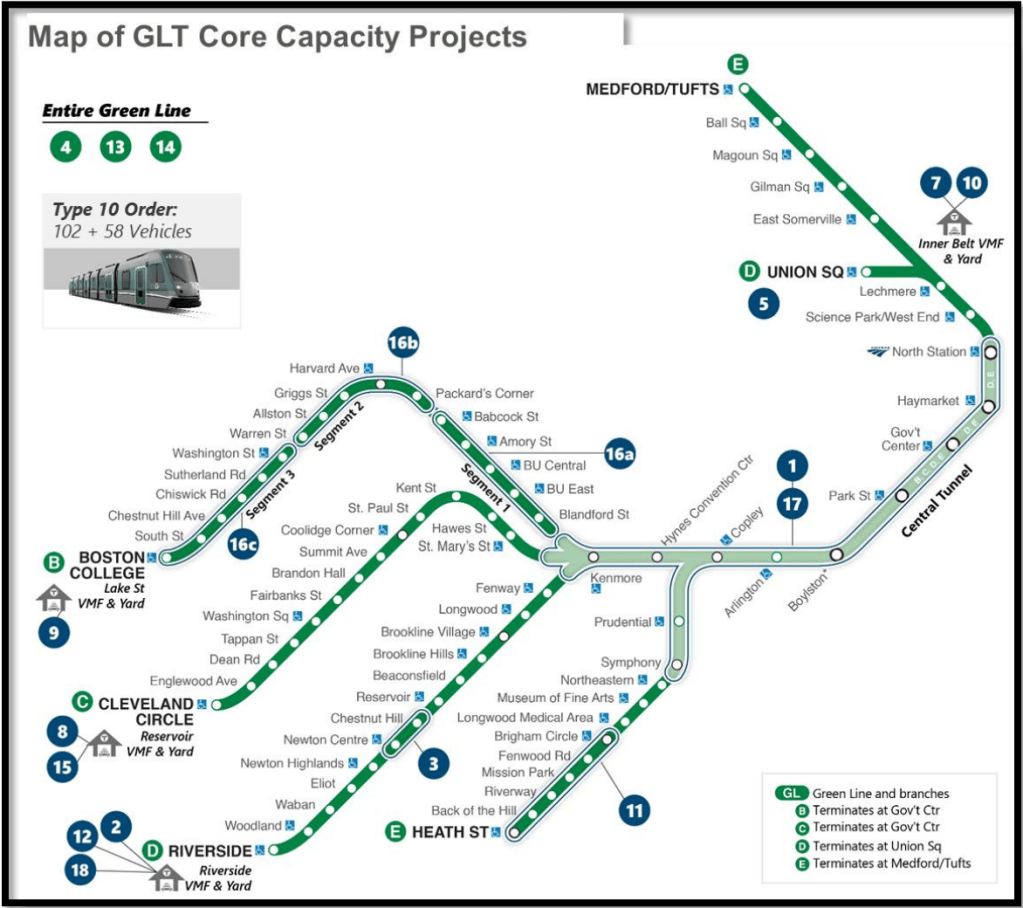
The agency’s most recent capital investment plan budgeted $891 million worth of Green Line core capacity spending over the next five years.
If the agency ultimately receives a $2 billion CIG grant, all this spending would count towards the agency’s required dollar-to-dollar match for the federal funds.
Among the “core capacity” projects that are already in the works:
- A $285 million project to build new stations and a dedicated center-running transitway for E branch trains on Huntington and South Huntington Avenue in Mission Hill (#11 in the map above), where buses and Green Line trains currently share a roadway with private vehicles.
- $200 million to renovate B branch stations and tracks along Commonwealth Avenue (#16a, #16b, and #16c in the map above).
- A $45 million test track on the D branch in Newton (#3 in the map above), where the T will conduct the necessary testing for new trains before they start carrying passengers
- A $33 million project to assess and adjust overhead catenary wires to make them compatible with the new trains
- $34 million for D branch electrical system upgrades, including a new traction power substation to support the new trains’ power requirements
- Track and power upgrades for the Green Line central tunnel (some of this work has been started during this fall’s Green Line closures)
- $297 million for track reconfigurations, facility upgrades, and other supporting infrastructure at various Green Line storage yards and maintenance facilities (Reservoir Yard, Lake Street Yard, Inner Belt Yard, and the Riverside Vehicle Maintenance Facility)
The new trains will also require platform height adjustments at most Green Line stations to allow for accessible, level boarding.