Legislature’s Fair Share Budget Compromise Gets MBTA Closer to Budget Fix
A new compromise on Beacon Hill for unspent Fair Share surtax funds would give the T nearly half a billion dollars to help it fill its large structural funding deficit for one more year.
While the official state budget for fiscal year 2026 is still being debated, legislators from the House and Senate have reached an agreement on a “supplemental” budget that will allocate $1.3 billion from higher-than-expected Fair Share taxes that the state has been collecting since 2023.
The legislature’s compromise would give the T less funding than Governor Healey had initially proposed in her own budget plan from January.
The Governor had proposed setting aside $765 million in supplemental Fair Share funding for the T, most of which would have been set aside to replenish the agency’s depleted reserves and would have fixed most of the T’s budget problems until after Healey’s reelection race in 2026.
The Legislature’s proposed compromise would leave the T with a much smaller cushion of reserve funds, making it more likely that the legislature would need to approve new taxes or fees to fund public transit in next year’s budget.
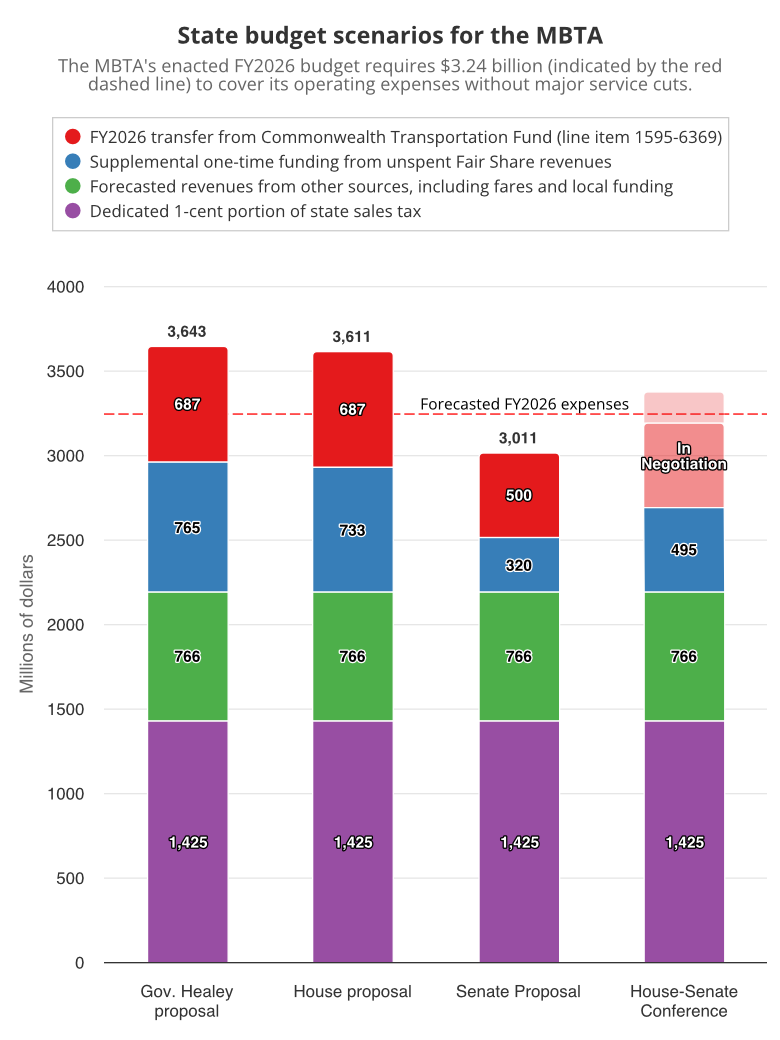
The legislature’s compromise proposal, by contrast, would give the T a $495 million infusion for its operating budget: $300 million to replenish its deficiency fund, $175 million for its workforce and safety payroll reserve, and $20 million for low-income fares.
The bill would allocate another $60 million for MBTA capital projects.
Larger 2026 budget bill still under negotiation
The compromise on the supplemental budget gets the T closer to meeting its projected budget for 2026, but there’s still one big piece of uncertainty: how much additional assistance the agency will get from the Commonwealth Transportation Fund, which is traditionally its largest source of additional state funding.
That funding will be determined in the legislature’s bigger fiscal year 2026 budget package.
Lawmakers are supposed to approve the annual budget by July 1, but they frequently procrastinate their final votes well beyond that deadline.
The Governor and the House both proposed to give the T $687 million in operations funding from this year’s Commonwealth Transportation Fund transfer, but the Senate had proposed a smaller $500 million contribution.
If lawmakers go with the Senate’s figure in their final budget proposal, then the T would likely need to spend all of its remaining reserves next year, and might need to make some additional spending cuts in order to balance its budget.
MBTA board-approved budget requires nearly $1 billion in state assistance
At last week’s monthly meeting, the MBTA Board of Directors approved an operating budget for the next fiscal year – which starts on July 1 – with a projected $3.24 billion in expenditures.
The approved budget assumed that the legislature would provide at least $969 million from its fiscal year 2026 budget law and the supplemental Fair Share budget.
The budget plan also relies on a $86 million drawdown from the agency’s dwindling deficiency reserve fund, and an $82 million “savings target” from cost-cutting initiatives, like reduced overtime spending and reduced reliance on third-party consulting contracts.
One of the biggest challenges in the T’s budget is its growing workforce, which would collect over $1.3 billion in wages and benefits in the board-approved budget.
The budget plan calls for hiring another one thousand workers to fill vacant positions in its ranks of bus operators, safety workers, and maintenance shops.

Read More:
Streetsblog has migrated to a new comment system. New commenters can register directly in the comments section of any article. Returning commenters: your previous comments and display name have been preserved, but you'll need to reclaim your account by clicking "Forgot your password?" on the sign-in form, entering your email, and following the verification link to set a new password — this is required because passwords could not be carried over during the migration. For questions, contact tips@streetsblog.org.