MBTA Communities Act Holdouts Are Losing State Funding

Consequences are starting to set in for communities that are not in compliance with the state’s mandate to increase transit-oriented, affordable housing supply in a landscape that is in dire need of it.
Over the holiday season, Tewksbury Public Schools received notice from the Department of Elementary and Secondary Education (DESE) that they were ineligible for certain grants due to being noncompliant with the MBTA Communities Act.
The MBTA Communities Act
To increase housing supply, promote walkability and transit access, and create diverse housing options for Massachusetts residents, the legislature passed the MBTA Communities Act in January of 2021.

The law requires cities and towns that have an MBTA station (commuter rail, subway, or ferry), or are adjacent to another town with a station, to update their zoning to legalize additional, multifamily housing units.
The most recent deadline to adhere to the legislation passed on December 31st, 2025.
In July of last year, Attorney General Andrea Campbell even warned that the state may enforce against those noncompliant towns come 2026.
Noncompliance Isn’t Cheap
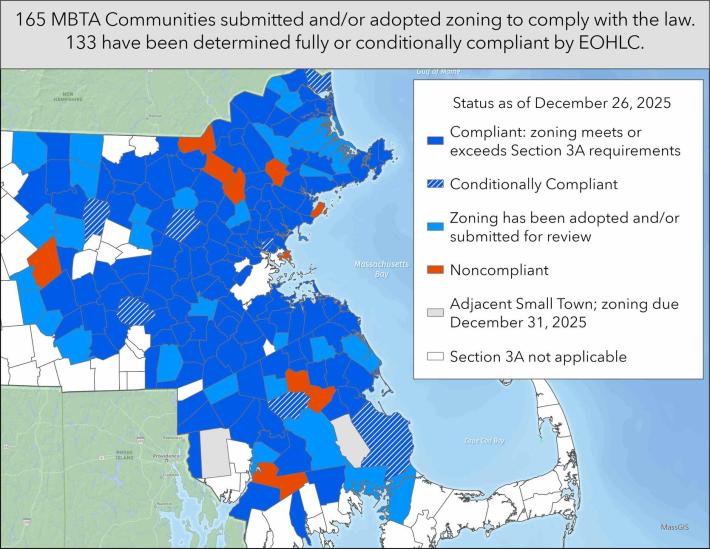
The twelve remaining municipalities that still haven’t amended their zoning rules to comply with the law are: Carver, Dracut, East Bridgewater, Freetown, Halifax, Holden, Marblehead, Middleton, Rehoboth, Tewksbury, Wilmington, and Winthrop.
The consequences are beginning to show for those cities and towns.
Holden lost grants of roughly $25,000 dollars, including a recycling grant. Middleton lost a $2 million dollar MassWorks grant, in addition to funding for a Council on Aging passenger van that would have provided seniors with an affordable, accessible option for their local transportation needs.
Winthrop, a coastal town that’s within walking distance of the Blue Line and has its own ferry route, lost two state grants totaling about $1.2 million dollars in September of last year.
How the state is engaging with noncompliant municipalities was most notably on display in Milton, where the town was engaged in a public back-and-forth with the state since 2023.
Milton has four light rail stations on the Mattapan line, which connects to the Red Line at Ashmont.
But Milton is also an embarrassing example of the Boston region’s persistent segregation. 71 percent of Milton’s residents are white, and the town’s median household income is $178,053, more than 1.7 times the statewide average. By comparison, the 02126 zip code for Mattapan, which is located right across the Neponset River from Milton’s four light rail stations, is 71 percent Black, with a median household income of $67,206.
The town initially approved a rezoning plan in December of 2023, but voters shot down that plan in a special referendum in February 2024. The Attorney General’s office filed a lawsuit against Milton mere weeks later, and the Supreme Judicial Court of Massachusetts upheld the law but granted municipalities more time to comply at the beginning of 2025.
Finally, a Town Meeting vote of 69 to 31 percent adopted zoning language that would allow for potentially 2,461 new units last June, which brought the town into compliance with the state law.
Tewksbury in Hot Water
Most recently, Tewksbury has been bearing the brunt of state enforcement.
In May of 2024, Tewksbury’s voters rejected plans to rezone an 84-acre area of Main Street by a wide margin of 565-142. State directives encourage zoning plans that could theoretically handle at least 1,214 units of housing, but Tewksbury’s plan was done so in a way that would have only resulted in the development of a fraction of that target.
Still, progress to align with the MBTA Communities Act stalled out with a 3-2 vote blocking an attempt to even bring the measure back to Town Meeting in April of 2025, resulting in Tewksbury missing the end-of-year cutoff. Now, the town is feeling the consequences.
At the town’s December 17th School Committee meeting, the district Superintendent, Brenda Theriault-Regan, provided notice that the district was “currently ineligible for certain educational grant funding due to the town of Tewksbury’s noncompliance with the MBTA Communities Act.” by DESE.
The grants that Tewksbury is now ineligible for include an Early College planning grant for $50,000, an Early College designation funding grant for $250,000 over five years, and a time-out practices implementation grant for $50,000.
Superintendent Theriault-Regan also shared that Tewksbury’s participation in current grants for 2026 and eligibility for future ones are all “at risk until the town remediates this compliance issue.”
‘Just stay tuned’
It remains to be seen exactly what other consequences the state may enforce on the other 11 cities and towns. But if they remain noncompliant, they will continue to lose critical funding, and the state may even have a court-appointed official who could override local zoning authority to create or revise local zoning bylaws – without the municipality’s input.
In a WGBH interview earlier this week, AG Campbell was asked about her plans, timeline, and strategy to respond to noncompliant municipalities. Her remarks begin at 24:24.
“We are on top of this,” Campbell said Tuesday on GBH Radio, citing that there are roughly 165 out of 177 municipalities that have adopted compliant zoning.
As for those remaining few, Campbell noted that they were given until the end of January to come into compliance, “and those who do not, we will take action as appropriate by the end of the month… We’re evaluating those options, and we’ll have something, certainly by the end of this month.”
Streetsblog has migrated to a new comment system. New commenters can register directly in the comments section of any article. Returning commenters: your previous comments and display name have been preserved, but you'll need to reclaim your account by clicking "Forgot your password?" on the sign-in form, entering your email, and following the verification link to set a new password — this is required because passwords could not be carried over during the migration. For questions, contact tips@streetsblog.org.