Climate Report Card Gives MassDOT A Failing Grade As Mass. Misses Key Climate Goals
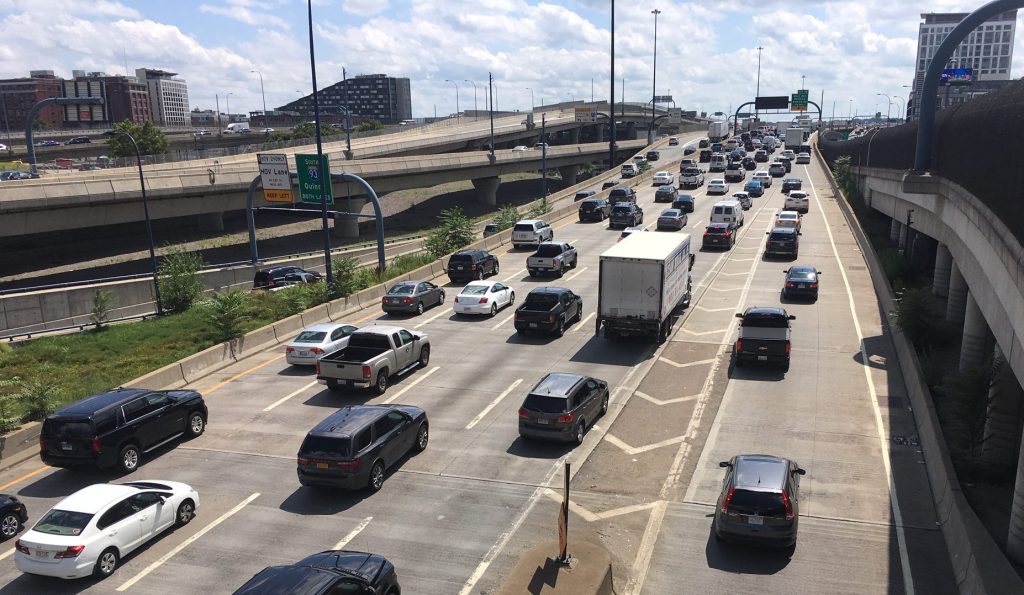
Massachusetts missed key benchmarks in its climate plan for the year 2025 thanks to persistent pollution from the state’s roads and highways, the state’s biggest source of climate-heating pollutants.
Under state law, Massachusetts must reduce the entire economy’s climate pollution to at least 50 percent below 1990 levels by 2030 as an interim step towards “net zero” emissions by 2050.
There’s been considerable progress toward that goal in the heavily-regulated electric power and building construction sectors, which have been pressed to shut down fossil-fueled power plants, improve energy efficiency, and expand renewable electricity production.
But lawmakers have been extremely reluctant to regulate MassDOT to a similar degree.
As a result, MassDOT’s own bureaucracy regularly ignores the state’s climate goals.
In 2024, for instance, the agency’s new long-range strategic plan, Beyond Mobility, evaded any committment to comply with the state’s official climate plan.
And earlier this year, environmental filings for the MassDOT’s Cape Cod bridge replacement proposal revealed that MassDOT does not intend to meet the state’s legally-mandated pollution-reduction requirements.
Sluggish EV sales, surging traffic congestion
The transportation sector as the worst source of climate-heating pollutants in the Commonwealth, and the state’s official climate plan recommended two broad strategies to tackle the problem: reducing “vehicle miles travelled” by shifting more trips to walking, biking, and public transit, and putting at least 200,000 electric cars on the road by 2025.
On both measures, Massachusetts is officially falling short.
According to an annual climate report card published by the state’s climate office Friday morning, there were only 166,296 electric vehicles registered in Massachusetts at the end of 2025 (and a third of those were plug-in hybrid models with gasoline engines).
Meanwhile, the number of “vehicle miles travelled” (VMT) continues to grow unsustainably, generating more tailpipe pollution and traffic congestion on the state’s roadways.
According to the report card, Massachusetts drivers logged over 58 billion miles of driving in 2025, a 9 percent increase since 2023.
Those worrying statistics are also evident in the state’s gasoline tax collection data, which StreetsblogMASS has been tracking for several years as a proxy for climate pollution from roads and highways (see chart below).
Massachusetts drivers burned 2.53 billion gallons of gasoline in 2025, which pumped 22.5 million metric tons of climate-heating pollutants into the Commonwealth’s skies.
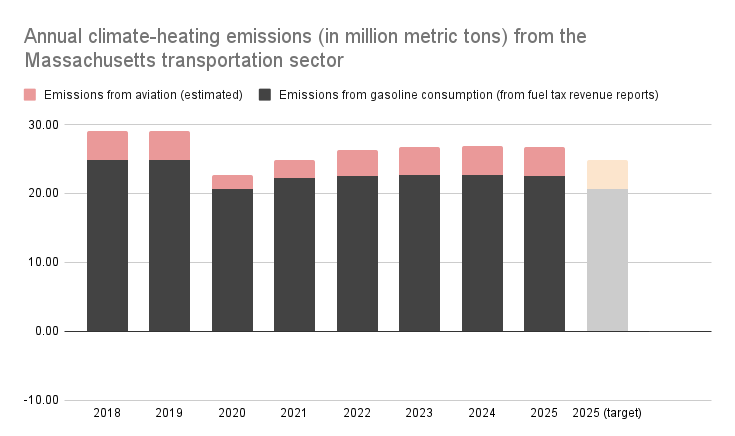
Fuel tax collection data indicates that this represents a 1 percent decrease from last year’s gasoline consumption – a sign that more fuel-efficient vehicles may finally be making a difference.
But MassDOT would have needed to post a 9 percent decrease in gasoline consumption this year to actually meet its 2025 emissions targets.
Pointing fingers vs. taking action
The Healey administration wants to pin some of the blame for their failing grades on the Trump administration and Republicans in Congress.
“In the past year, the Trump Administration rolled back EV tax credits, dismantled fuel economy standards, and attacked states’ ability to support EV adoption. These actions have slowed our progress,” Hardiman wrote in an email to StreetsblogMASS Friday morning.
However, the state’s EV sales were lagging behind expectations long before Donald Trump took office for his second term at the beginning of 2025.
In October 2024 – before Trump’s election – Governor Healey announced that she would delay implementation of a regulation that California had adopted that would have required truck dealerships to sell more electric models.
Public transit offers a silver lining
There is one benchmark in the state’s new climate report card that offered a glimmer of good news: MBTA ridership increased by 10 percent in 2025 compared to the previous year.
The state doesn’t have much leverage in the electric vehicle market, but improving public transportation is something that Massachusetts policy makers have much more control over.
“We are continuing to advance strong support for EVs in Massachusetts through investments in charging infrastructure and rebates, while also transforming our public transportation infrastructure – both at the MBTA and regionally – to boost ridership,” Hardiman told StreetsblogMASS.
The person who can claim the most credit for the MBTA’s growing ridership, General Manager Phil Eng, is now in charge of MassDOT.
StreetsblogMASS has reached out to Eng and the MassDOT press office to ask whether the agency would take more responsibility under Eng’s leadership for meeting the state’s climate goals. We will update this story if and when we receive a response.

Read More:
Streetsblog has migrated to a new comment system. New commenters can register directly in the comments section of any article. Returning commenters: your previous comments and display name have been preserved, but you'll need to reclaim your account by clicking "Forgot your password?" on the sign-in form, entering your email, and following the verification link to set a new password — this is required because passwords could not be carried over during the migration. For questions, contact tips@streetsblog.org.