Wheels Start Turning For the Lower Broadway – Alford Street Transit Priority Corridor Project
The MBTA is developing design concepts for a new dedicated busway that would connect Sullivan Square area to Everett on Broadway and Boston’s Alford Street bridge in hopes of locking down a $22 million grant that was awarded during the Biden administration.
Nearly two years ago, Washington pledged a $22 million-dollar federal grant to construct a dedicated busway along the Lower Broadway – Alford Street corridor between Sullivan Square and Everett.
The concept germinated about 10 years ago with MassDOT’s 2016 Everett Transit Action Plan, which recommended bus lanes to connect Everett to the Orange Line at Sullivan Square.
Later, MassDOT, in conjunction with the T, recommended the route for a planned extension of the Silver Line from Chelsea into Everett.
15,000 new bus riders
The T expects that, because it would connect multiple destinations where transit demand is high, this extended Silver Line route would attract extremely high ridership, adding more than 15,000 daily riders to the SL3 route.
That would bring the total SL3 ridership to over 27,000 daily riders, which would make it busier than some branches of the Green Line.
“Everett and Charlestown residents will get a new one-seat ride to Chelsea, East Boston, Logan Airport, Seaport, and South Station,” said Andrew McFarland, a Senior Project Manager at the MBTA who presented the T’s plans during Thursday’s virtual meeting.
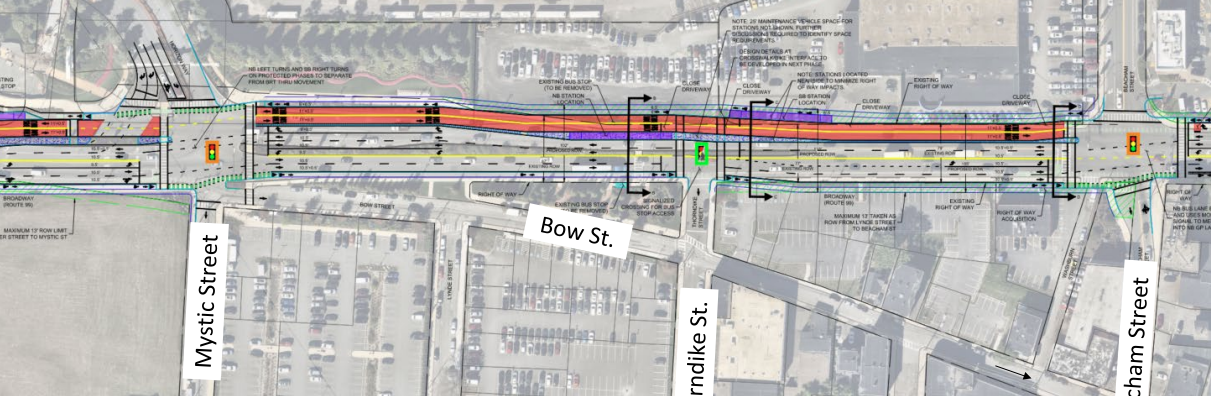
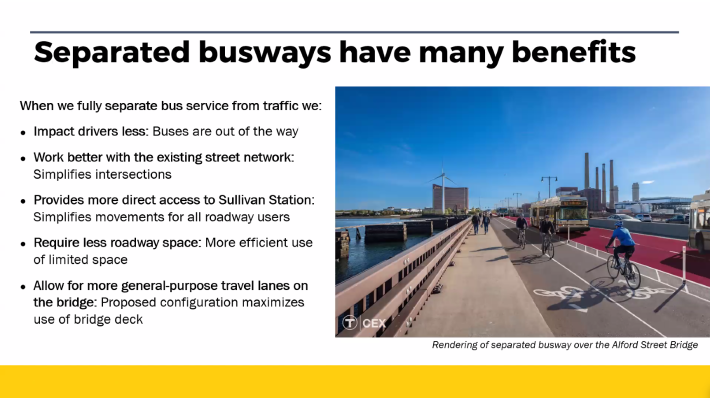
In order to serve all those riders effectively, the MBTA is recommending the creation of a physically-separated busway on Alford Street and lower Broadway in Everett, along with new bus stations, a bike path, and pedestrian safety improvements.
In addition to the extended Silver Line, regular MBTA bus routes like the frequent-service Route 109 and emergency vehicles would also benefit from a dedicated busway.
Since expanding the 109 to Somerville and Cambridge in 2024, the MBTA has seen bus ridership between Boston and Everett surge. However, traffic congestion remains an issue, increasing travel time “for over 8,000 daily riders today,” said McFarland.
“Change is critical for supporting growth and moving more people with less space,” he added.
Splitting the roadway
The MBTA’s proposed design would put the busway and a separated bike path on the northern edge of Alford Street and lower Broadway, with general-purpose traffic on the southern side of those streets, effectively splitting the corridor into two parallel roadways – one for bikes, emergency vehicles, and transit, and one for private vehicles.
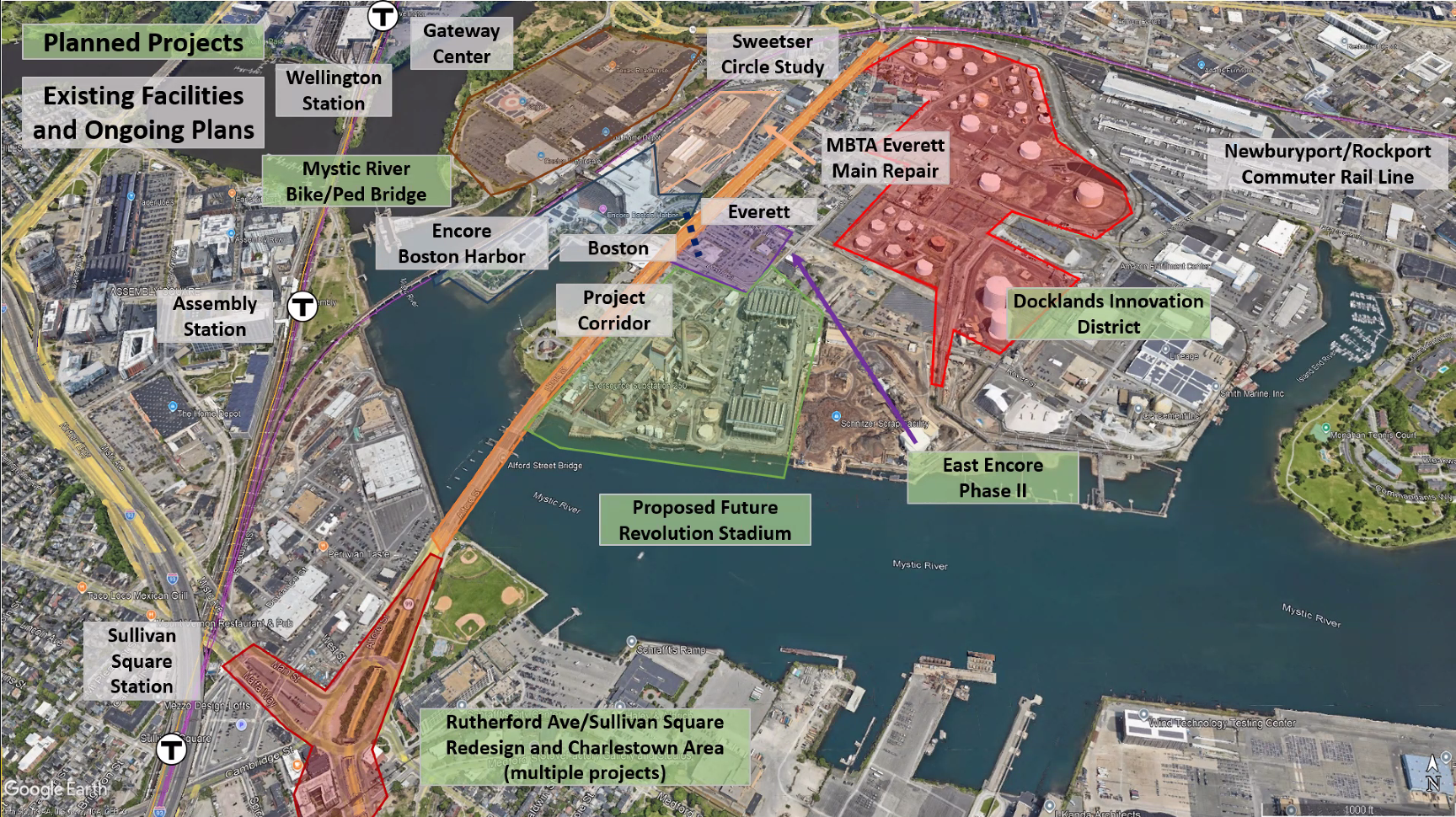
In Boston, the new busway would tie into the city’s planned redesign of Rutherford Avenue and Sullivan Square. The project would also facilitate transportation to several large-scale development projects in the area, including the proposed New England Revolution stadium on the Everett waterfront and the proposed redevelopment of the former Everett oil tank fields.
The T’s proposed busway would extend from Sullivan Square to Beacham Street. Between Beacham Street and Sweetser Circle, where the width of the roadway is more constrained, the T is recommending only a single southbound bus lane, with northbound buses sharing a general-purpose lane between Beacham and Sweetser Circle.
Project consultant Gary McNaughton claimed that continuing the two-way busway on that narrower segment between Beacham Street and Sweetser Circle would result in “unacceptable traffic operations” for drivers using the remainder of the roadway.
However, McNaughton also admitted that this prediction was based on an fairly unrealistic assumption – that the same number of drivers will continue sitting in traffic on Broadway even after the T builds a faster, more convenient Silver Line alternative.
“When a project does reduce roadway capacity for particular movements, patterns tend to change,” McNaughton admitted. “Driver behavior tends to change, and folks will find different ways to accomplish their trips in a lot of instances, and that’s something we’re taking into consideration.”
Funds at risk
The urgency around has been heightened by how over the past year, the Trump administration has been cancelling federal grants that have not yet been formally obligated by the United States Treasury.
The T needs a formal grant agreement in place to secure the $22 million that the Biden administration had pledged for the Alford Street busway project.
A grant agreement requires, among other things, agreement on a concept-level “15 percent” design, and a public hearing.
Last Thursday’s meeting represented the first step in that process. The T hopes to submit the necessary concept-level design plans later this year, and the MBTA says that public meetings like these would be key to vetting its plans and securing the federal funding.
The virtual hearing’s Q&A portion highlighted a diverse audience of community members, including neighbors from Charlestown, daily commuters, volunteers for Boston’s Bike to Work Day, and Encore staff.
Overall, the consensus stood that this corridor is due for some much-needed change.
Some design specific feedback brought forward including a flexible, reversible general-purpose lane, given the directional morning-night peak traffic flow, addressing bike-bus conflict zones, addressing flooding and drainage issues, and improving access to the Northern Strand Trail and the proposed new Mystic River bike and pedestrian bridge.
Next Steps
Following last week’s public meeting, the MBTA will continue to work with Everett and Boston to develop this design plan guided by public feedback from the meeting. If you have comments, you can send them by email to thebetterbusproject@mbta.com. The project website can be found here, and you can sign up for email updates on the project here.
In the spring, the project team will host a series of in-person meetings in Everett and Charlestown specifically to gather community feedback from those in the project area. From there, the team will work to reach the 15 percent design threshold, and leverage other resources to help obligate the federal grant in the fall.
McFarland closed with a call for the public to stay engaged.
“We will be working hard to advance our hybrid alternative based on the feedback that we’ve gotten from you all,” he promised.
Streetsblog has migrated to a new comment system. New commenters can register directly in the comments section of any article. Returning commenters: your previous comments and display name have been preserved, but you'll need to reclaim your account by clicking "Forgot your password?" on the sign-in form, entering your email, and following the verification link to set a new password — this is required because passwords could not be carried over during the migration. For questions, contact tips@streetsblog.org.