MBTA Wins $140 Million to Run More Trains to Lawrence and Haverhill
The Federal Railroad Administration has announced that it plans to grant $140 million to the MBTA to support new track infrastructure and upgraded stations along the Haverhill Line, which connects Boston to the Merrimack Valley in northern Massachusetts.
Current MBTA service on the Haverhill Line runs every 45 minutes for most of the day, but half of those trains end their trips in Reading instead of continuing all the way to Haverhill.
That’s largely because a crucial segment of the line north of Reading consists of a single track, so that trains are unable to pass each other.
That bottleneck prevents the T from adding additional train service to Lawrence and Haverhill, gateway cities with large populations of transit-dependent residents and home to one of the state’s fastest-growing transit agencies.
By eliminating that bottleneck, the T could theoretically be able to start running trains every 30 minutes to and between those cities within the next few years.
“Obviously, greater reliability and frequency opens up more options for all riders, and facilitates greater intermodal connectivity between bus and rail,” said Noah Berger, the administrator for the Merrimack Valley Transit (MeVa) in Lawrence and Haverhill.
“The MBTA has embraced a genuine spirit of collaboration with MeVa and all of the RTAs, recognizing that T riders’ journeys don’t end when they get off the train. I deeply appreciate that the leadership at the T understands that their riders are also our riders,” Berger told StreetsblogMASS.
The T and Governor Healey’s administration first announced the grant award last week. StreetsblogMASS has since obtained additional details on the planned work, including a copy of the MBTA’s original grant application.
New double-tracked railway
One of the central elements of the proposed upgrades will be the addition of a second track along the central segment of the Haverhill Line, such trains moving in opposite directions will be able to pass each other.
The Haverhill Line today has eight miles of single-tracked railway along its 33-mile route.
One single-tracked section occupies about 4.5 miles of railway between Melrose and Sullivan Square, where the Haverhill Line shares limited space with the Orange Line.
However, because that segment is less than 10 minutes away from North Station, inbound and outbound trains rarely need to wait for each other to clear the tracks there.
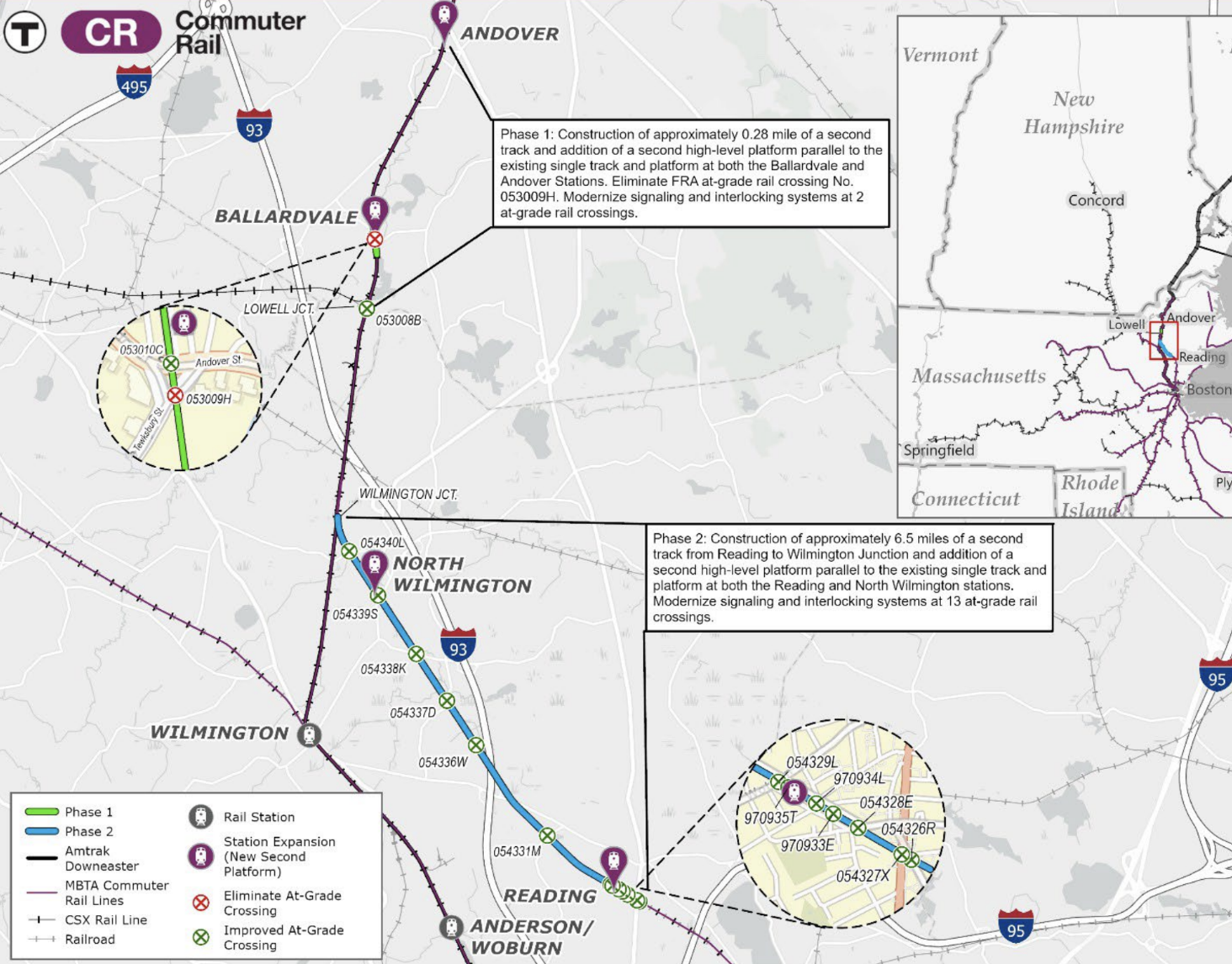
Instead, the T plans to focus on double-tracking an 11-mile section in the middle of the line, between Reading station and the Ballardvale station in Andover.
Double-tracking this segment of the Haverhill Line was one of the primary recommendations of TransitMatters in its 2021 “Modernizing the Haverhill Line” report, and of the more recent 2026 TransitMatters and MassINC joint report, “Harnessing the Full Potential of Regional Rail”.
According to both of those reports, double-tracking the Reading-to-Ballardvale segment will theoretically enable the T to begin running trains every 30 minutes between Boston, Lawrence, and Haverhill – presuming it has enough trains to do so.
The funding to build a full-length double-track will supersede the T’s previous plans to build a single “turnback track” in Reading. A T spokesperson confirmed to Streetsblog that the agency no longer intends to pursue that project.
Expanded stations with level-boarding platforms in Andover, Wilmington, and Reading
The new funding will also provide major station upgrades at four stops along the same central segment of the route.
The T will need to build new platforms at those stations in order to serve trains on its new second track.
Those new platforms will be “high-level” platforms, designed to provide step-free boarding into the train. The same stations today consist of a single low-level platform, such that the majority of riders need to climb stairs to board trains, along with a short “mini-high” platform where wheelchair users can board.
According to an MBTA spokesperson, “the plan for all four stations (at Andover, Ballardvale, North Wilmington, and Reading) is to have two-sided, short high-level platforms. They will not be full-length (not 800 feet), but they will be accessible.”
High-level platforms aren’t merely a benefit for accessibility. They also make it faster for all passengers to board and disembark from every door, and therefore reduce the amount of time that trains have to wait at stations.
What’s not included
An MBTA spokesperson confirmed to StreetsblogMASS that the planned Haverhill Line work will not include any electrification projects, like substations or catenary wiring, that could lay the groundwork for faster electric trains.
When we asked whether Lawrence and Haverhill would get 30-minute service as a result of these improvements, the T’s press office hedged.
“The double track project will increase capacity and throughput on the Haverhill Line, which will result in more service, increased reliability, and more operational flexibility,” an MBTA spokesperson told us.
But they also warned that “frequency also relies on train availability, as well as engineer and conductor availability, among other factors.”
The MBTA’s commuter rail staff have been sounding the alarm about its aging diesel locomotives that serve its commuter rail system. In order to run more frequent service to gateway cities like Lawrence and Haverhill, as well as cities like Fall River, New Bedford, and Worcester, the T needs to obtain more trains, while it also finds replacements for its oldest equipment.
First improvements done by 2027
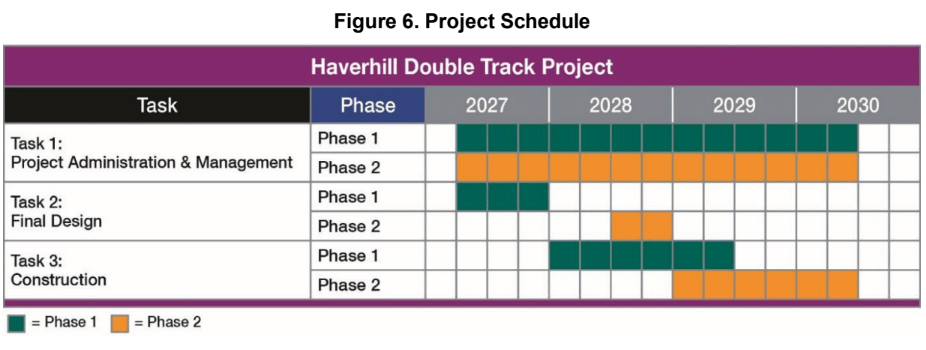
A project schedule from the MBTA’s grant application suggests that these improvements could be in place by 2030.
The grant application suggests that the work will proceed in two phases. Phase 1 would begin construction in early 2028, and the shorter segment of double-track from Lowell Junction through Ballardvale, plus the construction of new high-level platforms at Ballardvale and Andover stations.
“Phase 2” would begin construction in 2029, and includes the longer section of double-track from Reading to Wilmington Junction (where the Haverhill Line intersects with the Wildcat branch line) and the new high-level platforms at Reading and North Wilmington stations.

Streetsblog has migrated to a new comment system. New commenters can register directly in the comments section of any article. Returning commenters: your previous comments and display name have been preserved, but you'll need to reclaim your account by clicking "Forgot your password?" on the sign-in form, entering your email, and following the verification link to set a new password — this is required because passwords could not be carried over during the migration. For questions, contact tips@streetsblog.org.