Buses Keep Getting Pokier As Wu Administration Cancels, Delays Bus Projects
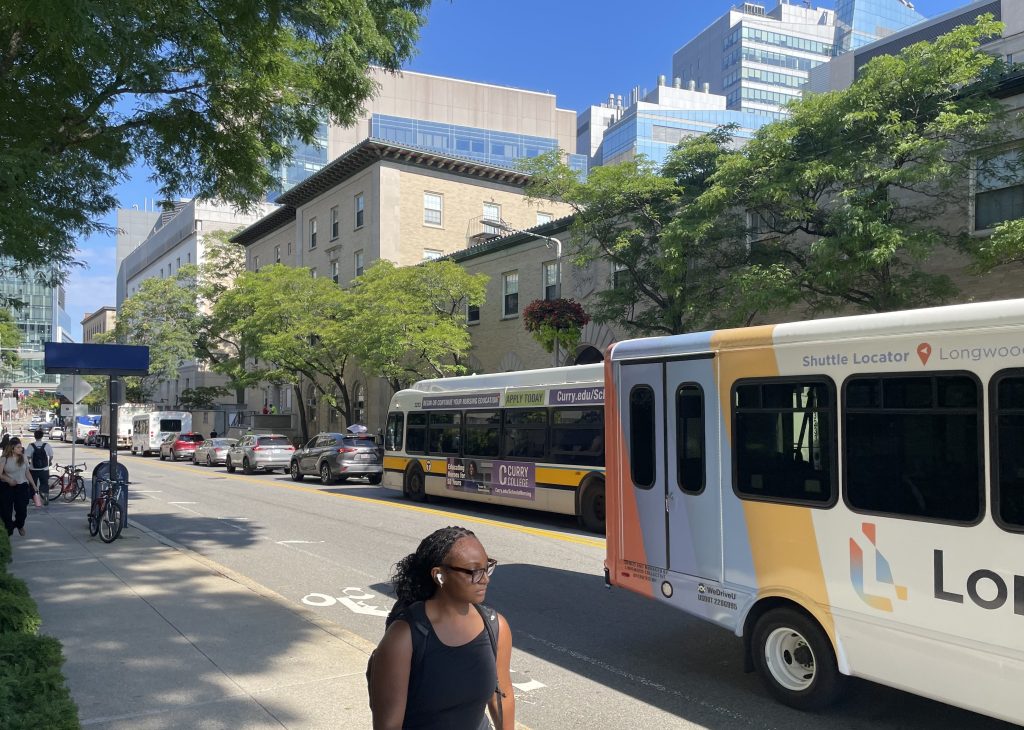
Key MBTA bus routes continue to get slower while Mayor Wu’s administration postpones and cancels long-planned infrastructure projects, according to this year’s annual analysis of the MBTA’s slowest bus routes from TransitMatters.
The 2026 “Pokey/Schleppie Awards” spotlight the T’s ten slowest and most-bunched bus lines – almost all of which suffer their most severe delays on streets within the City of Boston.
It’s the third annual report of its kind, and while the list and rankings of the 10 slowest bus routes haven’t changed that much since 2024, the MBTA-provided data on average bus speeds suggests that buses are getting slower with every passing year, especially in the City of Boston.
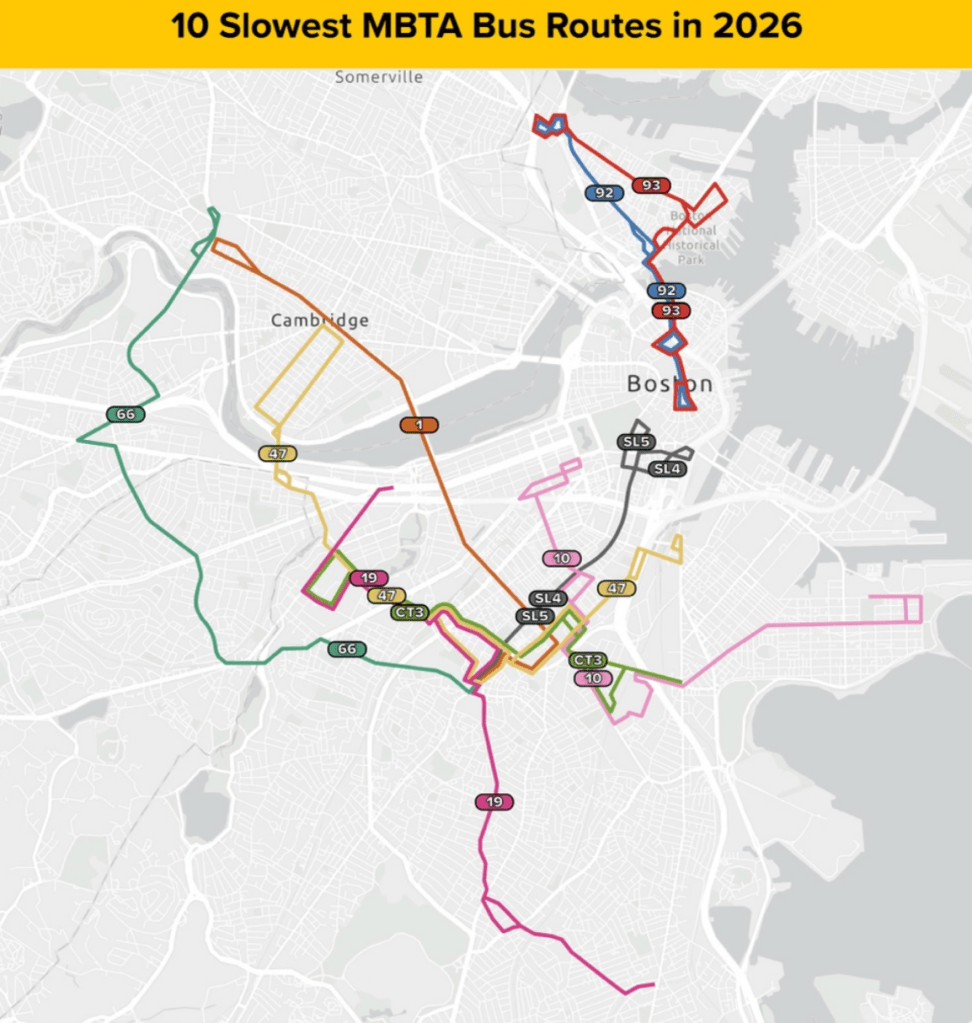
The average speed among the top ten slowest MBTA routes declined to 6.42 mph in October 2025 – the time period that TransitMatters used for its Pokey/Schleppie analysis.
That’s a decline from an average speed of 6.52 mph in October 2024, and 6.83 mph in October 2023.
TransitMatters points out that for someone who rides the bus for 6 miles a day, five days a week, a 0.41 mph decline in speeds amounts to over 14 lost hours over the course of a year – and these bus routes serve tens of thousands of riders every day.
“Since spring 2025, progress has been held up on some of the City’s most critical bus infrastructure projects by the Mayor’s office,” TransitMatters observes in their report. “In total, the City removed or slowed planning for bus lanes along the routes of eight buses on this year’s Pokey/Schleppie lists.”
Many of those bus infrastructure projects had been planned or implemented under Mayor Marty Walsh’s administration, with the explicit goal of reducing the city’s notorious congestion.
But between late 2024 and early 2025, at the behest of wealthy and well-connected business interests, and with little to no notice for ordinary riders, Mayor Wu deleted dedicated bus lanes for the Route 7 through the Seaport and on the Route 39 on Boylston Street in Back Bay in order to create more publicly-subsidized space for private vehicles.
And last July, the mayor scrubbed away one of the most heavily-used bus lanes in New England, a northbound bus lane on North Washington Street, which used to benefit about 14,900 daily bus riders, the vast majority of whom identify as Hispanic or Latino.
Two bus routes that used the bus lane – the 92 and 93 – rank among the 10 “pokiest” routes in TransitMatters’s report, and the third – the 111 to Chelsea – ranks among the “schleppiest” for its frequent bus bunching.
In a statement, the MBTA affirmed the report’s findings and expressed their appreciation for the report.
“Ongoing congestion is a leading factor for slowed trip times, and the T is aware of this impact to riders,” an MBTA spokesperson wrote. “Congestion is costing the agency too. Nearly 1 out of every 3 new bus operators we’re hiring is working to simply run the same schedule, not expand service.”
Silver linings
While this year’s report paints a discouraging picture, the report did find that the majority of the T’s “schleppiest” bus routes – routes where riders are most likely to encounter two buses bunched together, followed by a long gap in service – have managed to reduce their rates of bus bunching since 2023.
And the report also notes several new developments on the horizon that could help the MBTA’s suffering bus riders.
The first is the MBTA’s new automated bus lane and bus stop enforcement system, which will be designed to photograph and automatically issue small fines to drivers who block bus lanes and bus stops.
An MBTA spokesperson told StreetsblogMASS on Wednesday that the agency still plans to debut the new technology “in late 2026,” starting with a 60-day trial period when cameras will issue warnings but no fines.
The T intends to start with a “limited launch” on the SL4 and SL5 Silver Line routes between downtown Boston and Nubian Square (the SL5 took the crown as this year’s “Pokiest” bus route, in spite of having curbside bus lanes along the majority of its route).
The TransitMatters report also broke news about a new MBTA “Hot Spot Pilot Program” that’s designed to make targeted, quick-build improvements at bus stops and intersections to improve bus reliability.
StreetsblogMASS reached out to the T for more details, and a spokesperson told us that the agency has “over 30 locations in the pipeline.”
In an early example of the program’s work, the spokesperson said that the T had “recently worked with Town of Brookline to upgrade and move bus stops at three locations on Harvard Street for the Route 66 (at Stedman Street, Coolidge Street, and Verndale Street).”

Streetsblog has migrated to a new comment system. New commenters can register directly in the comments section of any article. Returning commenters: your previous comments and display name have been preserved, but you'll need to reclaim your account by clicking "Forgot your password?" on the sign-in form, entering your email, and following the verification link to set a new password — this is required because passwords could not be carried over during the migration. For questions, contact tips@streetsblog.org.