Boston’s Big Bet On Battery-Powered Trains

This story was produced by Grist and co-published with StreetsblogMASS.
Marvin Martin was in the Four Corners area of Dorchester one day when a train sped by on the Fairmount Line into downtown Boston. It was filled with white people, sitting comfortably and reading newspapers. It made him wonder why the commuter line seemed to pass through communities of color without stopping, leaving people in his neighborhood to crowd into buses.
Martin decided to do something about that. In 1995, he and others began pressuring the Massachusetts Bay Transportation Authority to expand service. It took more than 15 years, but the agency added three stops in Dorchester in 2012 and 2013. It opened a fourth in Mattapan in 2019.
But he wasn’t finished. Martin also had been pushing for electrifying the line.
“We want a train that would not be spewing a bunch of toxic particulates into the air,” Martin, who recently retired as the head of the transit advocacy organization Action For Equity, said.
Nearly three decades after Martin saw the train roll through Four Corners, the T, as the transit agency is known, plans to electrify the Fairmount line. It will lease seven battery-powered trains, each with four cars, for 15 years in a deal expected to cost $765 million. The arrangement allows the agency to gain experience with the technology before deciding whether to use it more widely.
The trains, built by the Swiss company Stadler, are slated for 2030. They will boost frequency of stops along the 10-mile route from every 30 minutes to every 20 and save 17,700 tons of carbon dioxide emissions annually compared to the diesels they will replace, according to the T.
Battery-powered trains allow transit agencies to electrify without the expense or complexity of installing overhead power lines, called catenary. But some worry the technology remains unproven on lines with ridership similar to what the Fairmount carries daily.
They’ll find out soon enough. Caltrain, which provides regional service in the San Francisco Bay Area, plans to introduce battery-powered trains by 2028. Chicago’s Metra has a similar timeline. The projects could offer a glimpse into the future of rail electrification, but the technology must first show that it is capable of transporting thousands of people each day.
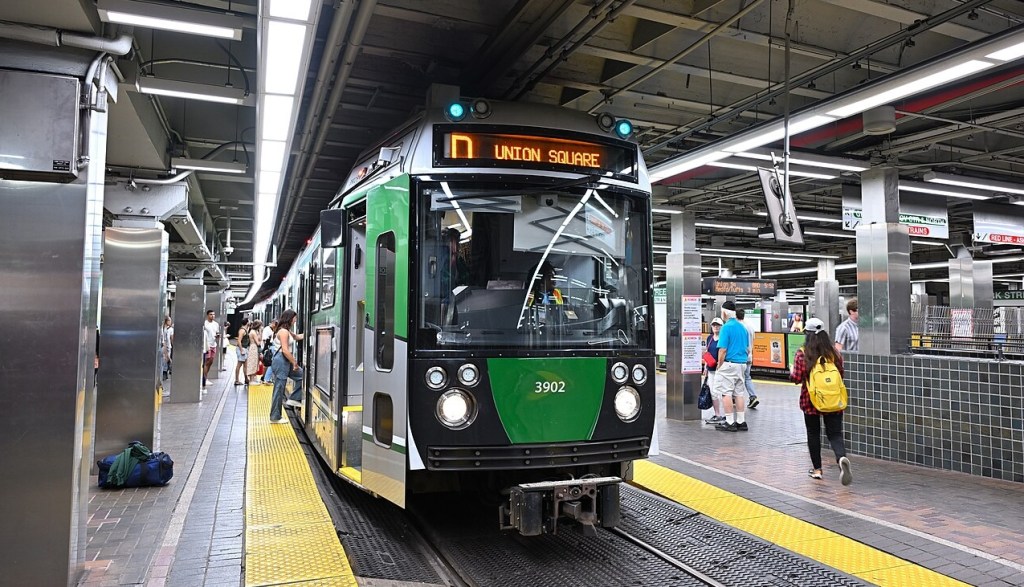
Boston is no stranger to electric rail. Its first electric streetcar rolled out in 1889, and the Tremont Street Subway — now part of the Green Line — was the first electric subway in North America. (It was third worldwide behind Budapest and London.)
Chris Friend, interim executive director of the advocacy organization TransitMatters, considers the Fairmount line a logical place to begin the T’s regional re-electrification because it is the system’s shortest commuter route. But he added that battery-powered trains have not yet been widely used on busy routes anywhere in the world. “So, is this the thing,” he asked, “or are we going to end up in another quagmire of an unproven technology?”
Battery-powered trains built by the French manufacturer Alstron are zipping back and forth on a 50-mile route in Germany that carries 2 million people annually. Dani Simons, the company’s vice president of communications in the Americas, said rising fuel prices make electrification more appealing. (The average price of diesel was $6.32 a gallon on Monday, up from $3.70 a year ago.)
Simons conceded the technology is best suited to “medium ridership.” But she said transit agencies should be pursuing electrification in all its forms, including diesel-electric hybrids and trains powered by overhead lines. These technologies can mitigate the impact of rising fuel costs and improve air quality. Even the MBTA is diversifying, with plans to deploy both battery and catenary trains on the Providence Line.
In some ways, electrifying transit means going back to the future. Urban systems began the transition from horse-drawn vehicles to electric streetcars in the 1880s and 1890s, said Albert Churella, a history professor at Kennesaw State University. Steam railroads, meanwhile, carried passengers between cities and their outskirts, helping spur the growth of suburbs.
Some commuter lines, including routes from New York to New Haven and Philadelphia to Paoli, along with the Long Island Rail Road, electrified at the start of the 20th century. Subways in Boston and elsewhere used electricity because steam trains emitted smoke and risked asphyxiating passengers underground.
It also helped that the technology was new.
“People get infatuated with technological advancements, and they tend to believe that these are cure-alls, that these are things that have extraordinary, almost unlimited potential,” Churella said. “Electrification of railways was no different.”
Most commuter lines, however, were never electrified. Many ran on tracks owned by larger railroads that also carried long-distance passengers and freight, operations that favored steam and, later, diesel power, said Nicholas Dagen Bloom, a historian and author of The Great American Transit Disaster. As passenger rail declined after World War II, he added, those companies increasingly wanted out of the passenger rail business. Diesel trains also offered a cheaper alternative to electrification because they do not need miles of wire.
Caltrain provides a look at what electrification can deliver. In 2024, it replaced diesel trains with electric ones on the 51-mile route between San Francisco and San Jose, powering them with overhead lines. Commute times dropped by as much as 23 percent because electric trains accelerate so much faster, and people loved the smoother, quieter cars. Ridership climbed 60 percent, and quality improved. Beyond the immense reduction in CO2 emissions, Joshua Apte, an environmental engineer at the University of California Berkeley, found that riders’ exposure to black carbon dropped 89 percent — a result he called comparable to what California cities achieved during 30 years of regulation.
Given the number of commuter rail systems that still rely on older diesel locomotives, “you might see similar air quality gains if you electrify them,” he said.
Although battery-powered trains might be slightly less efficient than those that use overhead lines or a third rail, Apte said they still do wonders for easing pollution.
That’s enough for Martin. He acknowledges that the cleaner, quieter trains that will begin rolling through the Four Corners will be a “novel thing” and that riders will continue breathing air polluted by diesel exhaust until they go in service. But he considers his three decades of advocacy a success.
“I’m pretty satisfied with where we ended up,” he said. “As long as we still get that train.”
Streetsblog has migrated to a new comment system. New commenters can register directly in the comments section of any article. Returning commenters: your previous comments and display name have been preserved, but you'll need to reclaim your account by clicking "Forgot your password?" on the sign-in form, entering your email, and following the verification link to set a new password — this is required because passwords could not be carried over during the migration. For questions, contact tips@streetsblog.org.