Boston Residents Fume As Mayor Wu Fails to Deliver Promised Traffic-Calming to Neighborhood Streets
One of Mayor Wu’s most popular first-term programs – a “safety surge” of speed hump installations on neighborhood streets across the city – has been paused indefinitely for two years, and city officials say that the mayor herself is responsible for throttling the popular program.
Mayor Wu’s 2023 “safety surge” initiative called on the city to install up to 500 new speed humps on an annual basis on smaller neighborhood side streets.
At the time, city officials said that “instead of asking residents to nominate their street for traffic-calming, we will work proactively to add speed humps on all eligible streets, in every neighborhood.”
In that first year, the city made a strong start towards delivering that promise. The city installed hundreds of new speed humps on streets around Hemenway Street in the Fenway, around Bowdoin Street in Fields Corner, on dozens of blocks in South Boston, and along several new bike routes in Jamaica Plain.
The work continued in 2024, with more speed humps installed in places like the Hancock Street triangle near Columbia Road in Dorchester, Forest Hills Street on the west side of Franklin Park, and the Moreland Street neighborhood in Roxbury.
From speed hump installations to speed hump demolitions
But in early 2025, as Mayor Wu initiated her re-election campaign and her notorious “30 day review” of her transportation department, progress on speed humps – like many other transportation projects across the city – ground to a halt.
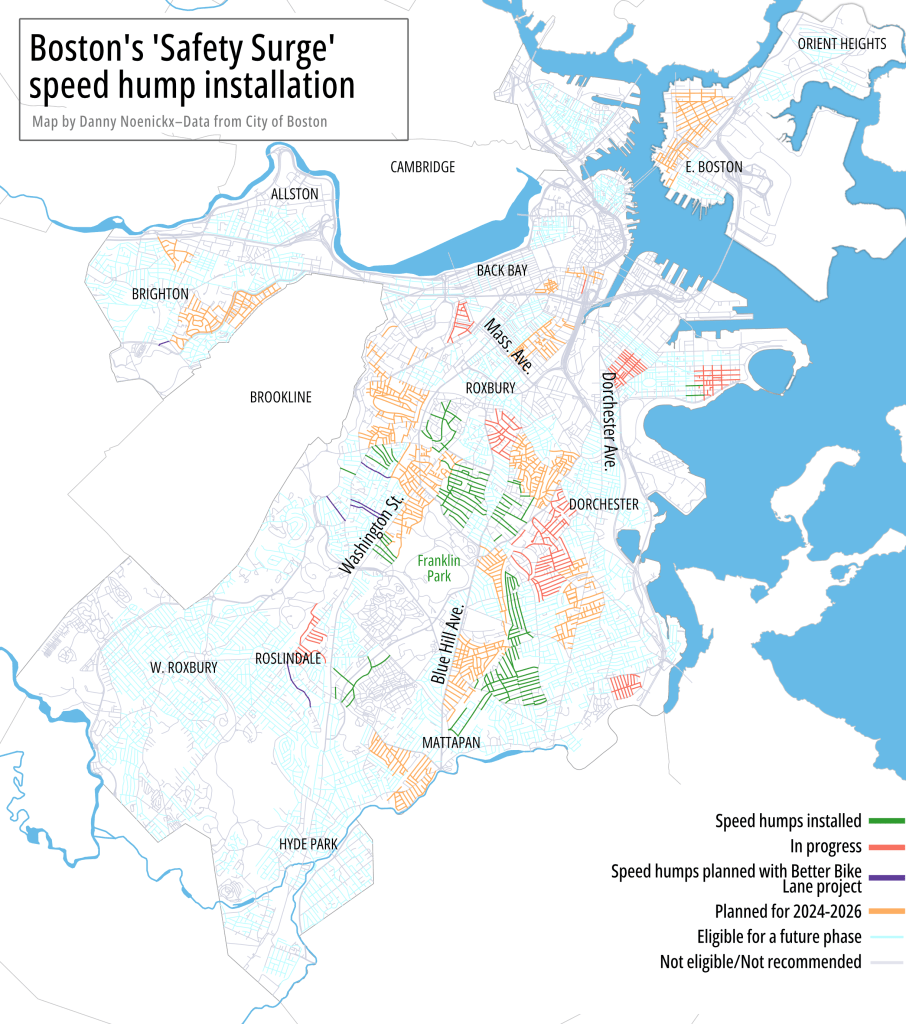
At some point in 2025, the city removed the citywide map of planned speed hump installations from the Boston.gov website (StreetsblogMASS has preserved a copy of the map, pictured below).
In February 2025, Mayor Wu also directed her staff to rip out about a dozen newly-installed speed humps on Allendale Street – a wooded 25 mph street on the border between Brookline and Jamaica Plain – over the vocal objections from neighborhood residents and from the mayor’s own transportation engineers.
“I do not think this option meets the safety goals laid out by our department,” warned Dan Merrow, the city’s principal transportation engineer, in a January 29, 2025 email to his colleagues, which StreetsblogMASS obtained through a constituent’s public records request.
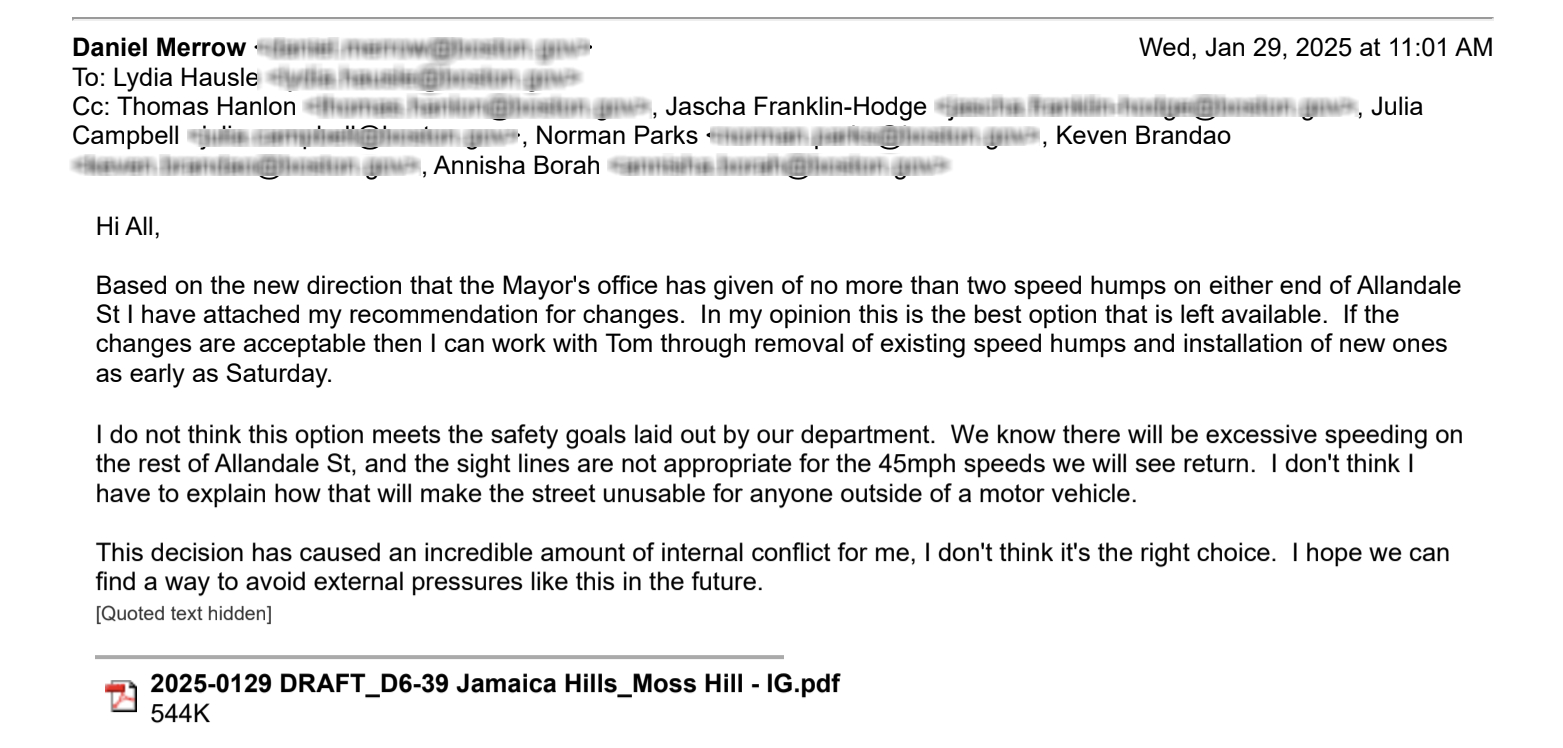
Merrow’s email also indicates that the order for speed hump removals on Allendale Street came from the mayor’s office.
“We know there will be excessive speeding… This decision has caused an incredible amount of internal conflict for me, I don’t think it’s the right choice. I hope we can avoid external pressures like this in the future.”
‘Speed humps are not happening right now’
Nearly two years later, residents and elected officials are baffled about the administration’s decision to cancel the popular program.
“There’s an immense number of speeding drivers on our street, from people using it as a cut-through to avoid traffic on Mass. Ave.,” says Jacob Oppenheim, a parent of two young children and a board member for the Worcester Square Neighborhood Association in the South End.
Oppenheim’s neighborhood includes several of the streets marked in orange just northeast of Massachusetts Avenue in the map above, which had been slated for speed hump installation by 2026.
“I’ve been trying to figure out what’s going on, because the City of Boston has basically stopped building speed humps,” Oppenheim told StreetsblogMASS.
At an September meeting of the Worcester Square Neighborhood Association, Michaela Nee, the mayor’s neighborhood liason, admitted that “speed humps are not happening right now.”
“Even if the map (of planned speed humps) is no longer visible on Boston.gov, it’s just that we’re really re-evaluating,” Nee said.
StreetsblogMASS reached out to the mayor’s press office to ask why Mayor Wu has been stonewalling constituent requests for traffic-calming measures on their streets.
Chris Osgood, the mayor’s new Chief of Streets, responded that Nee “was communicating that these streets would not have speed humps installed this construction season,” and that “as part of the 2026 construction season, we’ve started to couple more traffic calming measures into more capital projects such as our annual resurfacing program.”
However, Osgood and the mayor’s press office were unable to answer follow-up questions about how many speed humps they had actually installed this year, or where they are.
The lack of results from the speed hump program has also been a source of frustration for Boston city councilors, who frequently field requests for street safety improvements from constituents like Oppenheim.
At an April 22nd, 2026 City Council hearing on recent delays and cancellations of long-planned transportation projects across the city, Councilor Ben Weber expressed his frustration about the lack of communication from the mayor’s office.
“I’ve got a dozen different streets being used as cut-throughs. People want speed humps on their streets. And many of those (streets) could be made a lot better with speed humps on those streets. So what do I tell my constituents?”
Boston Public Works Commissioner Nick Gove, who was still the city’s Chief of Streets at the time, told City Councilors that “we will be rolling out our spring program of speed hump installations next month. We’re happy to share that with you if we haven’t already.”
StreetsblogMASS reached out to Councilor Weber’s office on Monday to ask if Gove ever actually followed through on that pledge.
“We still don’t have a firm process in place for how the city will examine street safety issues. We don’t know the metrics they will use or how constituents can best advocate for changes,” answered Weber in an email message. “We are still waiting to learn what the streets cabinet’s process will be going forward. I was told very recently that Interim Chief Osgood and his team will announce a new process for the next construction season.”
Weber reported that the city had, in fact, installed a handful of speed humps in his district over the summer and fall: on Moraine, Atherton, and Castleton Streets and Spring Park Avenue in Jamaica Plain. He also reported that Maxfield Street, a short 800-foot street in West Roxbury, would get speed humps later this month.
Those five streets combined are about one mile long, and represent about one-tenth of one percent of the city’s total street mileage.