Lawmakers Say Infrastructure Needs More Funding, and Congestion Pricing Should Be On the Table

As 2025 comes to an end, the future of transportation is just getting started. While Massachusetts’ state legislature has largely stabilized transportation funding in the short term, they’re going to need to come up with new, innovative ideas to balance budgets in the longer term – and one prominent state senator thinks that congestion pricing needs to be part of the conversation.

The final installment of the Transportation First series hosted by the Greater Boston Chamber of Commerce closed out the series with an update from state legislators on Thursday, November 20th.
Co-chairs of the legislature’s Transportation Committee, Senator Brendan Crighton and Representative Jim Arciero, presented on the status of transportation policy in the state, and engaged in moderated and audience questions.
MBTA funding, by the numbers:
- 2026 MBTA operating budget (does not include capital projects, like track maintenance, stations, and new vehicles): $3.02 billion
- 2026 state budget operating support for the MBTA: $470 million
- Supplemental 2026 one-time MBTA operations funds, from unspent Fair Share revenues: $495 million
Transportation policy is housing and climate policy
A large theme of Sen. Crighton’s remarks was about how to modernize transportation funding with more sustainable and equitable funding sources and stabilizing the immediate finances of the state’s transportation agencies, while Rep. Arciero brought a housing perspective to his presentation.
Both discussed how funding shifts from the “Fair Share” amendment, bonding, the Chapter 90 bill, and other legislation has transformed the transportation system.
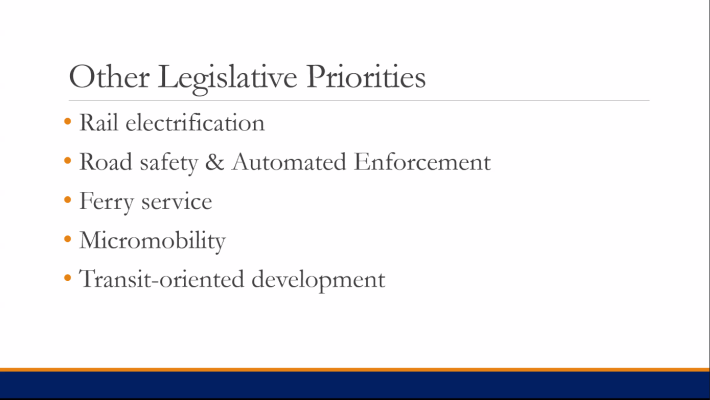
According to their presentation, the future of transportation is intersectional. It looks like rail electrification to wind down diesel, road safety and automated enforcement to save lives, ferry service to expand serve up and down the coast, micromobility to safely provide people multiple options, from scooters to e-bikes, and transit-oriented development to provide affordable housing with the freedom to move.
The co-chairs regularly hear from their constituents, namely the remote workers in Arciero’s Chelmsford, Littleton, and Westford district looking for frequency and flexibility to travel into Boston (supported by the newer Littleton Commuter Rail station and its expanded parking back in 2017), while Crighton’s constituents of Lynn are looking for Blue Line connectivity, as well as increased ferry service. By and large, folks are looking for increased reliability and frequency alongside lowered costs.
“If we’re looking for greater revenue or modernizing our revenue system, I think we need to do it in a thoughtful way that isn’t based around just closing the T’s gap,” Crighton shared. He highlighted the progress made regarding East-West rail, and investments made in the state’s RTAs, thanks to legislators and their constituencies who have come out and advocated for an equitable approach to the state’s transportation.
“Everything should be on the table”
When faced with the question of how to not only stabilize short-term financial needs of the state’s transportation agencies but also enhance existing revenue streams and establish more equitable and sustainable revenue sources in the long run, Sen. Crighton swung big – “everything needs to be on the table.”
Crighton specifically identified congestion pricing as a potential solution, but also noted the difficulty of even exploring the idea of a pilot, saying it has been “near impossible.”
“We shouldn’t be shy about talking about this stuff,” said Crighton.
He added that politicians were wary of getting “assailed for saying the phrase ‘congestion pricing’, but we shouldn’t be scared to have these conversations recognized.”
But Sen. Crighton also thinks there’s broad agreement on the fact that there is a real and urgent need to modernize the state’s funding sources for transportation.
“So if we start at that point” of consensus, he continued, then stakeholders can collaborate and be open to looking at different options.
“What best suits the needs, the workforce, the budgets of residents across the Commonwealth?” he asked.
“The cost of doing nothing is too much to bear”
A running theme of the conversation was that of “regional equity”; there was a clear understanding and commitment from the co-chairs to center equity in their work across the state, across modes of transportation, and across residents to build a comprehensive, statewide transportation system.
“When one mode receives investment, it benefits the entire system,” Rep. Arciero explained in his discussion on RTAs. He noted the domino effect of how when the T and RTA improve coordination between their services, people make their connections quickly and efficiently, this gets more cars off the road, reducing congestion and traffic.
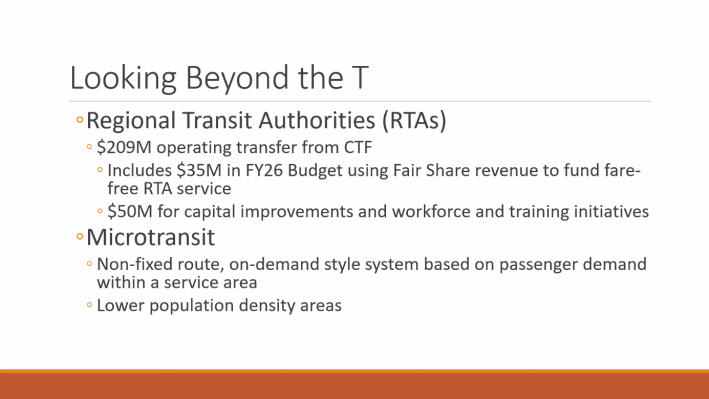
Rep. Arciero expressed how funding RTAs allows them to continue serving as a lifeline to their communities, combating the risk of isolation that those with no alternatives to personal vehicles face, while capitalizing on their unique ability to pilot innovative ideas like microtransit, fare-free programs, and mobility management that bigger agencies do not necessarily have the flexibility to do.
Sen. Crighton cited electrifying rail as an issue that sits at the intersection of housing, environment, and public health justice.
“For me, the electrification of rail is a no-brainer… when you think about the housing crisis, when you think about climate, public health… we’re operating with this outdated technology that’s harming our communities, you have a commuter rail that runs through the backyards of people that will never ride the commuter rail because they can’t afford to ride the commuter rail in Lynn. The frequency’s not there,” Crighton explained.
He also called for increased connectivity for all – from Lynn students that attend Salem State University, to Revere, Chelsea, Lynn, and Everett residents who don’t have a direct connection to working at Encore Casino, to residents who cannot connect to Wonderland in Revere and instead have to take the Commuter Rail or walk.
“That last mile piece is just crucial”
The next legislative session will see the introduction of a capital bond bill, and legislation for a commission to look at use of microtransit, the co-chairs shared. The idea of the commission was voted out of committee favorably in October, catching the eye of legislators and riders alike.
If it moves further, this microtransit commission will bring together riders and businesses from across the field to explore the potential of these smaller vehicles to provide on-demand, small van service, connect with employers and hospitals, and address first-and-last-mile gaps, continuing to get people off the roads, and how to fund these programs in municipalities.
Crighton highlighted ways municipalities have gotten creative, namely the popular and expanding Salem Skipper rideshare service. “But I don’t think we can expect them to fund these programs. So I think I’m excited to see how the commission plays out or, what recommendations we could use to implement this statewide.”
Rep. Arciero spoke to a recent revelation he had at the Northern Middlesex Council of Governments, where the town manager in Dunstable spoke up in a conversation about chapter 90 and microtransit issues, calling his community “rural”. Just 40 minutes from his home of Westwood, Arciero realized how much closer to home this conversation was, noting “I guess I didn’t really think of it as such.”
“So it’s an interesting concept, and I think it’s going to affect more individuals and more communities than we think.”
In the meantime, the Micromobility Commission is looking at necessary safety measures, definitions, and classifications slated to come out in a report in the new year.
“The long game”
In this moment, Crighton thinks that the state has stabilized for the next year or two.
“We’re at least at a point where we can take a deep breath and see how we can strategize, to help stabilize a longer term and to kind of enhance the system,” he said.
Arciero excitedly shared that this was an “exciting time to be involved in building the system,” and that we are starting to see benefits of a revitalized transportation system, with confidence that the work will pay real dividends in the near future.
Chamber Commerce President Jim Rooney closed out the event, speaking how “deeply personal” transportation is, and the need to play “the long game” when addressing the long-term funding and financing issues that are present in the current transportation system.
“It’s tough to sometimes focus on the future of funding for transportation when there’s so much right in front of you that has to be dealt with, but you have got to have the agility to do both,” said Rooney.
But overall, the energy in the room was resoundingly hopeful.
“This is the year the transportation in Massachusetts turned a corner,” Rooney claimed.
Streetsblog has migrated to a new comment system. New commenters can register directly in the comments section of any article. Returning commenters: your previous comments and display name have been preserved, but you'll need to reclaim your account by clicking "Forgot your password?" on the sign-in form, entering your email, and following the verification link to set a new password — this is required because passwords could not be carried over during the migration. For questions, contact tips@streetsblog.org.