Washington Snubs Dorchester Bus Riders In Favor of a Suburban Highway Interchange
The Trump administration turned down a request for federal funding for a planned bus rapid transit corridor on Blue Hill Avenue in Dorchester and Mattapan, and opted to award funding to a $300 million highway interchange in Hopkinton instead.
Those two projects were among the Massachusetts entries for funding through the $1 billion federal BUILD grant program, a competitive program intended to finance transportation projects with large regional impacts.

This year’s round of grants awarded $21 million for MassDOT’s planned I-495/I-90 Interchange Improvements Project, which will build new ramps and build additional lanes at the junction of I-90 and I-495 in Hopkinton and Westborough.
The total cost of that project is expected to be around $300 million.
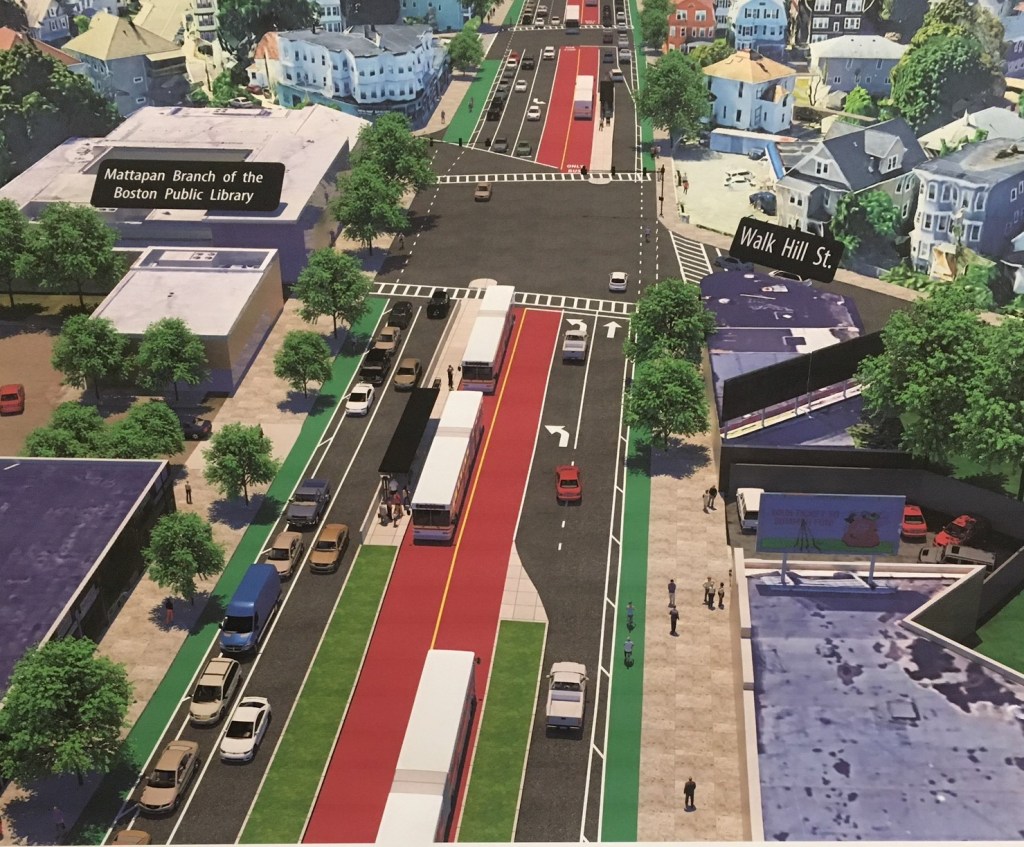
The MBTA and City of Boston also sought funds under the same program to fund a comprehensive redesign of Blue Hill Avenue, a project which would create a dedicated bus transitway and bus stations for the 6 MBTA bus routes that use the corridor and also add protected bike lanes from Grove Hall to Mattapan Square.
The grant application makes a compelling economic case for the project: the new bus lanes would benefit roughly 20,000 bus riders in Dorchester and Mattapan, reduce their collective commuting times by 800 hours every day, and, with less time wasted in traffic, allow the T to make over 100 additional daily trips on existing routes using the same number of buses and drivers. Furthermore, most of those benefits would accrue to historically underserved communities in Dorchester and Mattapan.
Previously-budgeted funds from the City of Boston and MBTA would cover about half of the project’s estimated $30 million cost; the BUILD grant application sought $15 million in federal funds to fill the financing gap.
On Wednesday, after the grant announcements, an MBTA spokesperson wrote via email that “the T is regrouping with the City to develop a strategy for moving forward.”
Julia Wallerce, Boston Program Manager for the Institute for Transportation and Development Policy and manager of the BostonBRT initiative, suggests that the T could apply for next year’s round of “Small Starts” grants – but that funding wouldn’t be available for at least another year.
“It’s still a huge regional priority – it stands to deliver phenomenal benefit,” said Wallerce in a phone conversation on Thursday. “If there’s any place to demonstrate what bus rapid transit can do, it’s Blue Hill Avenue.”
The Massachusetts congressional delegation was sanguine about the Trump administration’s funding priorities, and issued a press release to celebrate the additional highway funding.
“MassDOT’s Interchange Improvements Project is absolutely necessary to increase the efficiency of freight and commuter movement, enhance safety, and support planned growth in the region,” said Senator Ed Markey, co-sponsor of the Green New Deal, in a press statement. “I am proud to have helped secure the federal funding we need to support this vital project, and I thank my colleagues in the Massachusetts delegation for their partnership.”

Streetsblog has migrated to a new comment system. New commenters can register directly in the comments section of any article. Returning commenters: your previous comments and display name have been preserved, but you'll need to reclaim your account by clicking "Forgot your password?" on the sign-in form, entering your email, and following the verification link to set a new password — this is required because passwords could not be carried over during the migration. For questions, contact tips@streetsblog.org.