Among Elected Officials, A Strong Consensus Against I-90 Viaduct On the Charles River
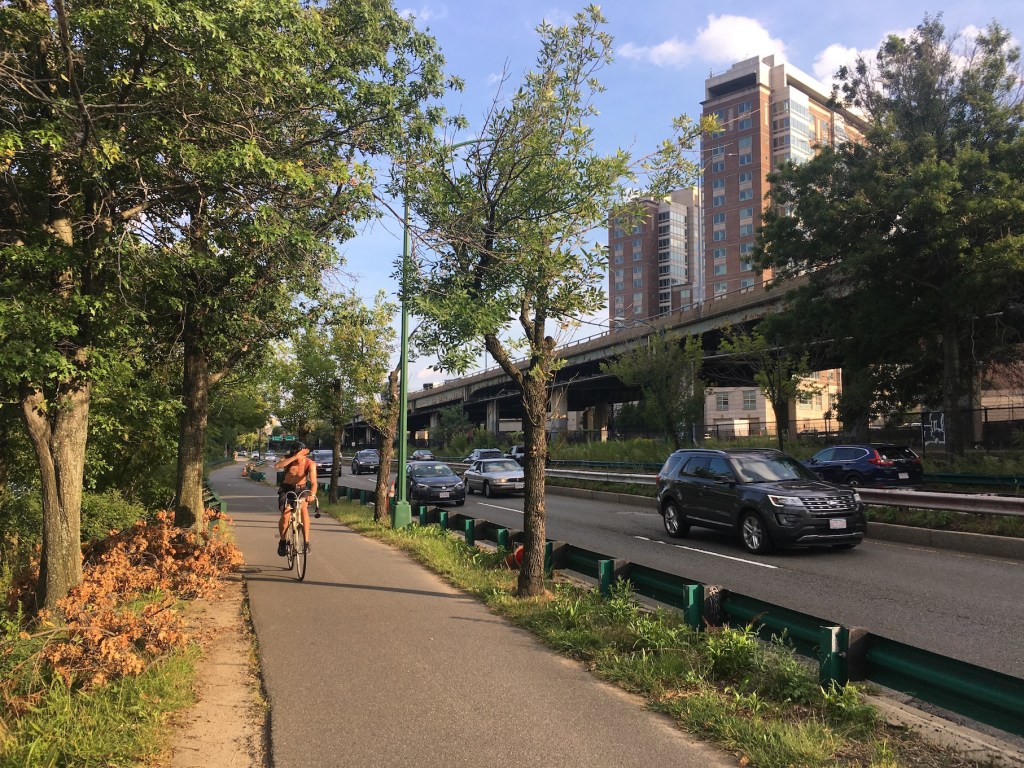
Elected leaders and local officials appear to be united in their preference for a new “at-grade” design for the Massachusetts Turnpike in the state’s Allston Multimodal Project, according to public letters submitted for the project’s National Environmental Policy Act review.
MassDOT and the Federal Highway Administration (FHWA) are currently in the process of selecting a “preferred alternative” – a conceptual design that will be carried forward into a more detailed design and permitting process.
One possible alternative being considered would essentially re-build the existing Turnpike viaduct in place; another, more recent alternative – the “modified all at-grade” option – would narrow the footprints of the highways to fit the project at ground-level.
In public comment letters submitted last week, advocates, city officials, and state legislators all stated a strong preference for the “at-grade” option.
A quick rundown of their arguments (click the links to read the letters in full):
- Boston Mayor Marty Walsh:
“Consensus is an ideal rarely reached in our field; there is, however, significant convergence on the Modified At-Grade (option) as the preferred design approach, which has now been endorsed by many constituents, advocates, and State and Local elected officials in Boston, in Cambridge, and throughout the region.”
- Congresswoman Ayanna Pressley and Sen. Ed Markey:
“We are specifically excited by the new connections and accommodations that the Modified All At-Grade Option will provide for pedestrians, bicyclists, and public transit, as well as the creation of a “living shoreline” that promises significant aesthetic and environmental benefits for the area surrounding the Charles River.
“In addition, we believe that this alternative’s transformation of local infrastructure -especially the elimination of the I-90 viaduct –will best address the long-standing noise, safety, and sustainability concerns raised by neighboring environmental justice communities disproportionately affected by the existing highway.”
- Cambridge City Manager Louis DePasquale:
“In contrast to the most recent Highway Viaduct Alternative, the Modified At-Grade (option), in the view of the City of Cambridge, is preferred since it meets many more project and community goals.”
- Boston and MetroWest-area legislators Rep. Hanlon Peisch, Rep. Aaron Michlewitz, Rep. Michael Moran, Rep. Kevin Honan, Rep. Danielle Gregoire, Rep. James O’Day, Rep. Kay Khan, Rep. John Lawn, Jr., Rep. Jay Livingstone, Rep. Tommy Vitolo, Rep. Jonathan Hecht, Rep. Steve Owens, Rep. John Mahoney, Rep. David Paul Linsky, Rep. Ruth Balser, Rep. Daniel Donahue, Rep. Jon Santiago, Rep. Mike Connolly, and Rep. Carmine Gentile:
“Our constituents span from Boston to Worcester and beyond, and the Modified All At-Grade Proposal is the least disruptive to commuter rail riders and allows for the most lanes to be in use on the Mass Pike during construction. For commuter rail riders, the Modified All At-Grade Proposal lays the foundation for a transformative transportation network expanding transit from MetroWest communities.”
- Worcester-area legislators Rep. Hannah Kane, Rep. Susannah Whipps, Rep. Donald Berthiaume, Rep. Kimberly Ferguson, Rep. Joseph McKenna, Rep. Brian Murray, Rep. James O’Day, Rep. Paul Frost, Sen. Anne Gobi, Sen. Harriette Chandler, and Sen. Michael Moore:
“We do not support the option of simply rebuilding the viaduct in place – this would represent a tremendous missed opportunity. We also believe that your mandate for consensus among the many stakeholder groups has produced a clear preference for the Modified All At-Grade Proposal.”
- Town of Brookline:
“(The) Modified All At-Grade Option best meets the stated project purpose to address roadway deficiencies and safety concerns, and the stated project need to address the multimodal deficiencies within the broader transportation system.”
MassDOT Secretary Stephanie Pollack and other MassDOT officials have expressed some notes of skepticism against the “at-grade” design in some public meetings, noting that it would impact the Charles River more than the viaduct option (for instance, by putting the Paul Dudley White pathway on a boardwalk over the river).
That could “result in more impacts to wetlands and waterways resources, and have a greater potential to delay the implementation schedule of the project in order to obtain needed permits,” warned Mike O’Dowd, the project manager for MassDOT.
The “at grade” option would also take the Grand Junction rail line – currently the MBTA’s primary route for moving commuter rail trains from south of the Charles River to its maintenance facility in East Somerville – out of service for several years of construction. MassDOT says that would force the T to build a new $300 million maintenance facility for its south-side commuter rail lines.

Read More:
Streetsblog has migrated to a new comment system. New commenters can register directly in the comments section of any article. Returning commenters: your previous comments and display name have been preserved, but you'll need to reclaim your account by clicking "Forgot your password?" on the sign-in form, entering your email, and following the verification link to set a new password — this is required because passwords could not be carried over during the migration. For questions, contact tips@streetsblog.org.