MBTA Revisits Its Long-Term Vision for Regional Rail

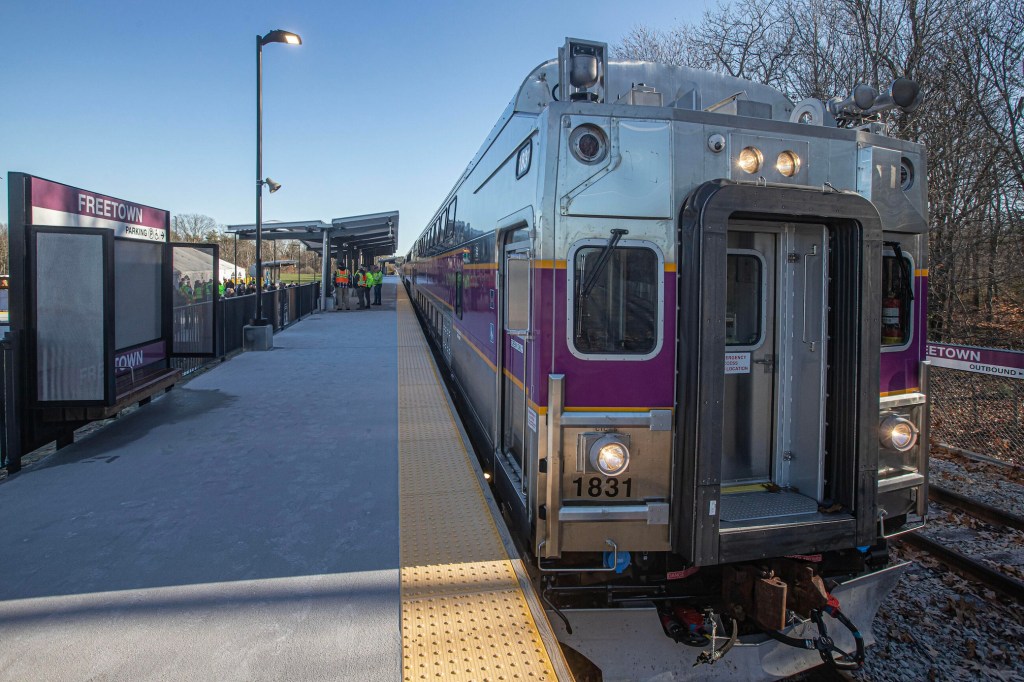
The MBTA is revisiting its $40.7 billion 2019 “rail vision” plans for the commuter rail system to reflect new post-pandemic and economic realities.
In a series of public meetings on November 4th and 17th, the T kicked off its new Regional Rail Modernization planning initiative.
The state of the system
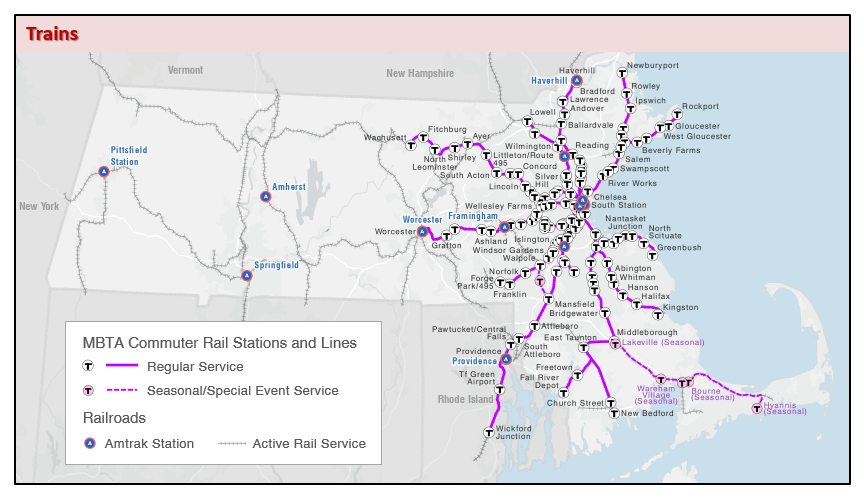
In 2019, the T conducted a “Rail Vision” study that analyzed ideas to modernize the Boston-centric commuter rail network into an all-day, two-way regional rail system.
The difference between the old commuter rail model, and what the system is moving towards, revolves around the evolution of commuters’ schedule and needs.
The system was originally designed around the 9-to-5 office worker, with two big peaks in service of morning trains into Boston and evening trains out of the city, leaving fewer trains during the day, and a full-on lack of service in the evenings and on weekends.
The “Regional Rail” model adapts to the needs of a broader range of riders, with trains running frequently throughout each day, including weekends, from early morning to late night.
Since 2019, the T has started to move to the regional rail model, including increased off-peak and weekend service, more “clock-face” schedules (where trains consistently leave at the same minute past the hour, every hour), and updated fares.
Major projects like returning service to Fall River and New Bedford for the first time in over 65 years through the newly opened South Coast Rail in March 2025, and buying battery electric multiple unit trains (BEMUs) for the Fairmount line, are moving the system towards cleaner, more reliable service.
The payoff of this work has been that the MBTA has the highest ridership recovery of any commuter rail system in the country, at 91 percent of its pre-pandemic levels.
However, the most ambitious and expensive ideas from the Rail Vision study – like building a new downtown tunnel to connect North and South Stations – were deemed “far beyond any funding that was available,” says Sibtay Haider, Director of Rail Modernization Delivery.
The COVID-19 pandemic’s impact on travel patterns with hybrid and work-from-home structures, the diversity in ridership as communities have changed, and the advancement of train technology is leading the T to explore different regional rail modernization plans through the lens of today’s conditions.
“Better rail service connects people to jobs and opportunity, supports cleaner travel, and makes it possible to build more homes near transit,” said Anna Tayag, the MBTA’s Deputy Director of Lean Analytics.
Regional Rail Modernization in Four Parts
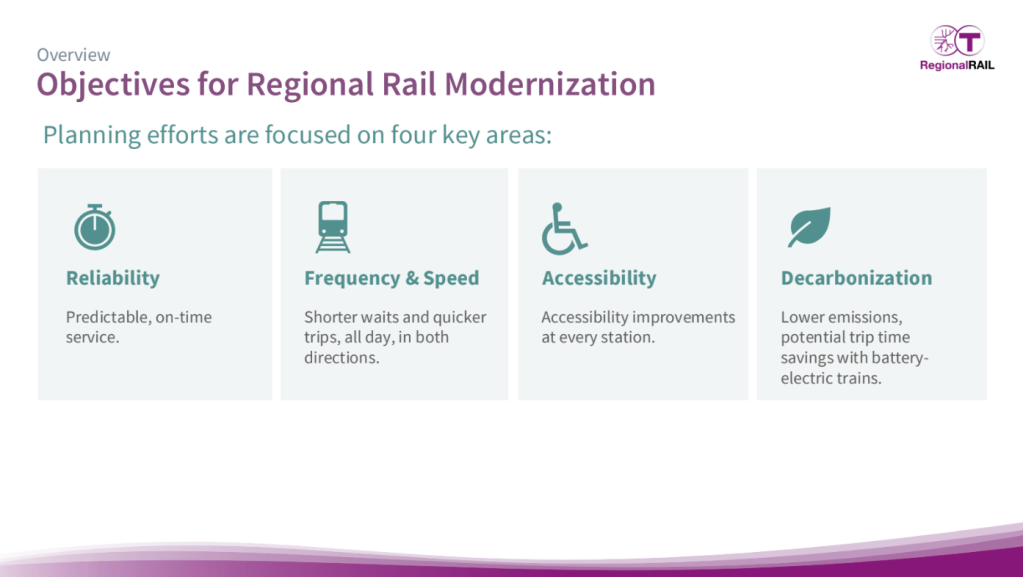
The MBTA’ current planning has four key objectives: reliability, frequency and speed, accessibility, and decarbonization.
The system’s performance depends on many interconnected components. Higher frequency service requires updated tracks and signals. Stations need level boarding to speed up trips and serve riders of all abilities. Investing in decarbonization will enable faster trains, but requires upgraded maintenance facilities. An expanded workforce is essential to facilitate expanded service.
Reliability
The goal of reliability is to drive more predictable and on-time service, which is, as Haider put it, “the foundation of any modernized rail service.”
Signal systems and the number of track segments determine when a train can move, and how many can run at once. The fewer the tracks, the more trains in opposite directions have to take turns and can only pass at certain points. On the T, every train funnels onto a limited number of tracks coming into Boston, further affected by drawbridges that can bring service to a stop when they open or when they fail.
Haider cited the Draw One bridge near North Station as evidence of infrastructure constraining a system, and how the T is replacing the bridge to improve reliability and safety.
He also pointed to the condition of the fleet and maintenance capacity as additional constraints that affect reliability. Many locomotives in today’s fleet are approaching the end of their “useful life.” There is only one dedicated heavy-maintenance facility – and its East Somerville location is inconvenient to access for trains that operate out of South Station.
The T’s plan to procure new battery electric and low emission diesel locomotives, and explore where and how trains are maintained, will affect how quickly trains move, where they can be maintained, and how fast they can be returned to service.
Frequency and speed
The second goal, frequency and speed, aims for shorter waits and quicker trips all day in both directions.
Signals and bridges continue to be constraints for this goal as well, in addition to sharp curves, grade crossings, collisions and crossing failures, and closely-spaced stations requiring trains to slow down.
The Haverhill Line has 33 grade crossings – one roughly every mile, while the Needham Line has 12 stations across about 14 miles.
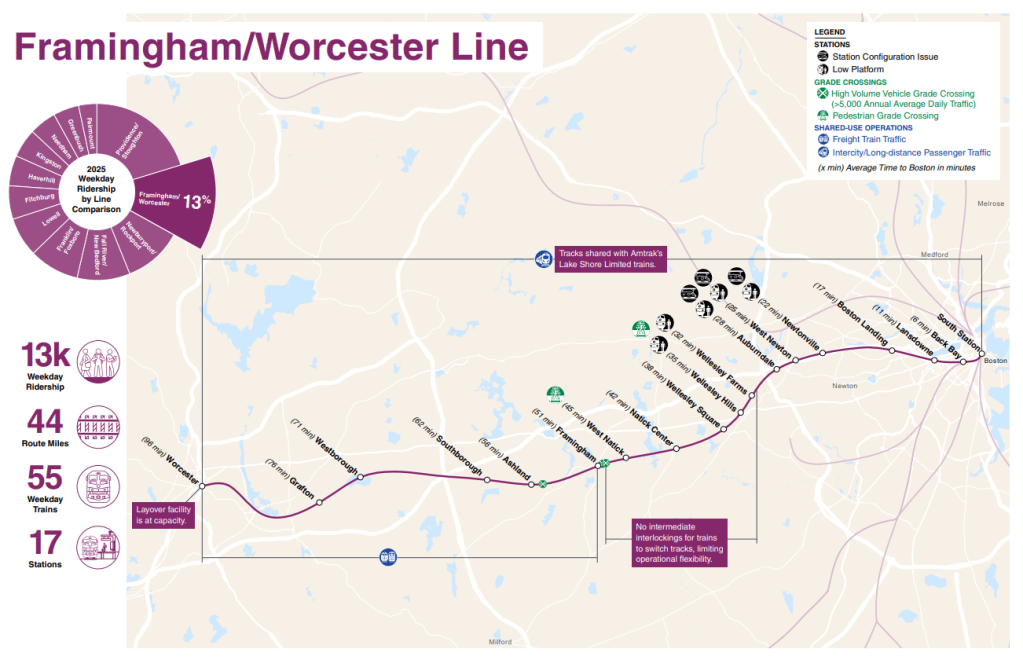
This goal is also sometimes constrained by where trains are stored, who else uses the tracks, and how schedules are built around these factors. Sharing the track with freight trains limits the capacity of the commuter rail, and some lines don’t have their layover yards at the actual end of the line, requiring empty trains to travel extra miles and use up valuable track space on corridors like the Fitchburg line.
Scheduling can also play a role. On the Worcester line, the T introduced “zonal express” service with no new construction, cutting end-to-end trip times by over 10 minutes.
Accessibility
Accessibility, “often viewed as a separate goal,” Haider explained, is actually quite closely related to service quality.
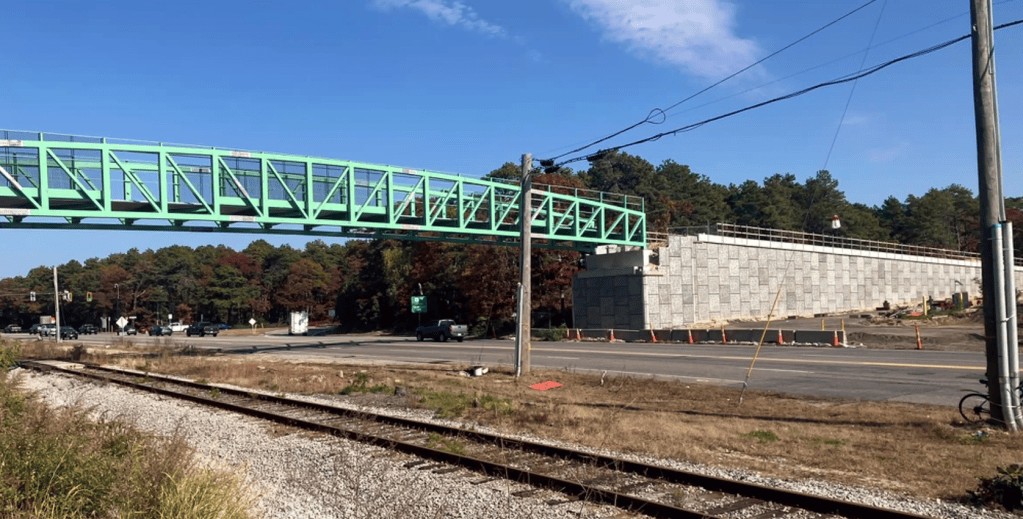
Low-level platforms and pedestrian crossings can create accessibility challenges that add boarding time, and create barriers for many riders. Introducing high-level platforms at every station will make it easier for all riders to board the trains.
The recent construction of higher, level-boarding platforms at Worcester Union Station, Winchester Center, and North Wilmington have made those stations fully accessible, and demonstrate how accessibility investments support regional rail.
Decarbonization
Decarbonization will not only improve air quality by lessening emissions, but allow for faster trains as well.
With a system developed around diesel trains, transitioning to electric power will require new trains, maintenance facilities, power systems, utility coordination, permitting, and maintenance practices.
New transmission equipment can take up to “10 years to be sited, permitted, and interconnected with the regional grid because of its scale,” Haider explained, as it often involves working with stakeholders outside the MBTA like utility providers and permitting agencies.
Overhead wires need a safe clearance zone, and the regional rail system has more than 600 bridges and crossings where clearance issues could pose challenges for new power lines.
To avoid the most complicated areas, the T is pursuing a “discontinuous electrification” strategy, where batteries can carry trains through the gaps where building wires would be too complicated, and developing additional power infrastructure to support expanded service on the already-electrified Providence Line.
The T’s new layover facility close to South Station at Widett Circle will offer additional train storage, servicing, and charging for electric trains alongside older diesel equipment.
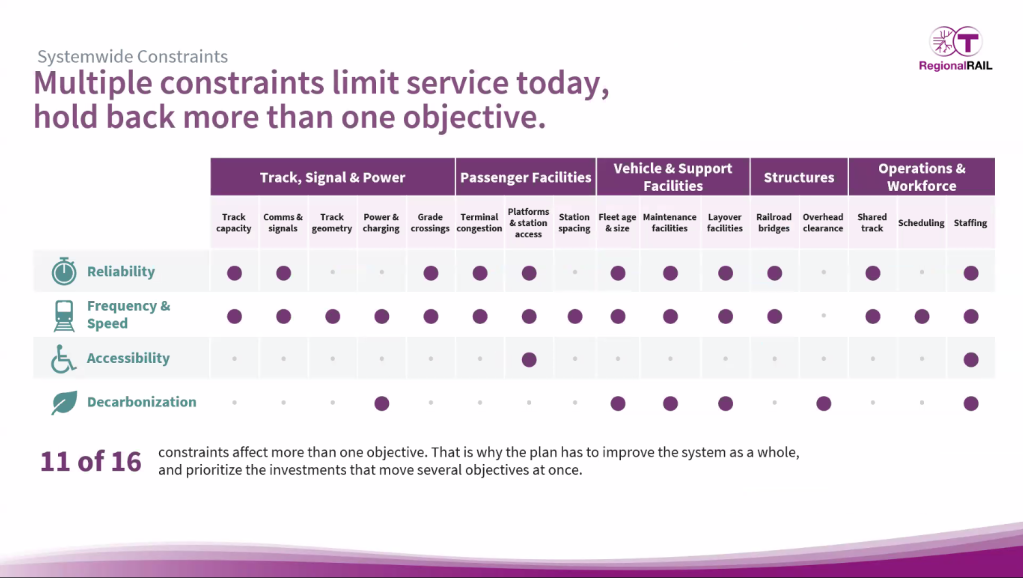
“Success comes from combining infrastructure improvements – fleet replacement, accessibility projects, operational changes, workforce development, and modernization of supporting facilities. And the role of this plan is to evaluate these combinations and identify a realistic sequencing for implementation,” Haider explained.
“Reaching these objectives means improving many parts of the system, likely at the same time,” said Tayag.
“I want to use the regional rail the same way I use the subway”
Following the presentation, the conversation turned to the participants in a smaller-group breakout and a larger group Q&A. In the breakout rooms, frequency was the main thread, with riders expressing desires for all kinds of practices to bring about a subway-like reliability.
“My ideal regional rail system would look like more frequent service… later night service… extensions on the weekend… a little more concentration on express trains on most lines,” commuter rail conductor Cole Czub shared.
Zachary Yaro agreed, saying he usually ends up driving to visit friends on the North Shore and Natick because “the schedules don’t line up with our schedules, or because they’re too infrequent at the times that we’re going.”
Participants also expressed concern over the space the stations occupy – where they are, what is around them – specifically looking to see transit-oriented development, pedestrian pathways and bike infrastructure, stronger outer-suburban bus transfers, and new infill stations in dense urban areas.
Vishal Kalakonnavar weighed in with his frustration living just three minutes away from the Kingston Line and still finding himself driving to the Red Line garages to go into the city to ensure he has more flexibility in getting back out.
It’s’s “not just having dense housing near stations, but also integrating it further into the community and making the station actually work with how people live,” he said.
Andrew Recker, City of Cambridge Transit Planner, added to this vision, citing Los Angeles as an example of how to make the space more multimodal. “They even have not only bike parking, bike share, but they even have a bike mechanic at, like, a transfer center. So, those kinds of opportunities give people non-vehicle, non-car ways to get to the station and get something done while they’re maybe taking their trip into town or whatnot.”
In the broader group Q&A, T staff fielded pushback around the electrification strategy, and questions on related projects and climate resiliency.
John Walkey of GreenRoots highlighted how North Shore rail upgrades could relieve the “traffic nightmare” along Route 128/I-95 and improve Logan Airport access, but also recognized the flooding risk along low-lying tracks in Chelsea, Rumney Marsh, and Cape Ann.
“As we try to get more people using this system and we invest to make it more reliable, we want to make sure that we are also not going to turn it into a submarine for portions of the trip to the north… The time it takes for these capital projects to get done is now at the scale at which climate change is taking place. So we really need to think about it.”
Some attendees pushed back on the T’s strategy of leasing battery-electric trains for the Fairmount Line, rather than installing traditional overhead electric wires – a $765 million deal that participant Benjamin Rider described as “the most expensive passenger trains ordered by any agency, ever.”
However, Haider defended the choice, citing how battery trains avoid the cost and delays of raising low-clearance bridges across the region. He also said that inflation and tariffs were driving up railcar prices industry-wide.
What comes next
The plan is in the early phases of development. As for next steps, the project will move through identifying system constraints and desired service outcomes, into a market assessment to understand the current and future travel market, into an iterative public engagement process of developing and testing scenarios to understand their benefits and impacts and identifying possible capital improvements and infrastructure improvements in the spring of next year, before putting forth a final plan.
The T has one-page summaries for each of the lines, and looking system-wide that outline the specific constraint on each of the lines, that will be published on the project website.
To give input, fill out the T’s feedback form or reach out to RRImprovements@mbta.com. For more information including the full presentation and additional materials, visit the project’s webpage. Stay tuned for more opportunities in the spring to dive into different service scenarios.